
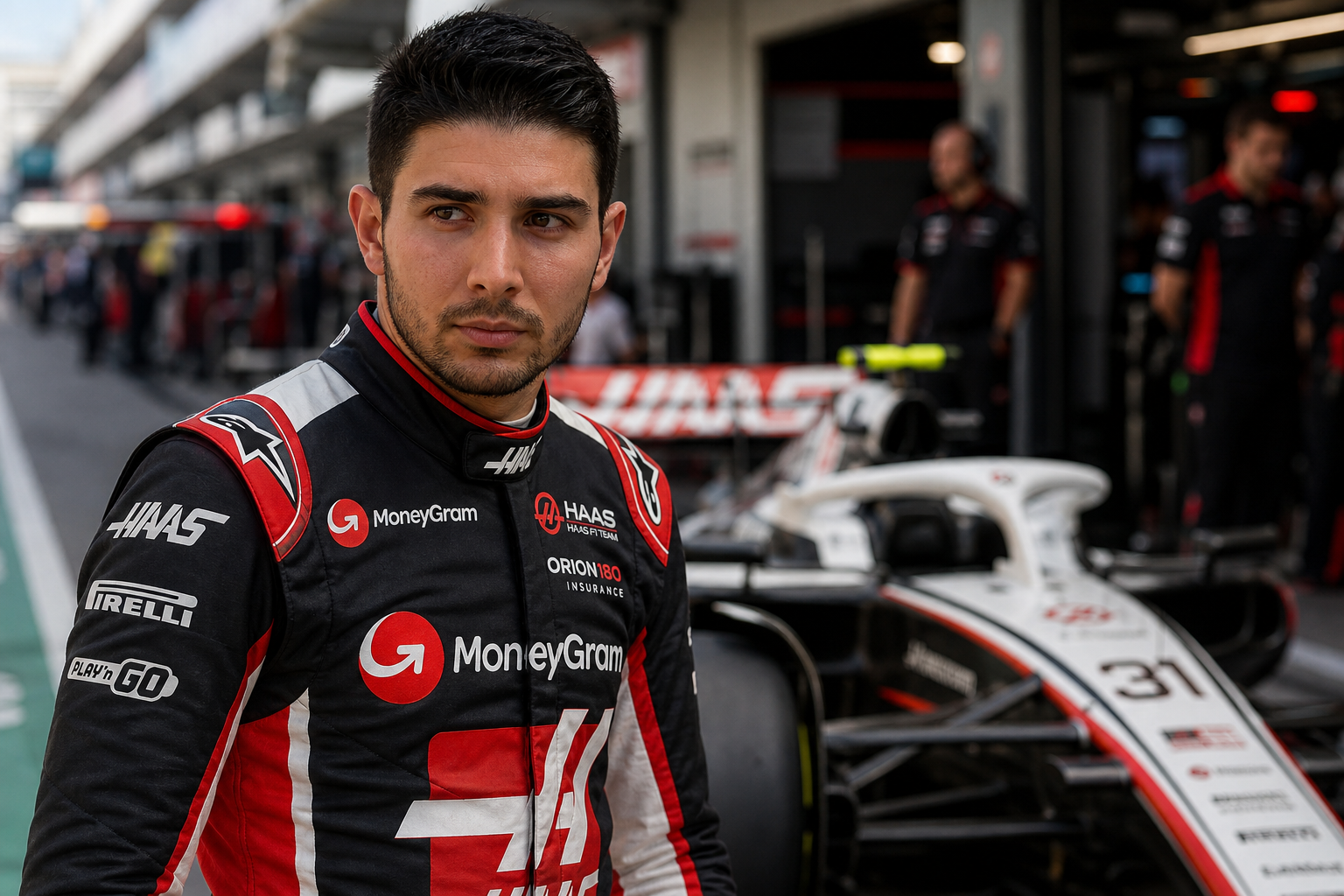

Esteban Ocon has made it clear that his Formula 1 future is not tied neatly to Haas, at least not yet. With the American team still refusing to confirm its driver lineup for 2027, Ocon says he is speaking with other teams while leaving the door open to staying where he is.
That is a fairly diplomatic way of saying the contract conversation has entered the portion of the season where everybody smiles in public and quietly checks who else might answer the phone.
Ocon’s position is particularly interesting because his recent performances have improved at precisely the wrong moment for Haas. The Frenchman has been driving better, but the team’s early-season points-scoring form has faded, leaving his stronger weekends with rather less to show for them on the results sheet.
Ocon Is Keeping Every Option Open
Speaking about his future, Ocon described himself as a “free agent” and confirmed that discussions with other Formula 1 teams are taking place. He did not, however, rule out remaining with Haas.
That distinction matters. Ocon is not announcing an imminent departure, nor is Haas announcing that it intends to replace him. The situation is simply unresolved, and both sides appear to be preserving their leverage while the 2027 market begins to take shape.
For Ocon, that is the sensible approach. A driver does not need to slam the door on his current team just because another one has been left ajar. Haas may still represent a worthwhile option if its development path looks convincing, particularly if the organization can turn its early pace into something more consistent across a full season.
At the same time, Ocon’s experience gives him reasons to examine alternatives. He has already driven for several teams during his F1 career, including Force India, Renault, Alpine and Haas, and has experienced both the rewards and frustrations of life in the midfield. A driver can survive there for years while being judged by machinery that is occasionally brilliant, frequently awkward and almost always inconsistent.
Better Driving, Worse Timing
The awkward part of Ocon’s current situation is that his personal form appears to have improved while Haas’s competitive picture has moved in the opposite direction.
Haas showed enough early-season speed to score points and suggest that its car could fight in the busy midfield. That kind of form is valuable because the midfield is decided by margins so small they can make a competent weekend look like a triumph or a catastrophe. A few tenths can mean a points finish, a lonely afternoon in traffic or a qualifying session spent admiring the rear wings of cars that were not obviously faster on paper.
As Haas’s performance slipped, Ocon’s stronger showings became less rewarding. Drivers can execute a clean qualifying lap, manage tires properly and produce a race that deserves recognition, only to finish outside the points because the car no longer has the underlying pace to convert that work into a result.
That is one of the harsher realities of Formula 1. Driver form is assessed through timing screens, and timing screens are notoriously uninterested in nuance.
Ocon therefore finds himself needing to demonstrate two things at once: that he remains a dependable, fast and technically useful driver, and that his current team can give him a realistic platform for future results. The first is within his control. The second depends on Haas’s engineering direction, operational execution and ability to develop the car without losing the qualities that made it competitive early in the year.
Why Haas Has Not Confirmed Its 2027 Lineup
Haas has not confirmed its driver lineup for 2027, which leaves the team with considerable flexibility. That flexibility can be useful, particularly for a team that must balance experience, performance and long-term planning without the financial muscle of a front-running organization.
Keeping the lineup undecided also allows Haas to evaluate how its drivers perform as the current technical cycle develops. A driver who looks valuable in a difficult car may become even more important if the team’s next package is competitive. Conversely, a team may decide that a change is necessary if it believes its existing pairing has reached its ceiling.
There is also the broader question of how the post-2026 Formula 1 environment settles. The major regulation changes arriving for 2026 will reshape the competitive order, with new power-unit and chassis requirements forcing teams to rethink their cars. By 2027, teams should have a clearer idea of which organizations have interpreted that rule set effectively and which are still rummaging around in the technical cupboard.
Haas’s decision will inevitably be influenced by that picture. It may want an experienced driver who can help develop a new-generation car, or it may prefer to invest in younger talent if an opportunity emerges. Ocon’s background makes him credible in the first category: he has substantial race experience, has driven for multiple teams and has already won a Grand Prix.
Ocon’s Experience Is His Strongest Asset
Ocon is not a driver who needs to explain why he belongs in Formula 1. He made his debut with Manor in 2016 before establishing himself at Force India, later continuing with Renault and Alpine. His victory at the 2021 Hungarian Grand Prix remains the clearest reminder of what he can do when the circumstances align.
That win was not a gift. Ocon absorbed pressure from Sebastian Vettel throughout the race and delivered under conditions that punished mistakes. It was precisely the sort of performance that makes teams value an experienced driver during periods of technical uncertainty: speed matters, but so do judgment, feedback and the ability to keep a difficult race from unraveling.
His career has also placed him in some politically awkward environments. Ocon has often raced in teams where internal competition was intense and the machinery was not consistently capable of showing its best qualities. He has had to build a reputation without the luxury of sitting in a dominant car, which is rather like trying to sell a fine watch while wearing it in a washing machine.
For a midfield team, that experience can be useful. Haas does not need a driver who merely produces one spectacular qualifying lap every six races. It needs drivers who can extract performance across changing conditions, recognize when a setup direction is wrong and turn limited opportunities into points.
The Decision Will Depend on More Than Ocon
Ocon’s future will not be decided by his recent form alone. Haas will also have to judge the development of its car, its wider technical ambitions and the alternatives available in the driver market.
For Ocon, the key question is equally straightforward: does Haas look capable of moving forward, or is it merely offering another season of fighting for scraps when the opportunity arises?
That is not an insult to Haas. The midfield is brutally competitive, and even well-run teams can spend months chasing a performance gain that turns out to be worth less than a badly timed pit stop. But drivers in Ocon’s position have limited time to wait for promises to become lap time. A contract is not much use if the car spends the season qualifying in the same traffic it was supposed to escape.
The fact that Ocon is speaking with other teams suggests he is taking that calculation seriously. It also gives Haas a clear message without turning negotiations into theater: he is interested in staying, but he is not prepared to behave as though staying is his only possible route.
A Waiting Game With Real Consequences
For now, there is no confirmed move and no confirmed Haas lineup for 2027. Ocon remains part of the team’s plans in the practical sense, but his public description of himself as a free agent shows that the relationship is not locked in beyond the current uncertainty.
That leaves both sides with a familiar Formula 1 task. Haas must decide whether Ocon’s experience and improving form make him the right driver for its next phase. Ocon must decide whether the team’s future offers enough competitive promise to justify turning down other possibilities.
His recent performances have strengthened his case, even if the points table has been stingy with the rewards. Now he needs Haas to show that its own case is equally persuasive. In Formula 1, good intentions are pleasant, but lap time remains the final interviewer.
0 Comments