
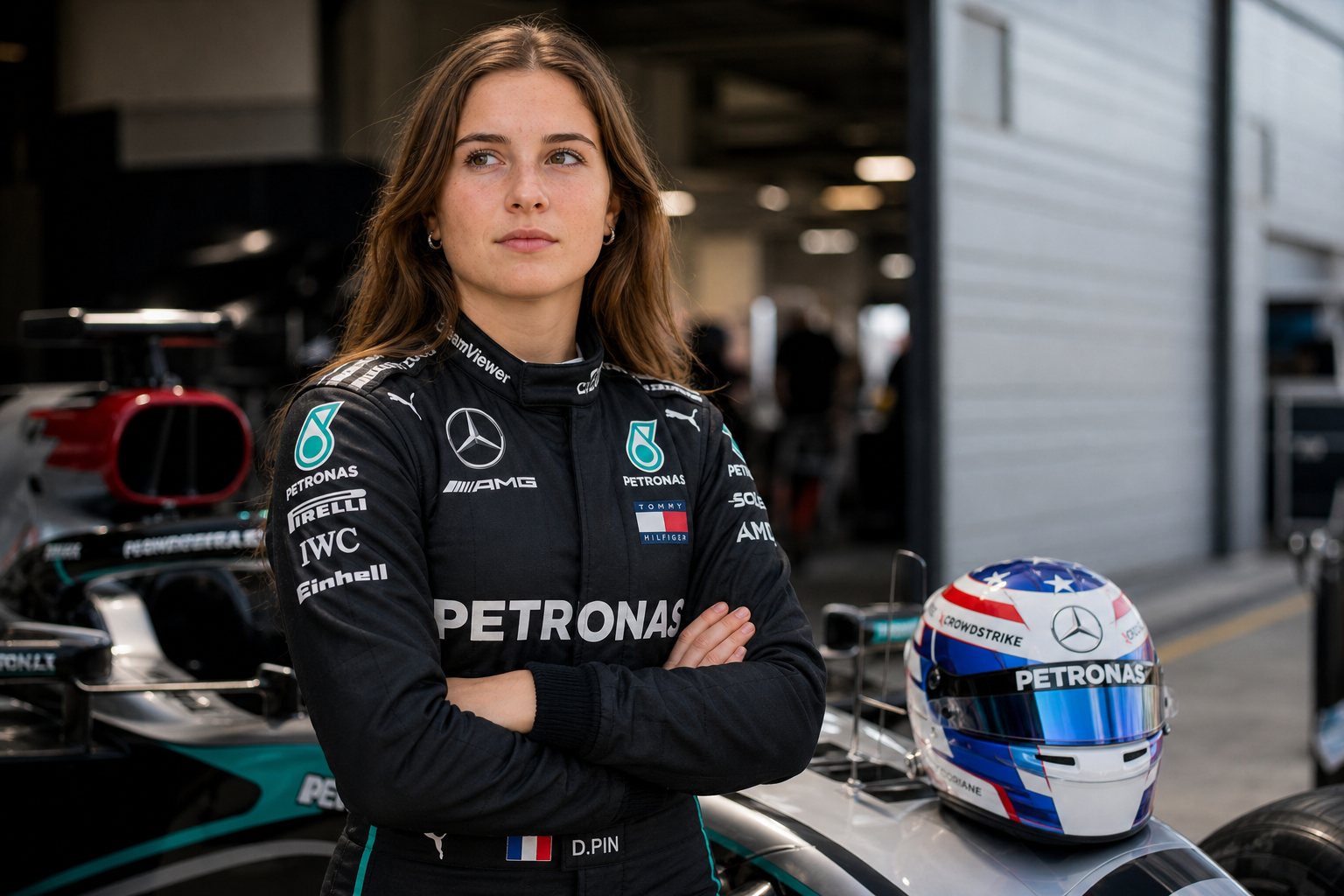

Doriane Pin has given herself five years to reach Formula 1. That is an unapologetically direct target, especially in a championship where even highly rated young drivers can spend years circling the paddock without finding a place on the grid.
The French driver, Mercedes’ Formula 1 development driver and the 2025 F1 Academy champion, outlined her ambition during a Mercedes In Convo With Kids interview. Asked where she expected to be in five years, Pin offered a refreshingly uncomplicated answer: “In Formula 1.”
There was no elaborate qualification, no carefully padded corporate language and no retreat into the usual “we’ll see what happens” territory. Pin wants a race seat. She believes female drivers can reach the championship. Now she has attached a timeline to the ambition.
A Clear Goal in a Brutally Crowded Pipeline
Reaching Formula 1 is difficult for any driver. The sport has only 20 race seats, and those positions are usually occupied by a mixture of established stars, manufacturer-backed prospects and drivers carrying substantial commercial or political support. A successful junior career is essential, but it is not always enough.
That makes Pin’s five-year target both bold and practical. It gives her a defined window in which to build the results, experience and support required to move through the single-seater ladder. It also reflects the reality that a driver cannot simply wait for opportunity to knock. In motorsport, opportunity tends to arrive in a racing suit, ask for several million dollars and leave if the paperwork is not ready.
Pin is not approaching the challenge from outside the system. Her role as a Mercedes development driver places her within the orbit of a Formula 1 manufacturer, giving her access to a major team’s broader driver-development structure and a direct connection to the paddock. That does not guarantee a future seat, but it is a considerably stronger position than attempting to advance without factory backing.
Why the 2025 F1 Academy Title Matters
Pin’s championship success gives the target more substance than a standard junior-driver declaration. Winning the 2025 F1 Academy title demonstrates that she can perform across a season, manage pressure and deliver results when the points matter as much as the individual race win.
F1 Academy exists to help female drivers develop the experience and visibility needed to progress toward higher levels of single-seater racing. The series provides a competitive environment built around Formula 4-style machinery and the familiar demands of a professional championship: qualifying execution, tire management, racecraft, technical feedback and the ability to recover from a bad weekend without allowing it to become a bad month.
Those skills are not glamorous, but they are the foundation of a serious racing career. A driver can produce a spectacular lap and still lose a championship through poor starts, inconsistent tire usage or an inability to work with engineers. A title requires the less photogenic qualities as well. Pin now has that championship credential on her record.
The next question is how effectively that success can be converted into progress outside F1 Academy. Winning a development series is one achievement. Showing that the same speed survives in faster, more demanding machinery is another entirely.
The Next Steps Will Matter More Than the Slogan
Pin’s five-year objective will ultimately be judged by what happens between the statement and the deadline. A realistic route to Formula 1 would require continued progression through increasingly competitive single-seater categories, strong results against experienced opposition and a growing body of technical and race-development experience.
That process is not merely about driving quickly. Formula 1 teams examine how drivers communicate with engineers, understand vehicle behavior, adapt to changing conditions and contribute to long-term development. They also look closely at consistency. A driver who can win one race but cannot explain why the car worked may attract attention; a driver who repeatedly extracts performance while helping the team understand the machine becomes much more valuable.
Pin’s Mercedes connection could be important here. A manufacturer-backed driver is evaluated not only on headline results but also on potential, professionalism and compatibility with the team’s future plans. The development-driver label can open doors, but it also places a driver under a microscope. Every session, simulator run and junior-category weekend becomes part of a larger assessment.
There is no guaranteed conveyor belt from F1 Academy to Formula 1. The series can provide a platform, but the next stage still demands money, testing, results and opportunities at precisely the right time. Motorsport has never been famous for making the tidy, logical choice.
Pin’s Ambition Carries Wider Significance
Pin’s declaration also lands in a sport that has spent years trying to create a more credible path for female drivers. Formula 1 has not had a woman start a world championship race since Lella Lombardi competed in the 1970s. That historical absence has often been treated as evidence that women cannot reach the required level, when it also reflects decades of limited access to the same funding, testing, academy structures and competitive opportunities available to male drivers.
F1 Academy is one attempt to address that imbalance by giving female racers a dedicated championship and greater visibility around Formula 1 weekends. The long-term test, however, is not whether the series can produce attention. It is whether its strongest drivers can progress into mixed-gender championships and remain competitive there.
That is why Pin’s aim is important without needing to be dressed up as a guarantee. Her goal is not proof that a Formula 1 seat awaits her. It is evidence that she sees the route as a genuine professional possibility rather than a distant publicity exercise.
Her statement also avoids one of the more tiresome habits in modern motorsport coverage: treating female drivers as inspirational symbols first and racers second. Pin is a champion, a Mercedes development driver and a competitor with a stated career objective. The relevant question is whether she can keep producing the results needed to support that objective.
Five Years Is Ambitious, Not Impossible
A five-year window creates pressure, but it can also create focus. Pin now has a clear destination and a period in which to demonstrate that she belongs in the conversation. The coming stages will reveal whether her progress continues at the same rate once the opposition becomes more experienced and the equipment less familiar.
Formula 1 will not hand over a seat because a driver has made a confident prediction. It will require performance, preparation and timing. The championship has room for only a tiny number of newcomers, and the people choosing them tend to be cautious when there is a perfectly serviceable veteran already occupying the garage.
Still, Pin’s answer is exactly the sort of ambition a potential Formula 1 driver needs. It is specific, public and backed by a championship title. Whether she reaches the grid within five years remains to be decided on track, but the target itself is refreshingly clear: Doriane Pin does not want to remain a promising name in the junior categories. She wants to race in Formula 1.


0 Comments