
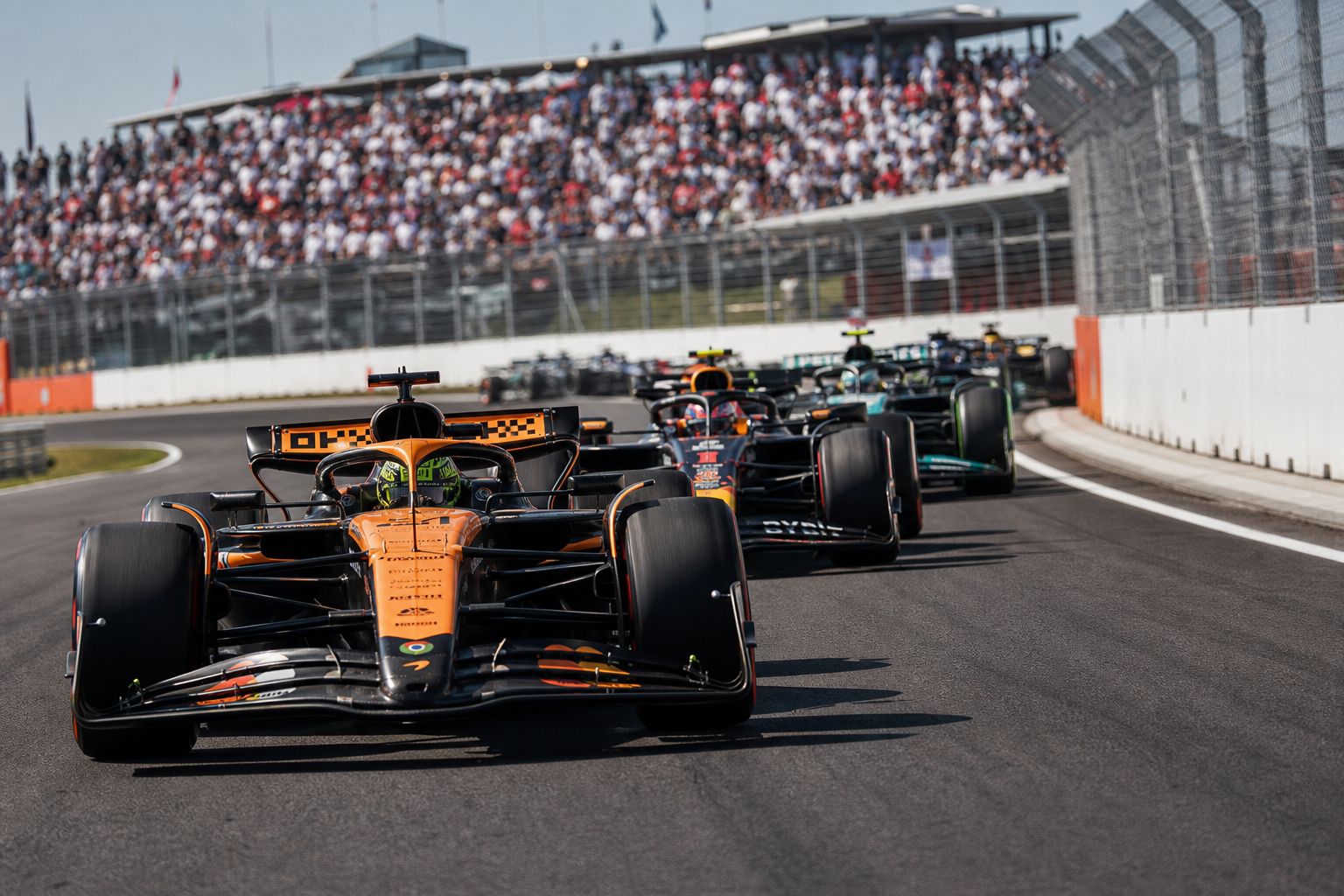

David Coulthard has delivered a blunt verdict on Formula 1’s first visit to the Madring: sending the championship back in 2027 without changing the circuit would be “stupidity.” It is not the sort of diplomatic sentence usually found in a promoter’s press release, but the former Grand Prix winner has identified the central problem rather neatly.
The race produced too little passing around the semi-permanent circuit, leaving qualifying position with an unusually large influence on the afternoon. Lando Norris started from pole, while an ill-timed virtual safety car added another strategic complication without solving the more fundamental issue: the track did not give drivers enough genuine opportunities to attack one another.
That is a serious warning for a venue hoping to establish itself on the Formula 1 calendar. A new race can survive an awkward first edition. It cannot keep serving up processional races and expect the audience, teams, and drivers to remain charitable forever.
The Problem Was Visible Before the Checkered Flag
Every circuit has a personality. Some reward bravery under braking, others punish a driver who gets greedy with the throttle, and a few seem to have been designed by a committee whose members were forbidden from speaking to one another. Madring’s opening Formula 1 race suggested that overtaking would be extremely difficult unless a driver enjoyed a major tire, pace, or strategic advantage.
That distinction matters. A circuit can be technically demanding and still produce poor racing. Narrow sections, long sequences of corners, and limited opportunities to position a car alongside another may look dramatic on television, but they can leave drivers trapped behind a rival who is only slightly slower. Once the field settles into order, the race becomes a matter of managing tires, fuel, and gaps rather than actively fighting for position.
The problem becomes even more pronounced in modern Formula 1, where the cars are large, heavy, and aerodynamically sensitive. Following another car closely through a fast corner can compromise the front tires and reduce downforce just when the pursuing driver needs both. If the next braking zone is not wide enough, long enough, or properly aligned for a pass, the driver may spend lap after lap close enough to irritate the rival but not close enough to overtake.
That is how a race can look busy without actually being competitive. Cars circulate. Tires wear. Engineers discuss strategy over the radio. The audience begins studying the support-race schedule.
Why Coulthard’s Warning Carries Weight
Coulthard is not objecting from the grandstand after watching a few laps on television. He spent years racing in Formula 1 and understands the difference between a circuit that challenges a driver and one that simply prevents meaningful racing.
His criticism also reflects a point that has become increasingly important in Grand Prix design: a track must provide more than visual identity. A distinctive setting, clever branding, and a glossy event package can attract attention for the first visit, but the race itself still has to work. Formula 1 is not a traveling architecture exhibition. The cars need room to race.
That does not mean every Grand Prix must produce a dozen passes for the lead. Overtaking is only one part of a good race, and artificial action can be worse than a quiet afternoon. But when a new venue offers few natural passing opportunities, it places too much pressure on safety cars, weather, tire differences, and strategy errors to manufacture drama.
That is a risky business model. A virtual safety car can shuffle the gaps, but it cannot create a proper passing zone. A different tire strategy may bring cars together, but if the layout still makes it impossible to run side by side, the closing speed merely produces a train of frustrated drivers.
The 2027 Return Is Already a Design Question
Coulthard’s point is not necessarily that Madring should be abandoned. It is that the organizers should treat the first race as a test rather than a finished product.
That is the sensible approach for a semi-permanent circuit. Temporary and semi-permanent venues have more flexibility than traditional permanent tracks, at least in theory. Walls, runoff areas, corner radii, and track connections can be reconsidered before the next event. The difficulty is deciding which changes will genuinely improve racing rather than merely making the map look more dramatic.
The obvious target is the circuit’s overtaking architecture. Designers need to examine where following cars lose time, where a driver can pull alongside, and whether the approach to a braking zone rewards a committed move. A long straight is not automatically useful if it feeds into a corner that is too fast or too narrow for two cars. Nor is a heavy braking zone enough if the preceding corner prevents a pursuing car from getting close in the first place.
Any revision would also need to preserve the venue’s identity. The answer cannot be to bolt an enormous artificial straight onto the course and call the matter settled. Formula 1 has already experimented with circuits where the passing zone feels less like part of the track and more like an airport runway inserted by an anxious committee.
The best changes tend to work with the circuit’s natural rhythm. A corner can be tightened to create a better braking opportunity, a sequence can be rearranged to improve the run onto a straight, or a slow section can be altered so that drivers have multiple lines rather than one narrow path. The details matter, and there is no evidence yet that a specific redesign has been selected for Madring.
Qualifying Should Not Do All the Work
Norris’s pole position became especially important because the race offered so few ways to recover from a poor starting place. That puts an enormous premium on qualifying, which is already one of Formula 1’s most finely balanced contests.
A strong qualifying session should provide an advantage. It should not make the race feel largely decided before the lights go out.
There is a subtle difference between a circuit where pole position is valuable and one where pole position is close to a protective force field. On the latter type, the driver at the front can concentrate on maintaining a gap while the cars behind are forced into a queue. Strategy may alter the order at the margins, but the basic hierarchy remains intact.
That can make mistakes unusually expensive. A driver who qualifies poorly may need an undercut, an overcut, a safety car, or a rival’s error simply to reach the fight they should have been able to create on track. It turns the Grand Prix into a calculation exercise, which may delight the strategy department but does little for anyone who came hoping to see racing.
Virtual Safety Cars Are Not a Substitute for Good Layouts
The ill-timed virtual safety car added another layer to the Madring race, but incidents and neutralizations should be seasoning, not the main ingredient. Formula 1 cannot design a circuit on the assumption that a safety car will arrive at just the right moment and rescue the entertainment.
That is particularly true of a virtual safety car. Unlike a full safety car, it does not bring the field tightly together. It controls speed while preserving much of the existing order, which can help one driver or punish another depending on tire condition and pit-stop timing. Those strategic effects are real, but they do not alter the basic geometry of the track.
If the circuit makes passing difficult, the cars may simply return to the same procession after the neutralization ends. The software can rearrange the paperwork. It cannot widen a corner.
What Formula 1 Should Learn Before Returning
Madring has been given a useful warning early enough to act on it. The 2027 race should not be approached as a ceremonial repeat of the first event, with a fresh batch of promotional photographs and a hope that the racing somehow improves by itself.
Organizers should study where drivers were able to follow closely, where they fell back, and which corners made overtaking impossible. Teams will have detailed data on speed, tire degradation, braking performance, and aerodynamic loss. Drivers will know which sections felt promising in theory but useless in combat. That information should guide the redesign.
The objective is not constant passing. It is to give drivers credible choices. A car should be able to attack under braking, switch lines, pressure a rival into a mistake, or use a different exit to set up a move later. When every lap follows the same script, the circuit is asking strategy to compensate for its own shortcomings.
There is still time for Madring to become a worthwhile Formula 1 venue. New circuits rarely arrive fully mature, and the first race has exposed a problem that can be measured rather than guessed. But ignoring that evidence would be difficult to defend.
Coulthard’s language may be sharp, yet the underlying message is perfectly reasonable: if the track does not encourage racing, change the track. Returning in 2027 with the same layout and expecting a different result would be less a bold commitment than an experiment in administrative optimism. Formula 1 has enough races already where the most exciting overtaking move happens in the pit-lane timing screens.

0 Comments