
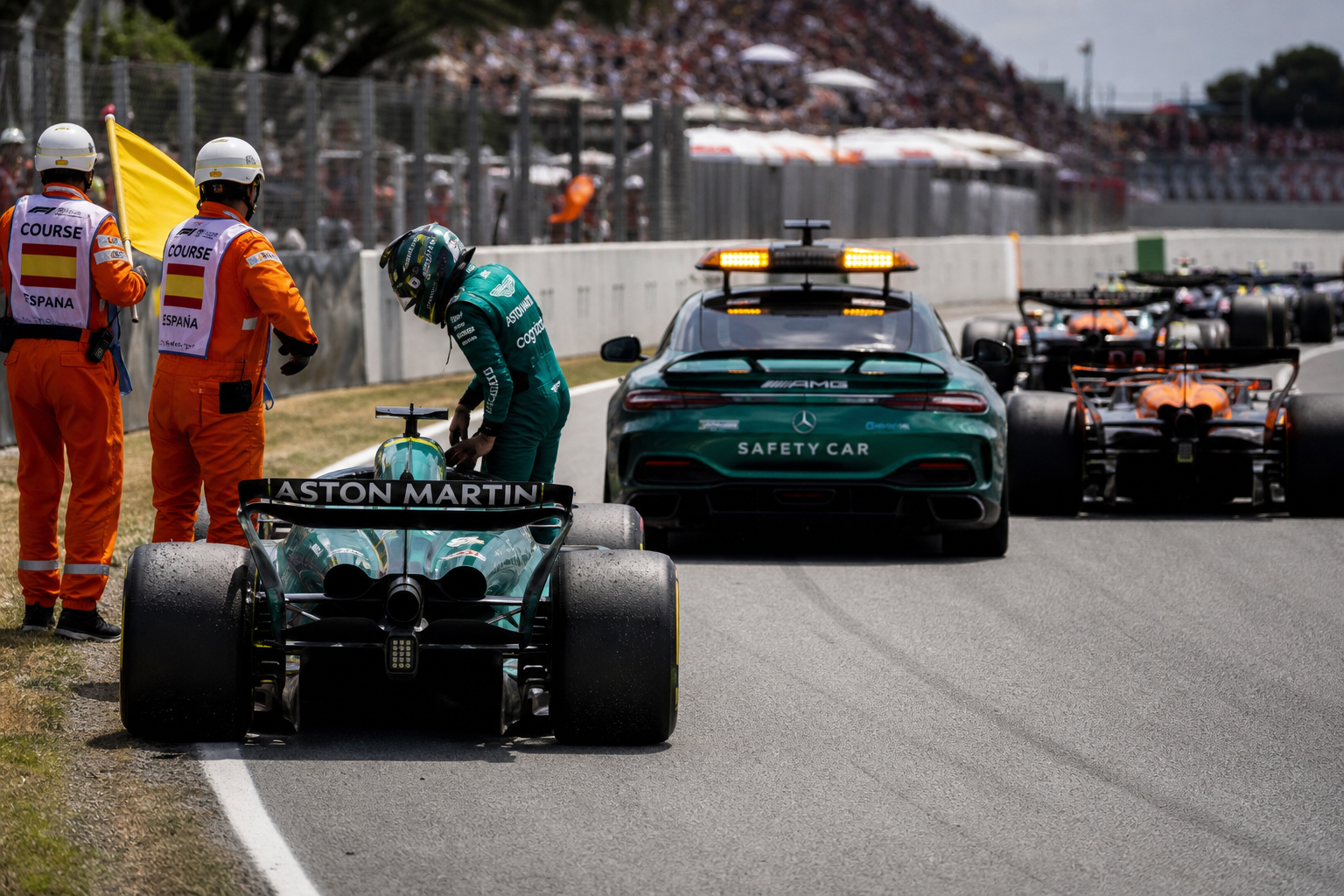

Formula 1 race control has a difficult job. It must protect drivers, marshals, and spectators while making decisions quickly enough to avoid turning a developing incident into a strategic disaster. At the Spanish Grand Prix, former F1 driver David Coulthard argued that the FIA did not move quickly enough—and Lando Norris may have paid the price.
The flashpoint came when Aston Martin’s Lance Stroll stopped on track after suffering a brake failure during the inaugural Spanish Grand Prix at the Madring circuit. The incident required race control to consider whether the race needed to be neutralized, and the delay in reaching that decision had consequences for McLaren’s Norris, who had been on course for what Coulthard described as a likely victory.
Coulthard’s criticism was not that the FIA should take reckless shortcuts. His point was rather more practical: when a car is stranded in a dangerous position, every second spent deciding how to respond can alter the entire race. He believes there is clear “room for improvement” in the process.
Why a Safety Car Decision Can Change Everything
A Formula 1 safety car is not merely a yellow flag with a rather imposing road car attached. It changes the arithmetic of the race.
When the field is neutralized, the gaps between cars shrink dramatically. A driver who has built a comfortable lead can see it vanish in a handful of corners, while a rival who has just made a pit stop may suddenly find that the timing of the stop has worked beautifully. Another driver can be left circulating on worn tires, having missed the window by seconds. It is motorsport strategy reduced to a particularly expensive game of musical chairs.
That is why the timing of the FIA’s response matters so much. A full safety car, a virtual safety car, or a local yellow-flag period each carries different sporting consequences. Race control must assess the position of the stranded car, the condition of the circuit, the proximity of marshals, the speed of approaching traffic, and whether recovery equipment can be deployed safely.
Those considerations are non-negotiable. The FIA cannot prioritize a driver’s pit-stop advantage over the safety of the people working beside the track. But once the danger is understood, a slow or uncertain decision can create a different problem: drivers continue approaching an incident while teams and spectators wait to learn what race-control action is coming next.
The Madring Incident Put the Problem in Plain View
Stroll’s brake failure provided exactly the sort of situation that exposes the tension between safety and sporting fairness. A car stopped on track is an obvious hazard, but race control must still determine the appropriate intervention rather than automatically reaching for the most disruptive option.
For Norris, the timing was especially painful. McLaren’s driver had been in position to win, according to the report, but the sequence surrounding the incident changed the complexion of the race. A victory that looked within reach became vulnerable to decisions made away from the steering wheel.
That is one of the most frustrating aspects of modern F1 for drivers. They can execute a clean qualifying lap, manage tire degradation, protect the brakes, and build a lead, only to discover that the race has been reshaped by a car failing several hundred yards away. Sometimes that is simply racing. Sometimes it is unavoidable. But when the neutralization process appears slow, the disappointment quickly turns into questions about procedure.
Coulthard is well placed to make that argument. As a former Grand Prix driver, he understands how rapidly conditions can change from inside an F1 car. Drivers do not see the entire circuit, and they do not have the same information as race control. They rely on flags, dashboard signals, radio instructions, and the actions of the cars ahead. A fast, clear response is therefore not just a matter of sporting presentation; it is part of the safety system.
Speed Does Not Mean Rushing the Wrong Decision
The obvious danger in calls for faster decisions is that “faster” can be misunderstood as “less careful.” That would be the wrong lesson.
Race control must not neutralize a Grand Prix merely because a team has found itself on the wrong side of a pit-stop window. Nor should it deploy the safety car before officials understand whether an incident can be handled under local yellow flags or a virtual safety car. The decision has to reflect the actual hazard, not the television drama surrounding it.
Still, speed and safety are not opposites. A well-designed process should help officials reach the correct decision quickly, with reliable information arriving from marshals, race directors, circuit cameras, GPS data, and the drivers themselves. If those systems produce conflicting information or require too many layers of confirmation, the problem is not that officials care too much about safety. The problem is that the procedure may be too cumbersome for an environment where a Formula 1 car can cover a mile in a matter of seconds.
The FIA has spent years refining how races are neutralized. The virtual safety car was introduced to slow cars without bunching the field in the same way as a physical safety car, while local yellow flags can warn drivers about a problem confined to a specific part of the circuit. Each tool exists for a reason. The challenge is applying the right one promptly and communicating the decision clearly.
Why Drivers and Teams Want Clarity
Teams can prepare for almost any sporting consequence if they know what is happening. They can pit, keep a driver out, switch tire plans, or tell a driver to change pace. What causes chaos is uncertainty.
During an incident, the pit wall is trying to interpret the same incomplete information as race control. Engineers watch marshal posts, onboard cameras, timing screens, and television feeds while asking whether the yellow flags will become a virtual safety car or a full safety car. A few seconds can determine whether a stop is efficient or disastrous.
That uncertainty also affects the drivers. A racer approaching a blind corner with a damaged car nearby needs to know whether the field is about to be slowed dramatically, whether the hazard is covered by double yellows, or whether normal racing speed remains permitted. Ambiguous or delayed messaging leaves drivers making high-speed judgments with incomplete information. No one wants that to become another variable in the championship.
For fans, the issue is easier to see through the lens of the result. A safety car can erase a lead and hand an advantage to a rival, but viewers generally accept that when the need is obvious and the response appears decisive. What creates resentment is the feeling that the sporting outcome was shaped by hesitation rather than by the incident itself.
The FIA’s Real Challenge Is Consistency
One difficult race will not prove that the entire safety-car system is broken. Circuits differ, incidents develop differently, and no two stranded cars present exactly the same risk. A brake failure at one corner may leave a car safely behind a barrier; at another, it may put the vehicle and marshals directly in harm’s way.
That variability makes consistency more valuable than a rigid formula. Teams and drivers need to understand the principles governing each intervention, even if the final decision depends on the details of the incident. The FIA should be able to explain why a particular response was chosen and why it was issued at that moment.
Coulthard’s comments point toward that broader issue. Race control does not need to eliminate every controversial decision—an impossible task in a sport where a tenth of a second can provoke an argument lasting three days. It does need to make decisions quickly enough that safety is protected without allowing avoidable uncertainty to determine the race.
Norris’s lost opportunity at the Madring circuit is a reminder that F1 victories are shaped by far more than lap time. Mechanical failures, pit-stop windows, tire strategy, yellow flags, and the judgment of race officials all sit inside the same brutal equation. That is part of the sport’s character, but it does not excuse an unnecessarily slow process.
The sensible response is not to demand instant decisions at any cost. It is to examine how information reaches race control, how quickly different neutralization options can be authorized, and whether teams and drivers receive clear instructions without delay. Safety must remain the first priority. Once that requirement is satisfied, there is little justification for letting hesitation become the most influential factor in a Grand Prix.

0 Comments