
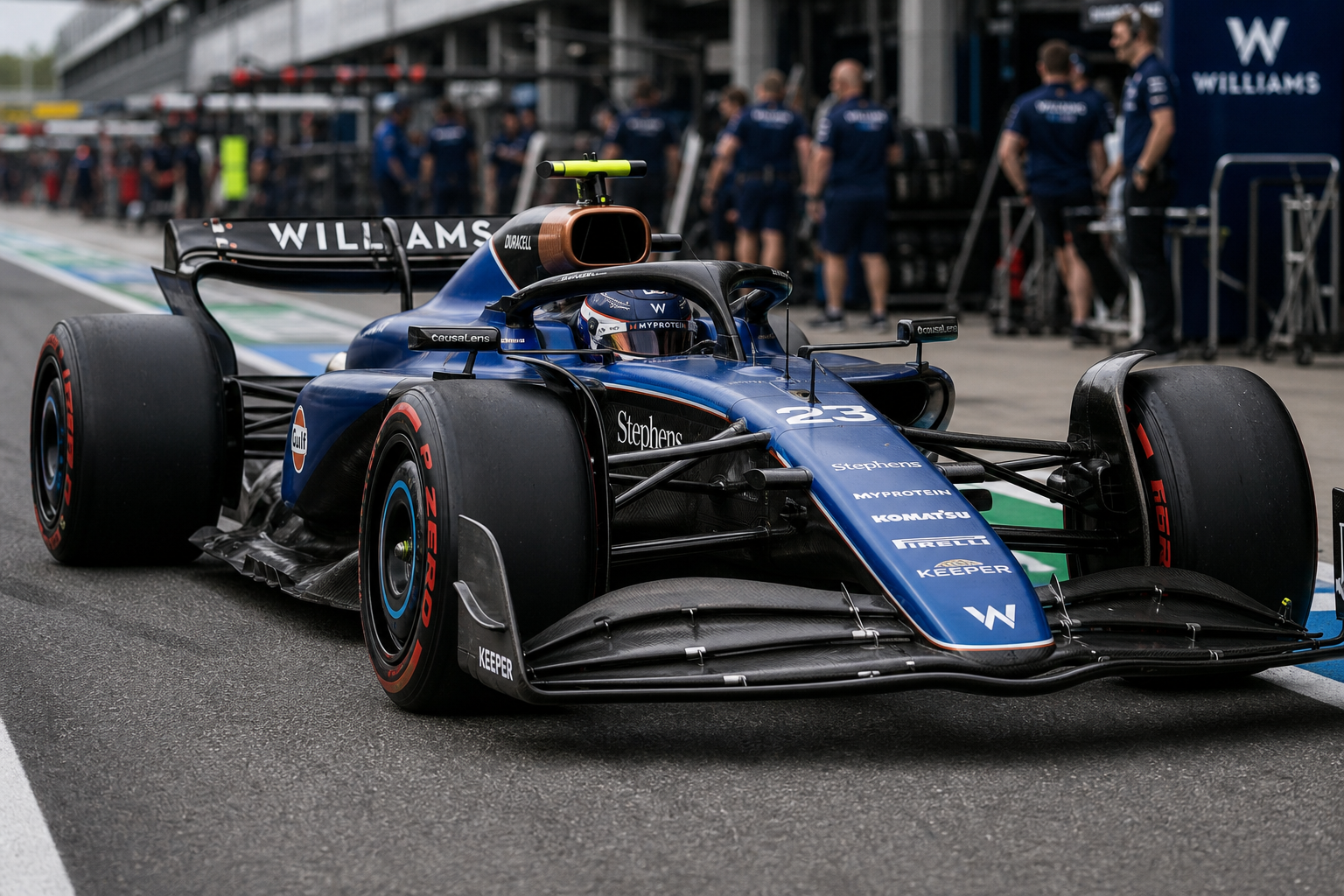

Williams has reached the uncomfortable part of its rebuild: the point where patience starts to run out and the next major upgrade is expected to do far more than merely look promising in a wind-tunnel presentation.
Former Formula 1 driver David Coulthard believes the pressure inside the Grove organization will become severe if the revised FW48 fails to produce an immediate improvement. His warning was blunt: “heads will roll.” That is not the sort of phrase usually deployed when a team is comfortably working through a long-term development program. It suggests that Williams’ next package is being viewed as a verdict on the people responsible for the car, not merely another data point in a difficult season.
Williams Has Little to Show for 14 Rounds
The numbers explain Coulthard’s concern rather neatly. After 14 rounds, Williams sits ninth in the constructors’ championship with 11 points. Carlos Sainz has scored six of them, while Alex Albon has contributed five.
That is a painfully modest return for a team that has spent the last few seasons trying to move away from the back of the field. Williams has occasionally shown flashes of speed, but flashes do not win the constructors’ championship and they do not keep a technical department comfortable. A car can look encouraging on a Friday afternoon, trouble a midfield rival over one lap, and still end the weekend with little more than a few damp patches on the hospitality carpet.
The immediate problem is not mysterious. The car has been overweight. In Formula 1, excess mass is not an aesthetic issue and it cannot be waved away with a clever social-media video. It affects acceleration, braking, tire behavior, direction changes and the ability to exploit the setup window. Every additional pound is carried through every corner and asked to stop, change direction and accelerate again.
That penalty becomes particularly cruel because it can disguise the underlying quality of the rest of the car. A chassis may generate useful aerodynamic load and still lose performance everywhere because it is hauling around more mass than its rivals. The driver feels the sluggishness, the engineers see it in the timing sheets, and the stopwatch remains entirely unimpressed by anyone’s explanations.
Why an Overweight Car Is Such a Difficult Problem
Weight reduction is often treated by outsiders as the simplest form of performance development: remove material, fit lighter components and enjoy the speed. In reality, it is one of the most expensive and awkward jobs on a modern Grand Prix car.
Reducing mass without compromising stiffness, crash performance, cooling, durability or aerodynamic consistency demands careful redesign. A lighter part may require more exotic materials or more complex manufacturing. A change in one area can force changes elsewhere. Altering the packaging of a component can affect cooling airflow, while trimming bodywork weight may create a reliability concern that only appears after the car has completed hundreds of miles at racing speed.
There is also a less obvious consequence. Teams do not want to build a car merely light enough for one track. They need a platform that behaves consistently across circuits with different corner speeds, tire demands and weather conditions. If the car has to be ballast-adjusted or aggressively set up to compensate for its mass, the drivers can end up with a machine that is fast only under a narrow set of circumstances.
That is why a major upgrade aimed at an overweight car carries unusual importance. Williams does not simply need new aerodynamic surfaces. It needs evidence that the organization understands why the car missed its targets and can correct the problem without creating three fresh ones.
The Drivers Have Done Their Part—So Far
Sainz’s six points and Albon’s five tell their own story. The scoring is almost perfectly split, which suggests that neither driver has been able to turn the Williams into a regular points contender. There is no runaway internal battle obscuring the main issue. The car is the common denominator.
Sainz arrived at Williams with a reputation for technical feedback, race management and the ability to extract results from machinery that is not always the class of the field. Albon, meanwhile, has become an important reference point for the team and has already shown that he can deliver strong qualifying performances when the package gives him something to work with. Eleven points between them is therefore less a reflection of a weak driver pairing than a measure of how little margin the FW48 has provided.
That margin matters on Sundays. A car that is slightly too heavy may survive qualifying, particularly if one driver finds a favorable tire window, but the disadvantage often compounds during a race. Braking zones become more punishing, tire temperatures are harder to manage and overtaking becomes more difficult because the car cannot build speed as efficiently on the way out of corners. A few tenths lost in isolation becomes a permanent invitation for rivals to attack.
Coulthard’s Warning Is About Accountability
Coulthard’s “heads will roll” comment should be read as a judgment on accountability rather than a literal prediction about specific personnel. No names have been attached to the warning, and there is no basis for pretending that particular Williams employees are already facing dismissal.
But the phrase captures the reality of a Formula 1 team operating under pressure. A failed upgrade is not judged only by whether the new parts are faster in a straight-line comparison. Senior management will want to know whether the development tools were accurate, whether the factory identified the weight problem early enough, whether the correlation between simulation and track performance was trustworthy, and whether the team chose the correct compromise between immediate lap time and long-term design work.
Those questions can reach well beyond the designers who drew the parts. An upgrade program depends on aerodynamics, vehicle dynamics, manufacturing, race engineering and leadership all pulling in the same direction. If the package fails, the uncomfortable conversation may concern the process rather than one flawed component.
That is particularly relevant for Williams because the team has been rebuilding its technical operation and trying to establish a more competitive foundation. Rebuilding takes time, but Formula 1 is not famous for its generous patience. Every season spent near the back consumes development opportunities, championship revenue and driver confidence. A long-term plan still has to produce short-term evidence that it is working.
What Williams Needs From the Upgrade
The most obvious requirement is speed, but the useful question is where that speed appears. Williams needs the revised car to demonstrate a measurable improvement in the areas that have limited its performance, not merely produce a single flattering result at a circuit that happens to suit it.
- Lower mass: The car must move closer to the competitive weight target without sacrificing reliability or structural integrity.
- Consistent aerodynamic performance: Downforce needs to remain predictable across different ride heights and corner types.
- A wider setup window: Sainz and Albon need a car that is not dependent on one narrow tire or track condition.
- Raceable performance: Qualifying speed is useful, but the package must protect tires and maintain pace over a full stint.
- Reliable correlation: Track performance must confirm that the team’s simulation and wind-tunnel tools are pointing in the right direction.
An upgrade that delivers a tenth of a second in one session but leaves the drivers fighting the same balance and tire problems would be a disappointing answer. A less spectacular gain that works across several circuits could be more valuable, although that is not the sort of result that produces dramatic headlines or soothing boardroom presentations.
The Pressure Will Not Disappear With One Good Weekend
Even if the revised Williams immediately finds performance, one strong weekend will not erase the season’s underlying concerns. The team needs repeatable evidence. It needs the drivers to score points when opportunities appear, convert qualifying pace into race results and show that the car is no longer being compromised by a basic weight deficit.
Conversely, a poor first outing would not automatically prove that every part of the project has failed. New components can require setup work, and track characteristics can distort the first impression. Engineers will examine the data in detail before reaching a final judgment.
That is the sensible technical view. Formula 1, however, is also a results business populated by people who enjoy asking whether the next upgrade has “worked” before the tires have cooled. If Williams arrives with a major package and remains ninth, the explanations will become much harder to sell.
Coulthard’s warning lands because the basic expectation is clear. Williams does not need a miracle or a surprise victory. It needs the FW48 to stop behaving like a project that is always waiting for the next solution. If the upgrade delivers, the team can begin turning its rebuild into something visible on the timing screens. If it does not, the question will shift from when Williams becomes competitive to who was responsible for making the wrong car in the first place.


0 Comments