
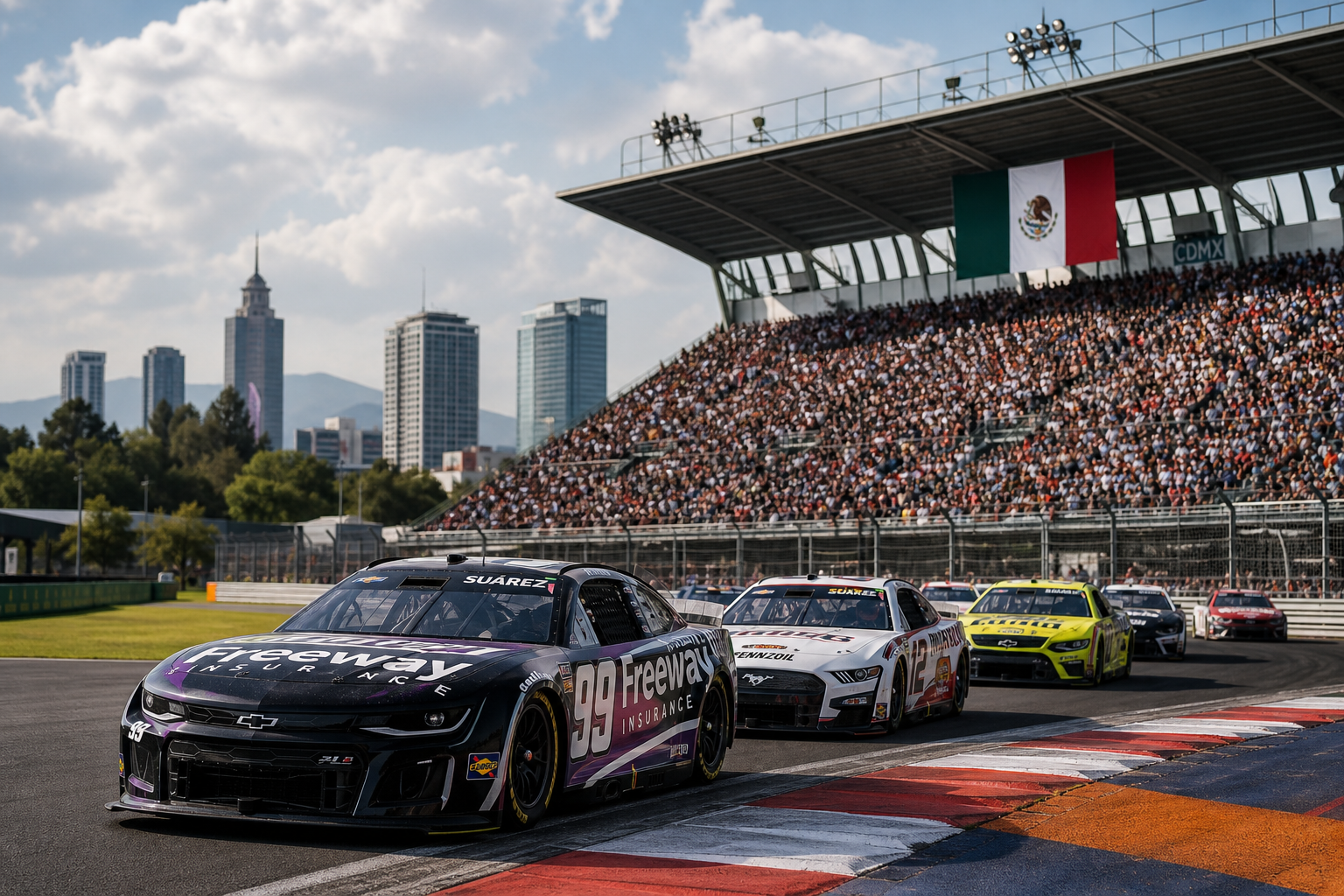

NASCAR’s trip to Mexico City was supposed to be a landmark moment for the Cup Series. It was also, rather awkwardly, a one-off.
The series made its first official visit to Latin America in 2025, racing at the Autódromo Hermanos Rodríguez in Mexico City. The event was not renewed for 2026, and it is not currently being considered for 2027 either. That sounds fairly conclusive until Daniel Suárez enters the conversation.
The Mexican-born Cup driver has not written off another race in his home country. He understands why the return is difficult, but he also knows that the first visit proved there is genuine interest in seeing NASCAR’s premier division south of the U.S. border.
A Historic Visit That Did Not Become an Annual Fixture
The Mexico City race represented a meaningful expansion for NASCAR. The Cup Series has spent most of its history within the United States, with occasional visits to Canada and a long-established international profile built through exhibition events and its wider racing ecosystem. Mexico was different: this was an official points-paying Cup race, staged at one of the country’s most recognizable circuits.
The Autódromo Hermanos Rodríguez was an obvious venue. It has hosted Formula 1, major sports-car events, motorcycle racing, and the Mexico City Grand Prix, giving it the facilities and international visibility required for a major NASCAR weekend. Its location also placed the series in one of the largest cities in the Western Hemisphere, rather than in a traditional oval-racing market.
That combination made the race interesting to existing NASCAR followers and to spectators who may have known the circuit primarily through Formula 1. Stock cars are not naturally at home on a road course designed around elevation, heavy braking zones, a stadium section, and a famously quick final corner. That was precisely the point. NASCAR was not merely taking its usual show to another American oval; it was asking its cars and drivers to operate in a very different environment.
But staging a race at a famous track and building a sustainable annual event are two separate jobs. The first creates headlines. The second requires calendars, freight plans, commercial agreements, local support, television strategy, team budgets, and a date that does not leave everyone else in the paddock quietly reaching for the aspirin.
Why a Return Is Logistically Complicated
NASCAR teams are not set up like a traveling Formula 1 operation with a compact group of cars and equipment moving between international venues. A Cup Series event involves a large collection of teams, haulers, spare parts, tires, pit equipment, personnel, officials, media, and support staff. Moving that operation across an international border is possible, but it is not a case of pointing a transporter south and hoping customs is in a good mood.
Teams must account for shipping schedules, border procedures, insurance, customs documentation, replacement components, and the timing of the return journey. A normal domestic race already places pressure on smaller organizations. An overseas event can magnify every weak point in the operation, particularly for teams without the financial and logistical depth of the sport’s biggest outfits.
There is also the calendar. The Cup schedule is already crowded, and Mexico cannot simply be inserted wherever a blank space appears. The track must be available, the weather must be suitable, the television audience must make sense, and the event must fit around the rest of the championship. A race in Mexico City may be geographically close to the United States, but calendar planning is governed by more than miles on a map.
Suárez’s position is therefore less a demand for an immediate return than a recognition that the door remains open. He has the obvious personal connection to the idea, but that does not make him blind to the practical side. A home-country race would be valuable for him and meaningful for Mexican fans, yet sentiment alone will not make the numbers work.
Mexico City Offers Something NASCAR Usually Lacks
The attraction is easy to understand. Mexico is a major automotive market with a strong racing culture, and Mexico City offers NASCAR a chance to reach people who may not regularly watch Cup racing on American ovals. The series can present itself as a national championship with international ambition, rather than a domestic product that occasionally ventures abroad for a photo opportunity.
For Suárez, the connection is especially powerful. He is the first Mexican-born driver to become a full-time Cup Series competitor, and his presence gives the event an authentic local figure rather than relying entirely on imported spectacle. Fans could see a driver from their own country competing at the highest level of NASCAR on home soil. That is the sort of ingredient marketing departments usually try to manufacture, and here it exists naturally.
The circuit also gives the race a distinct identity. Mexico City is not another stop where the main question is whether a driver can find the bottom lane and stay there for 200 laps. The road-course layout asks different questions of braking stability, tire management, curb usage, traction, and traffic. The high-altitude setting adds another layer, affecting engine breathing and cooling demands while changing the feel of the air around the cars.
That variety is useful for NASCAR. The Cup Series has spent years expanding its road-course presence, and a Mexican round would give the championship another event that looks and feels different from its established American venues. It would also allow the series to demonstrate that its cars can produce compelling racing outside the familiar world of short tracks, superspeedways, and intermediate ovals.
Why 2026 and 2027 Are Not on the Table
The immediate news is not that Mexico is returning. It is that the race is absent from the near-term plan.
The 2025 event has not been renewed for 2026, while a Mexico City race is also not being considered for 2027. That removes the possibility of a quick annual follow-up, but it does not necessarily close the project permanently. Sports series regularly test a market, pause, and revisit it when the calendar, commercial conditions, or venue arrangements change.
There is a difference between “not scheduled” and “never happening again,” although racing fans have learned not to confuse optimism with a contract. NASCAR will need to decide whether the event delivered enough value to justify the additional complexity. That judgment will involve more than attendance. Broadcast performance, sponsorship, hospitality demand, team costs, local promotion, and the quality of the overall weekend all matter.
The first race also had to establish whether Mexico City could become a repeatable part of the championship rather than a novelty. One international visit can benefit from curiosity. A second or third must create a reason for fans to return and for partners to keep investing. Novelty is a splendid fuel source, but it burns rather quickly.
Suárez Keeps the Possibility Alive
For now, Suárez’s comments amount to a realistic expression of interest rather than a prediction. He has not suggested that a return is imminent, and the published schedule makes clear that it will not happen in 2026 or 2027. What he has done is acknowledge that the obstacles are logistical and commercial, not a lack of enthusiasm from the driver or the Mexican audience.
That distinction matters. The 2025 race demonstrated that NASCAR can put on a Cup event in Mexico City. The next challenge would be proving that it can do so repeatedly, profitably, and without turning the teams’ preparation into an elaborate exercise in international paperwork.
Mexico remains a credible destination for NASCAR because the ingredients are already there: a major city, a famous circuit, a substantial fan base, and a homegrown Cup driver with a reason to care deeply about the event. The question is whether those ingredients can be assembled into a business case strong enough to bring the haulers back.
Suárez has left the door open. NASCAR, for the moment, appears content to leave it ajar rather than walk through it.


0 Comments