
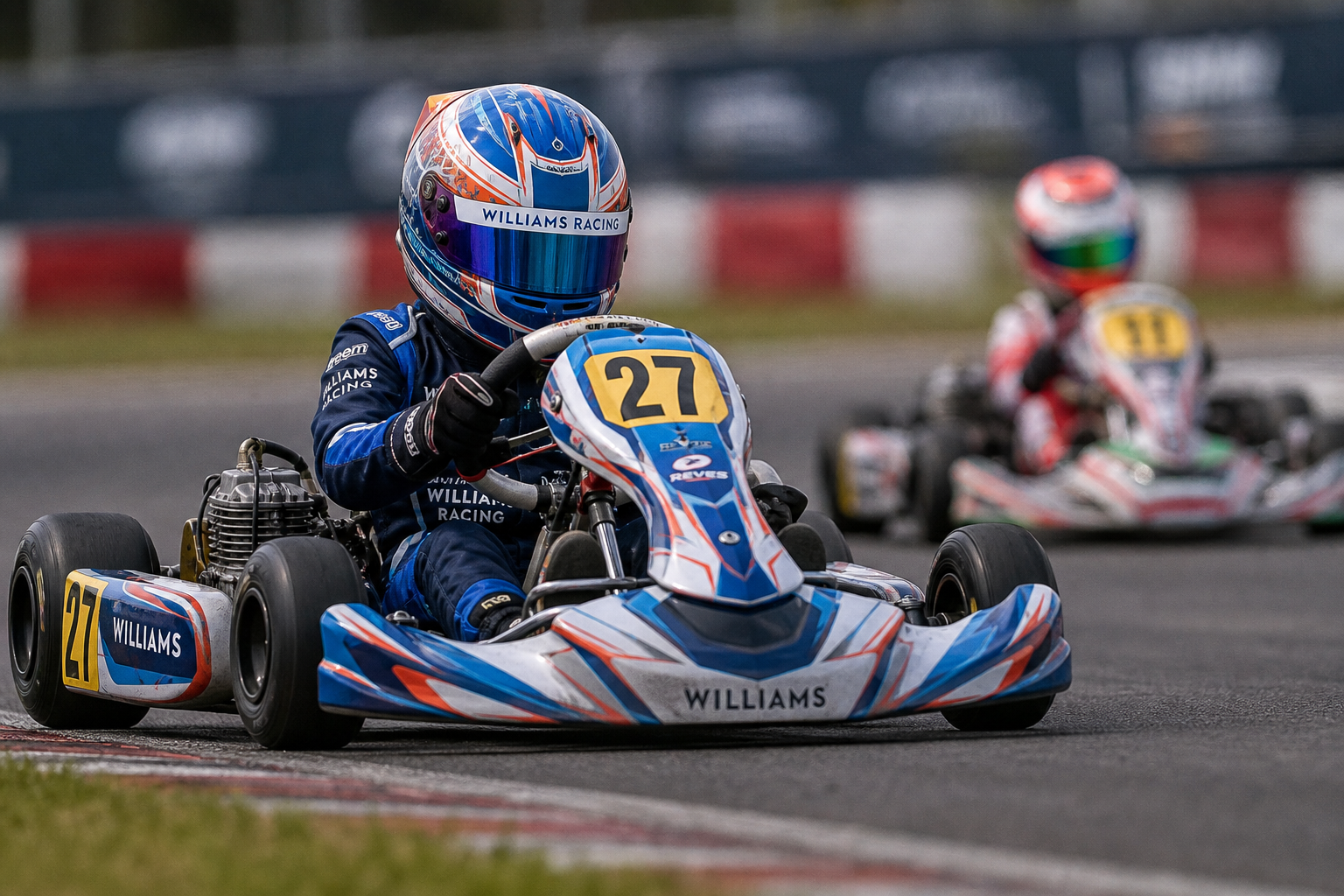

Consistency is a lovely thing. It wins championships, keeps engineers calm, and makes parents far less likely to age visibly at the racetrack. But Carlos Sainz believes Williams junior Will Green needs something rather less tidy as he moves toward single-seater racing: the willingness to find the limit, even when that means occasionally stepping over it.
That is a striking piece of advice for a 13-year-old driver, particularly one who has just added a major title to his name. Green was recently crowned junior champion in the 2026 Karting European Championship, having already been selected for the Williams Racing Academy in December 2024. His next phase will involve leaving the tightly packed world of karting for cars with wings, suspension, and considerably more machinery to break.
Sainz Prefers Ambition to Caution
Sainz’s message, as reported from an interview conducted by Green, was that the young driver should prioritize understanding the limits of the car rather than chasing flawless consistency at every stage. That does not mean driving carelessly or treating every corner like a personal argument with physics. It means learning how much grip is available, where it disappears, and how to recover when the car begins to object.
That distinction matters. A driver can look impressively polished while operating inside a comfortable margin. Such a driver may produce tidy laps, avoid mistakes, and collect respectable results. But single-seater racing quickly exposes whether a driver can extract the final fraction of performance when the tires are fading, the track is changing, or another driver is applying pressure from three feet away.
Finding that final fraction requires experimentation. Braking a little later. Carrying more speed into a corner. Trying a different line. Accepting that some attempts will end with an untidy exit or a trip through the runoff. The trick is to learn from those errors rather than repeat them with the confidence of a man assembling flat-pack furniture without reading the instructions.
Why the Karting-to-Car Move Is So Important
Karting teaches racecraft in an unusually direct way. The driver sits close to the ground, the field is tightly bunched, and small changes in positioning can have an immediate effect. There is no bodywork to hide behind and relatively little weight to disguise a mistake. A young racer learns to manage traffic, defend a position, judge overtaking opportunities, and understand how a rival’s momentum develops through a corner.
Single-seaters add another layer of complexity. The driver must work with suspension, aerodynamic load, tire behavior, braking systems, and a car that reacts differently as fuel load and grip change. The physical demands are greater, the consequences of poor preparation can be more severe, and technical feedback becomes a much larger part of the job.
Green will therefore be learning two things at once. He will be adapting to a new type of vehicle while also discovering how to communicate with engineers and make useful decisions between sessions. A fast lap is only one part of the process. Understanding why the car is fast, why it is not fast, and what needs to change next is what begins to separate a promising driver from a genuinely complete one.
Sainz’s advice fits that transition. A driver who becomes obsessed with avoiding every mistake can spend too much time protecting a result and too little time expanding his understanding. At the junior level, that can be a poor bargain. There are races to win, certainly, but there is also a far longer education taking place.
Green Already Has Williams’ Attention
Williams announced Green as a Williams Racing Academy driver in December 2024. That places him within the team’s junior-driver structure at an important point in his development, before the move into cars has fully begun. The academy connection does not provide a shortcut to Formula 1, nor should it. Junior programs are laboratories as much as ladders, and every driver still has to prove that speed, judgment, fitness, adaptability, and technical understanding can travel from one category to the next.
The timing of Green’s junior European karting title gives the association some useful momentum. Championships do not guarantee a future at the top, but they demonstrate that a driver can perform across a season rather than produce one memorable weekend and disappear beneath the next layer of talent. Winning a title also brings a different type of pressure: rivals now know the name, teams pay closer attention, and expectations become rather less forgiving.
That is where the advice about chasing the limit becomes particularly relevant. A young champion can easily become attached to the habits that secured the championship. Protect the points. Avoid unnecessary risks. Keep the car clean. Those instincts have value, but they cannot become a permanent operating mode. At some stage, Green must show that he can be quick when the circumstances demand something beyond controlled execution.
Consistency Still Has a Place
There is an important nuance here. Sainz is not arguing that consistency is irrelevant. Racing careers are not built by crashing out every Sunday in pursuit of a theoretical tenth of a second. Teams want drivers who can finish races, use feedback intelligently, and deliver performance repeatedly. A spectacular lap followed by a pile of carbon fiber is not a development plan. It is an expensive afternoon.
The more useful interpretation is that consistency should come after the driver has established where the limit actually sits. First, explore the operating window. Then learn to work within it. A driver who has never pushed far enough may be consistent simply because he is leaving performance on the table. That can look mature on a timing sheet while concealing a lack of ambition.
There is also a difference between a mistake caused by genuine exploration and one caused by poor preparation or impatience. Coaches and engineers will want Green to understand that difference. If a lap goes wrong because he tried a new braking point and discovered that the tires would not support it, the lesson can be valuable. If it goes wrong because he ignored the conditions and hoped optimism would create grip, the lesson is shorter and probably delivered in a firmer tone.
The Williams Path Will Demand More Than Speed
Williams has a long history in Formula 1 and remains one of the sport’s best-known independent teams, but the modern route from karting to a Grand Prix seat is crowded and ruthlessly competitive. Drivers arrive with strong results, professional coaching, simulator experience, and substantial backing. Raw pace is essential, yet it is only the entrance ticket.
Green’s progression will be watched through the usual questions. How quickly does he adapt to a new car? Does his racecraft survive the change in machinery? Can he identify a setup problem without simply asking for more grip? Does he recover properly from a bad weekend? Can he deliver when the pressure rises because everyone already expects him to be quick?
Those questions cannot be answered by a karting title alone. Nor can they be answered by one test or one strong debut. The value of an academy is supposed to be measured over time, as the driver encounters different cars, circuits, rivals, and setbacks. The glamour is in the results; the real work is usually hidden in the debrief room, where a young racer has to explain why the rear tires gave up three corners earlier than expected.
A Sensible Piece of Advice for a Very Young Driver
Green is still only 13. That should keep the conversation in proportion. He is not expected to behave like a finished Formula 1 driver, and trying to force adult-level certainty onto a young competitor would be counterproductive. The point of this stage is to build range: speed, discipline, technical understanding, resilience, and the confidence to attempt something difficult without confusing bravery with recklessness.
Sainz’s guidance is valuable because it addresses a temptation that affects drivers at every level. It is easy to protect an image of competence by never making the error that might reveal a weakness. It is harder, and usually more productive, to expose that weakness deliberately in practice so it can be understood and corrected.
Green now has a European junior title, a place in the Williams academy, and a major change of machinery ahead. The next challenge is not merely to keep winning in a new category. It is to discover how he drives when the car asks questions that a kart never could.
That process will involve some untidy laps. Good. A young driver who never gets caught out may simply not be looking hard enough. The important thing is whether Green can turn those moments into speed, judgment, and eventually the sort of consistency that Sainz is asking him not to chase too early.

0 Comments