
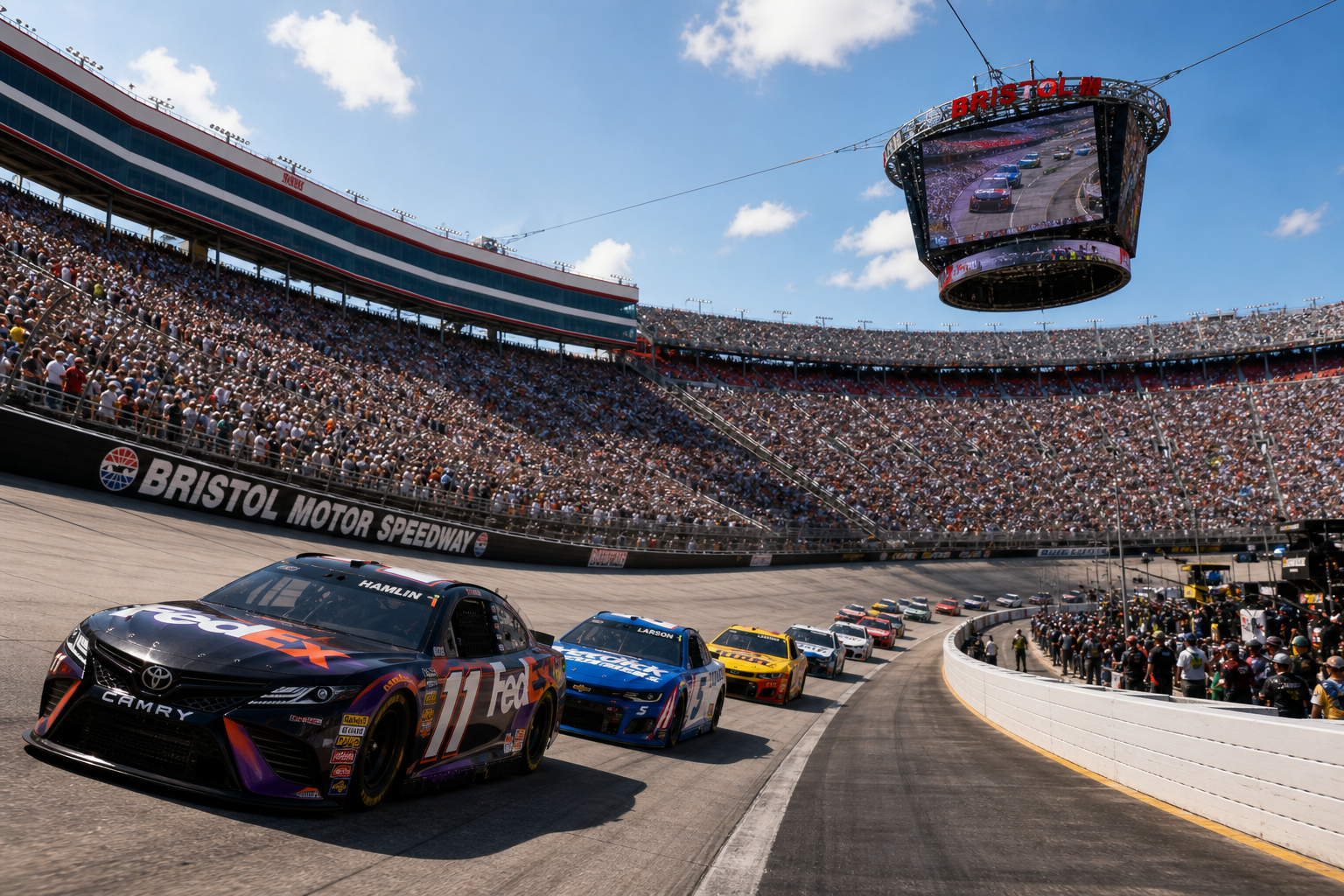

For a brief stretch at Bristol Motor Speedway, NASCAR looked like the version many fans remember from the late 1990s: a packed grandstand, a sense that the race was an event rather than merely another item on a long schedule, and enough celebrity polish to make the whole thing feel faintly Hollywood.
This was not quite the old waiting-list sellout. Pretending otherwise would be the sort of optimistic arithmetic usually reserved for a manufacturer’s fuel-economy claims. Attendance was, however, objectively among the better turnouts Bristol has seen for a Cup Series race during this decade. More importantly, the atmosphere suggested that NASCAR still knows how to create a proper occasion when the ingredients are right.
Bristol Still Knows How to Put on a Show
Bristol is not a neutral piece of asphalt. The Tennessee short track is one of NASCAR’s most theatrical venues, a steep-sided oval where the crowd sits close to the action and the cars spend the afternoon fighting for inches. Even before the green flag, the place has a naturally heightened mood. The track is compact, loud, visually dramatic, and completely uninterested in making life easy for anyone.
That matters because NASCAR’s best events have never depended solely on the quality of the racing. The race itself is the centerpiece, certainly, but the surrounding presentation gives the audience a reason to arrive early, stay late, and talk about the day afterward. Bristol can provide that theatrical framework more convincingly than most tracks on the calendar.
At this event, the pre-race presentation included a red carpet affair, bringing an extra layer of celebrity and occasion to the proceedings. It was a small but telling detail. The crowd was not simply being asked to watch stock cars circulate around a half-mile oval; it was being invited to attend something with a bit of ceremony attached.
The Late-1990s Formula Was Bigger Than the Race
NASCAR’s late-1990s boom is often reduced to a few familiar ingredients: huge crowds, national television exposure, famous drivers, and the intense rivalry between Dale Earnhardt and Jeff Gordon. Those were important parts of the story, but the appeal went beyond the names painted on the cars.
The series had become a visible part of popular culture. Actors, musicians, athletes, and other recognizable public figures appeared at races. Sponsors treated drivers as major personalities rather than interchangeable representatives in fire suits. A Cup race could function as a sporting contest, a networking event, a television production, and a very loud weekend away from home, all at once.
That combination created a useful sense of scale. Even someone who did not know the difference between a restrictor plate and a parking permit could understand that something important was happening when tens of thousands of people filled a grandstand to watch brightly colored cars collide with the laws of grip and patience.
NASCAR has not lost every part of that formula, but it has lost some of the effortless cultural reach that made the period feel unusually large. The sport now competes for attention with more racing series, more entertainment platforms, more sports content, and an internet that can turn every spare second into a bidding war for the audience’s concentration. A race weekend must work harder to feel unmissable.
Why Atmosphere Matters to NASCAR’s Business
Attendance is an imperfect measure of a sport’s health, but it remains a remarkably honest one. Television numbers can be influenced by scheduling, distribution, streaming habits, and changing measurement systems. A full grandstand, by contrast, is difficult to fake. People have paid for tickets, arranged travel, negotiated with their families, and committed an entire day to being in one place.
That is why a strong Bristol crowd carries weight even without reaching the sellout figures associated with NASCAR’s boom years. It demonstrates that the right venue can still produce a sense of urgency. The audience wants to be there when the race feels distinctive, when the track has an identity, and when the event offers more than a generic sporting broadcast with a different background.
The distinction is important. NASCAR does not need every race to resemble a late-1990s blockbuster. That would be impossible, and probably exhausting. It does need enough weekends that feel special to prevent the schedule from becoming a long procession of broadly similar television products.
Short Tracks Give the Cup Series Character
Bristol’s appeal also comes from what it refuses to hide. On a superspeedway, the racing can become a vast aerodynamic puzzle. At a road course, the drama is shaped by braking zones, elevation changes, and the occasional driver discovering that the gravel trap is less forgiving than expected. Bristol offers something more direct: traffic, pressure, contact, and very little room to pretend that a mistake was part of the plan.
The cars run close together, the walls remain uncomfortably near, and the racing line can become a physical argument between drivers rather than a theoretical exercise in data analysis. That rawness gives the race a character that no amount of lighting, music, or sponsor activation can manufacture.
It also makes Bristol an excellent setting for NASCAR to reconnect with its own identity. The sport’s modern presentation can be polished and highly managed, but the cars still need to look and sound like machines engaged in a serious disagreement. At a place such as Bristol, that quality is difficult to bury under branding.
The Red Carpet Is Useful—If the Racing Still Leads
Celebrity involvement can help a race feel larger, particularly when it encourages new audiences to pay attention. It gives television producers additional material, creates social-media moments, and provides sponsors with the sort of visibility they tend to regard as a pleasant development rather than an unfortunate accident.
But celebrities cannot carry a weak event indefinitely. A red carpet is an excellent appetizer. It is not dinner.
The important detail at Bristol was that the pageantry appeared alongside a stronger-than-usual crowd at a venue already capable of generating drama. The presentation added to the occasion instead of attempting to disguise a lack of substance. That is the right order of operations. Give people a compelling race, make the venue feel alive, and then add the glossy material around it. Reversing that sequence produces an expensive party with engines in the background.
NASCAR Does Not Need to Recreate 1998
There is a temptation whenever NASCAR enjoys a particularly strong weekend to declare the return of its peak. That is understandable, but nostalgia is a poor business plan. The late 1990s cannot be rebuilt by copying the surface details of the period. The media environment has changed, the audience has changed, and the commercial expectations surrounding major sports have changed with it.
What NASCAR can recover are the principles that made the era powerful: recognizable personalities, meaningful rivalries, venues with genuine identity, and races that feel like appointments rather than background programming. Bristol already supplies much of the venue magic. The challenge is creating enough compelling stories around the event to make casual viewers feel they are missing something by staying home.
That does not require artificial outrage or manufactured celebrity cameos every weekend. It requires drivers who feel distinct, races with consequences that are easy to understand, and a presentation confident enough to let the competition breathe. Spectacle works best when it points toward the racing rather than standing in front of it.
A Promising Sign, Not a Time Machine
Bristol’s better attendance and pre-race red-carpet treatment offered a glimpse of what NASCAR can still be when the venue, the crowd, and the presentation align. It was not a full return to the late-1990s boom, and calling it one would be needlessly romantic. The old era had different conditions, different stars, and a cultural reach that cannot simply be summoned with a few banners and a famous guest.
Still, the ingredients were recognizable. People showed up in meaningful numbers. The event carried a sense of occasion. Bristol did what Bristol does best: it made a Cup race feel noisy, immediate, and slightly dangerous in the best possible way.
That is the useful lesson. NASCAR’s peak may not return as an exact replica, but the sport can still produce flashes of it. Sometimes the answer is not another layer of technology or another carefully polished slogan. Sometimes it is a famous short track, a crowd that wants to be there, and several dozen cars being asked to settle an argument at full volume.

0 Comments