
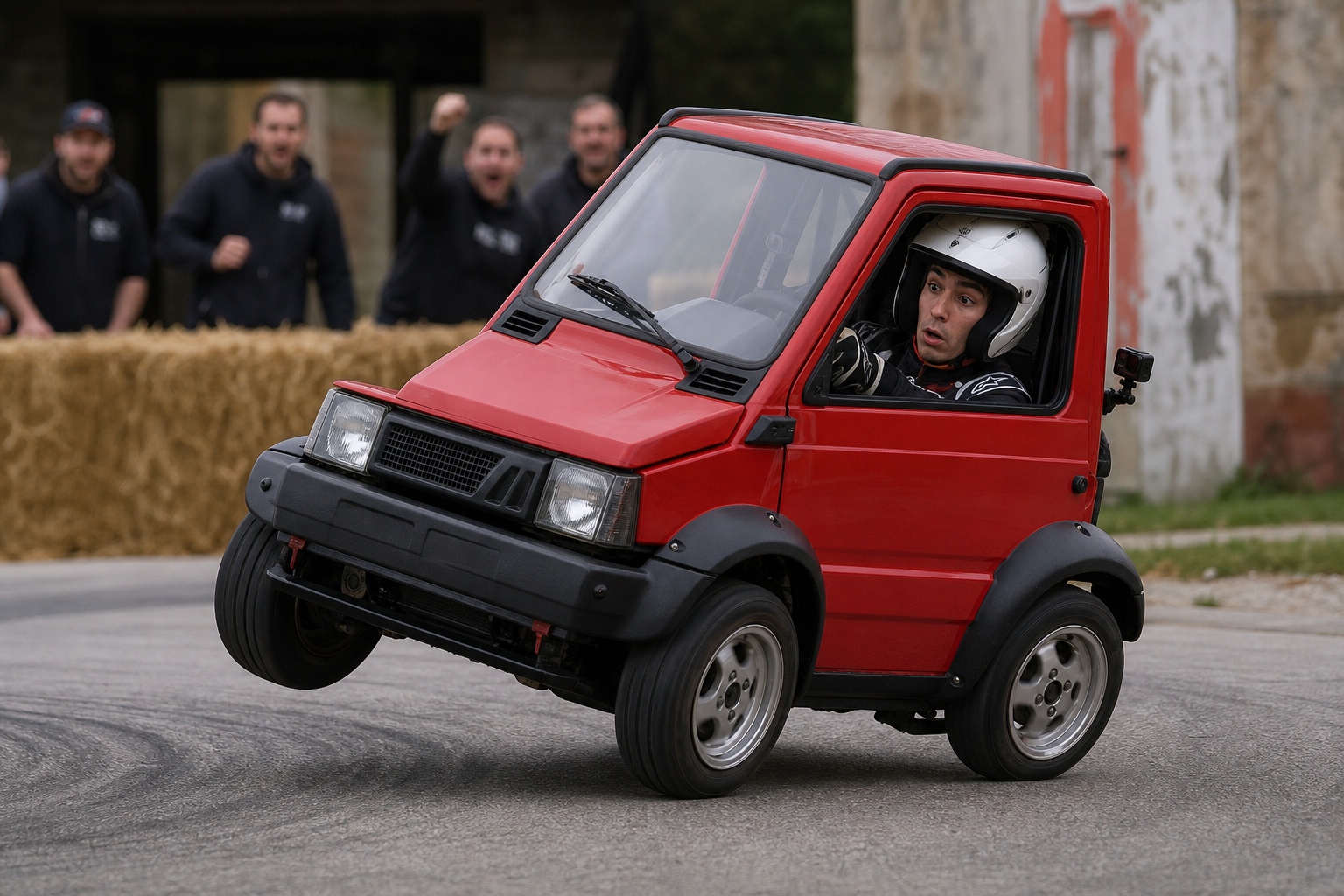

Formula 1 drivers spend their working lives learning precisely where the limit is. Arvid Lindblad found it in a heavily modified Fiat Panda, where the penalty for getting things slightly wrong was not a lost tenth of a second but a rather alarming flirtation with the laws of gravity.
The Racing Bulls rookie has appeared in a recent video from Italian car modification channel Carmagheddon, taking control of the vehicle described as the world’s shortest Fiat Panda. The Guinness World Record-holding machine is about as far removed from an ordinary city car as a go-kart is from a family sedan, and Lindblad nearly rolled it during the unusual challenge.
He did not, thankfully, turn the Panda into an impromptu piece of modern sculpture. The near-miss is nevertheless the moment that gives the video its real appeal. Put an experienced racing driver in a strange, radically altered vehicle and the result is not automatically graceful. Sometimes it is a reminder that even the quickest professionals on four wheels need a moment to understand what they have been given.
A Fiat Panda With Very Different Priorities
The standard Fiat Panda has always been a compact, practical machine designed for narrow streets, inexpensive running costs and the sort of urban life in which finding a parking space is considered a greater sporting achievement than carrying speed through a fast corner.
Carmagheddon’s Panda exists for a completely different reason. Its defining feature is its extraordinarily short length, achieved through extensive modification. The vehicle holds a Guinness World Record, turning a humble Italian runabout into a curiosity that belongs as much to the world of engineering dares and internet spectacle as it does to conventional car culture.
Shortening a car is not merely a matter of removing a section from the middle and welding the remaining ends back together while hoping nobody asks too many questions. The changes affect the relationship between the wheels, the body and the vehicle’s center of mass. They also alter how quickly the car responds to steering inputs and how much room there is for the chassis to absorb weight transfer before the driver runs out of usable stability.
That is why a vehicle built for a record attempt can feel so strange compared with the production car from which it began. The Panda badge may remain, but the familiar engineering compromises have been replaced by a much more peculiar set of priorities. Practicality has clearly taken the afternoon off.
Why the Near-Rollover Is So Interesting
Racing drivers are trained to manage changing grip, balance and momentum. They are not trained to assume that every car will react like a well-developed race car. Lindblad’s experience in single-seaters gives him superb car control, but it cannot tell him instantly how an unfamiliar, heavily modified Panda will respond to a particular steering movement.
A car with an unusually short wheelbase can react sharply to driver inputs. In broad terms, the shorter distance between the axles leaves less room for the chassis to moderate changes in direction. The vehicle may feel eager to rotate, nervous during transitions or simply unlike anything the driver has previously experienced. That does not automatically make it dangerous, but it does make the first few attempts a process of discovery.
There is another important distinction. A racing car is engineered around its intended use, with suspension geometry, tire choice, aerodynamic behavior and structural design developed as a complete package. A record-setting modified road car is a different proposition. It may be brilliantly constructed for its specific purpose, but its behavior can still be unusual, especially when a new driver climbs in and starts exploring its limits.
Lindblad’s near-roll therefore says less about a lack of skill than it does about the difficulty of calibrating yourself to an unfamiliar machine. A driver can have all the reflexes in the world and still need to learn where the grip ends, how quickly the vehicle loads its suspension and whether the next steering correction will save the moment or make it considerably worse.
From Formula 1 Precision to YouTube Chaos
At 19, Lindblad is part of the next generation of Formula 1 drivers, having joined Racing Bulls as a rookie. His professional environment is built around preparation, repeatability and data. Every lap is dissected. Every setup change has a reason. Every movement is expected to serve a measurable purpose.
Carmagheddon’s Panda challenge offers almost the exact opposite experience. The point is not to optimize a lap time or produce a polished technical demonstration. It is to place a young racing driver in something gloriously odd and see how quickly he can make sense of it. The contrast is what makes the appearance work.
Formula 1 drivers are often presented as if they possess a universal ability to master any vehicle immediately. They do have exceptional reactions, sensitivity and spatial awareness, but cars are not interchangeable tools. A modern Grand Prix car, a road-going hatchback and a record-holding mechanical oddity each communicate their behavior differently. The driver still has to listen.
That listening process is usually less dramatic in a standard vehicle. In the shortest Panda on record, it appears to come with rather more body movement than anyone would ideally request.
The Appeal of the Carmagheddon Challenge
There is no shortage of polished automotive content in which every car is described as fast, premium, dynamic and somehow transformative. Carmagheddon’s format occupies a much more entertaining corner of the internet. The channel’s Italian modification projects are built around visual absurdity, mechanical experimentation and the simple joy of asking whether a perfectly ordinary car can be turned into something deeply unreasonable.
The shortest Panda is an especially effective subject because the starting point is so familiar. Most people know what a Fiat Panda looks like. It is boxy, friendly and reassuringly sensible. Remove much of its length and suddenly the same basic idea becomes a small rolling engineering question mark.
That contrast also makes the vehicle more interesting than a purpose-built novelty. A bizarre machine designed from scratch is expected to be bizarre. A Panda that has been transformed into a Guinness World Record holder has the charm of a supermarket trolley that has somehow qualified for the Olympics.
Adding Lindblad to the equation brings a useful layer of credibility and danger. He is not merely a celebrity being handed a strange car for a photo opportunity. He is a trained racing driver being asked to explore a vehicle whose behavior is clearly outside his normal professional vocabulary. When he nearly rolls it, the moment feels less like scripted internet theater and more like a genuine reminder that engineering experiments do not always behave politely.
A Small Car, a Large Lesson
The episode also illustrates a basic truth about vehicle dynamics: a car’s reputation does not tell you how it will behave after major structural changes. A Fiat Panda may be recognizable by its shape and name, but a heavily modified example cannot be judged by the driving characteristics of an ordinary production model.
That distinction matters whenever enthusiasts alter a vehicle’s wheelbase, suspension, body structure or weight distribution. Even seemingly simple changes can affect steering response, load transfer and the driver’s available margin for correction. A project may be entertaining, clever and perfectly suited to a record attempt while remaining a very poor candidate for casual experimentation.
There is also a lesson here for anyone who has watched a professional driver make a difficult maneuver look effortless. Skill helps, obviously. It does not repeal physics. Lindblad’s experience allowed him to react when the Panda began to do something unhelpful, but experience cannot eliminate the need to understand the machinery underneath you.
That is why the near-roll is more memorable than a flawless run would have been. A perfect demonstration would show that a fast driver can drive a strange car. A wobbling Panda shows the more interesting truth: even a Formula 1 rookie has to negotiate with an unfamiliar vehicle before he can command it.
The video leaves the world’s shortest Fiat Panda exactly where it belongs — somewhere between a record-breaking engineering project, an internet curiosity and a stern warning not to assume that a familiar badge means familiar behavior. As for Lindblad, he has gained a useful reminder that not every driving challenge arrives with tire blankets, telemetry and a tidy set of setup sheets.
Sometimes it arrives as a very short Fiat Panda, looking innocent, behaving oddly and waiting patiently for gravity to make its point.
0 Comments