
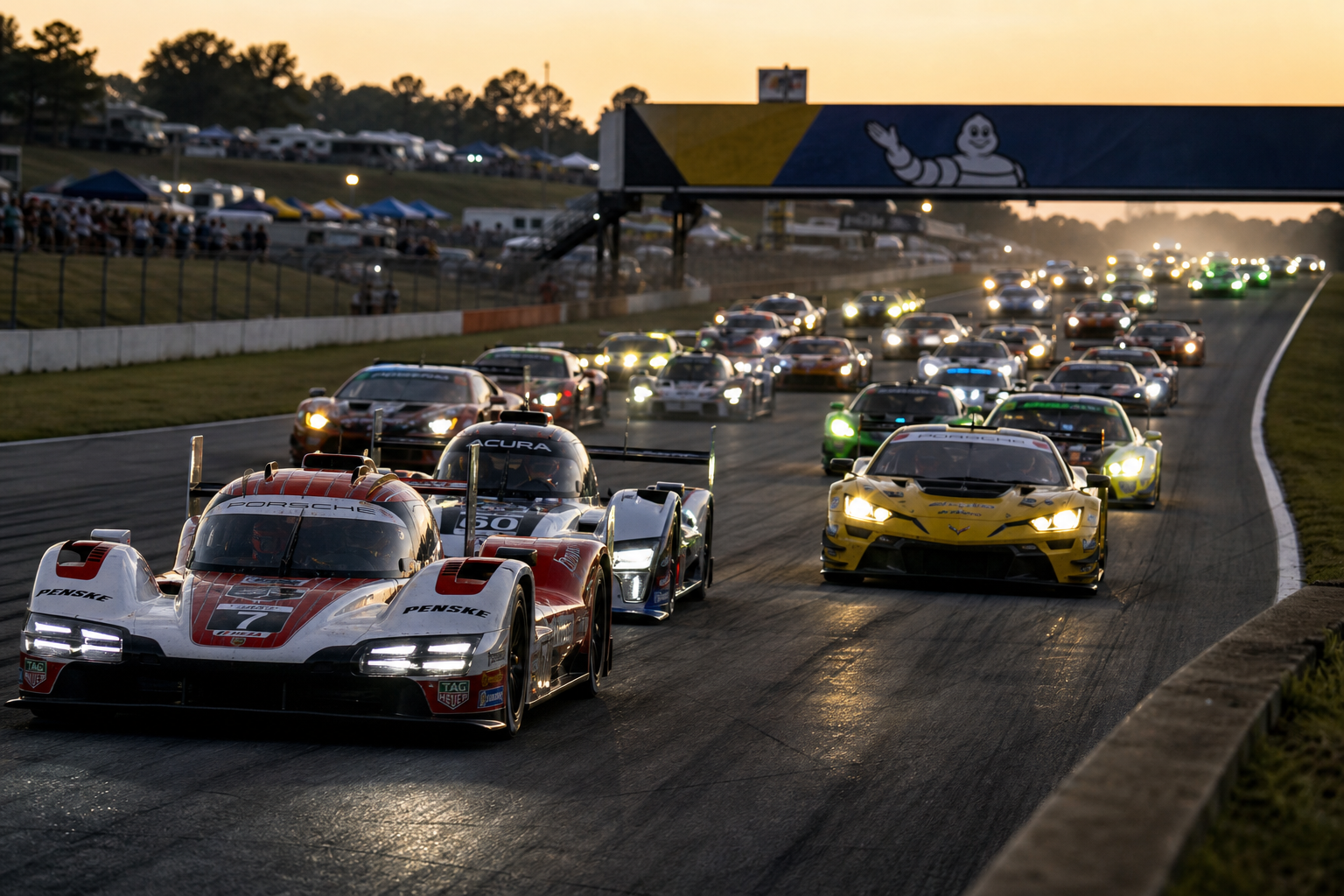

There are easier ways to spend a Saturday than putting 54 race cars on one circuit for 10 hours and asking several championships to sort themselves out before dinner. IMSA, rather sensibly, has chosen the louder option.
The 2026 IMSA WeatherTech SportsCar Championship will reach its finale at Michelin Raceway Road Atlanta with the 29th running of the Motul Petit Le Mans. The official entry list confirms a full 54-car field for one of North America’s most demanding endurance races, where title fights, class victories, and the end of several racing programs will all share the same piece of asphalt.
That combination gives Petit Le Mans its particular flavor. It is not merely the final round of a season, nor is it simply a long race with a large field. It is a sporting deadline, a technical stress test, and occasionally a rather public farewell party for cars and programs that will not return in their current form.
The GTP Championship Will Carry the Main Suspense
The headline battle sits in IMSA’s premier GTP class. These are the fastest prototypes in the championship, built around the current hybrid-based technical formula and tasked with dealing with traffic from the slower categories while maintaining the pace expected of a top-level endurance racer.
Petit Le Mans is a particularly unforgiving place to settle a championship. Road Atlanta is quick, narrow in places, and full of elevation changes that punish a car whenever its driver gets even slightly greedy. The long back straight encourages close racing, while the Esses and the fast final sector leave little room for heroics that have not been properly discussed with the laws of physics.
In a 10-hour race, raw speed is only one part of the argument. Teams must manage tire life, fuel strategy, traffic, pit-lane timing, driver rotations, caution periods, and the simple matter of keeping every expensive hybrid component attached to the car. A machine that is two tenths faster over a qualifying lap is not much use if it spends the afternoon looking like modern art in the garage.
The GTP title will therefore be decided by the championship’s full endurance formula rather than a single spectacular pass. A clean run through traffic can matter more than a brave qualifying lap. A well-timed pit stop can undo an hour of someone else’s hard work. And one small contact in the closing stages can turn a championship campaign into an expensive lesson in humility.
Why a 54-Car Grid Changes the Race
A full grid is excellent news for spectators and a mild administrative nightmare for everyone holding a steering wheel. The 54 entries will include the different classes that make up the WeatherTech Championship field, creating the familiar multi-speed traffic that defines American endurance racing.
The fastest prototypes must carve through traffic without losing momentum, while the drivers in the other classes are fighting their own races and cannot simply vanish when a GTP car appears in the mirrors. That produces the complicated choreography that makes endurance racing so compelling: a pass that helps one car may compromise another, and a driver defending a class position can unintentionally alter the championship fight several seconds behind.
Road Atlanta magnifies the problem. The circuit is compact enough to keep the cars in close proximity, yet fast enough that the closing speeds between categories can become dramatic. Drivers have to make decisions quickly, often with limited visibility and a great deal of confidence in competitors they may only have spotted through a windshield full of brake lights.
For teams, the size of the field also increases the importance of preparation. Radio discipline matters. Spotters matter. Traffic models matter. So does resisting the temptation to treat every opening as an invitation. Petit Le Mans rewards aggression, but it has never shown much sympathy for the kind of aggression usually followed by a long conversation with a carbon-fiber repair bill.
The Ten-Hour Test Is Longer Than It Sounds
Ten hours occupies an awkward middle ground in endurance racing. It is long enough to expose every weakness in a car and every questionable decision made by a pit wall, but short enough that teams cannot rely on the race eventually settling into a relaxed rhythm.
The opening stint can be frantic, particularly when championship contenders are close on points. The middle hours test consistency and mechanical durability. Then, as darkness arrives and the race moves toward its conclusion, the event often becomes a contest of accumulated survival. Tires are no longer fresh, drivers are no longer fresh, and the margins between a controlled attack and a very expensive mistake become thinner than anyone would like.
Weather can complicate matters further, although no specific forecast should be assumed this far out. Even without rain, changing temperatures and the transition from daylight to darkness can alter tire behavior and visibility. Engineers may spend most of the race adjusting to conditions that are never quite the same from one hour to the next.
Farewells Add a Different Kind of Pressure
The 2026 entry list also carries a more emotional subplot: several programs are set for notable farewells. The supplied announcement does not identify every departing car or organization, but its presence on the grid gives the race an extra layer of consequence.
Endurance racing has always been temporary by nature. Cars evolve, manufacturers change direction, sponsorship arrangements expire, and technical rules eventually make even successful machinery obsolete. A final appearance at Petit Le Mans can therefore mean more than the end of a season. It may be the last time a particular car, livery, team structure, or driver combination appears in competition.
That can change how a program approaches the weekend. A championship contender has to protect points. A departing entry may have greater freedom to chase one final result. Engineers may be willing to take a risk they would avoid during a normal championship round, while drivers are often acutely aware that the final lap is not merely the final lap of this race but the last lap of an entire chapter.
There is a danger in over-romanticizing these departures, of course. Racing teams do not become sentimental when a wheel nut is cross-threaded. The stopwatch remains brutally indifferent. Still, the knowledge that a program is ending can make the ordinary rituals of an endurance weekend feel rather less ordinary.
Road Atlanta Is an Appropriate Place to Settle It
Michelin Raceway Road Atlanta is not a circuit that allows drivers to hide. Its fast, flowing layout rewards commitment, but its narrow sections and substantial elevation changes punish cars that run wide or arrive at the wrong corner with too much optimism.
The track’s character also makes it a suitable home for a race in which different classes and championship objectives collide. It is fast enough to showcase the premier prototypes, technical enough to reward a well-balanced GT car, and compact enough to keep traffic in play throughout the event.
Petit Le Mans has become one of the defining endurance races on the IMSA calendar precisely because it refuses to behave like a tidy season finale. There is no guarantee that the fastest car will win, no promise that a championship leader will remain comfortable, and no polite pause in the action for a departing program to enjoy its final appearance.
When the 54 cars take the green flag, the 2026 season will be reduced to a familiar endurance-racing equation: speed, patience, traffic, and mechanical sympathy. The championship battles will receive the headlines, but the race itself will decide how those stories end. At Road Atlanta, that usually requires surviving first and celebrating afterward.
0 Comments