
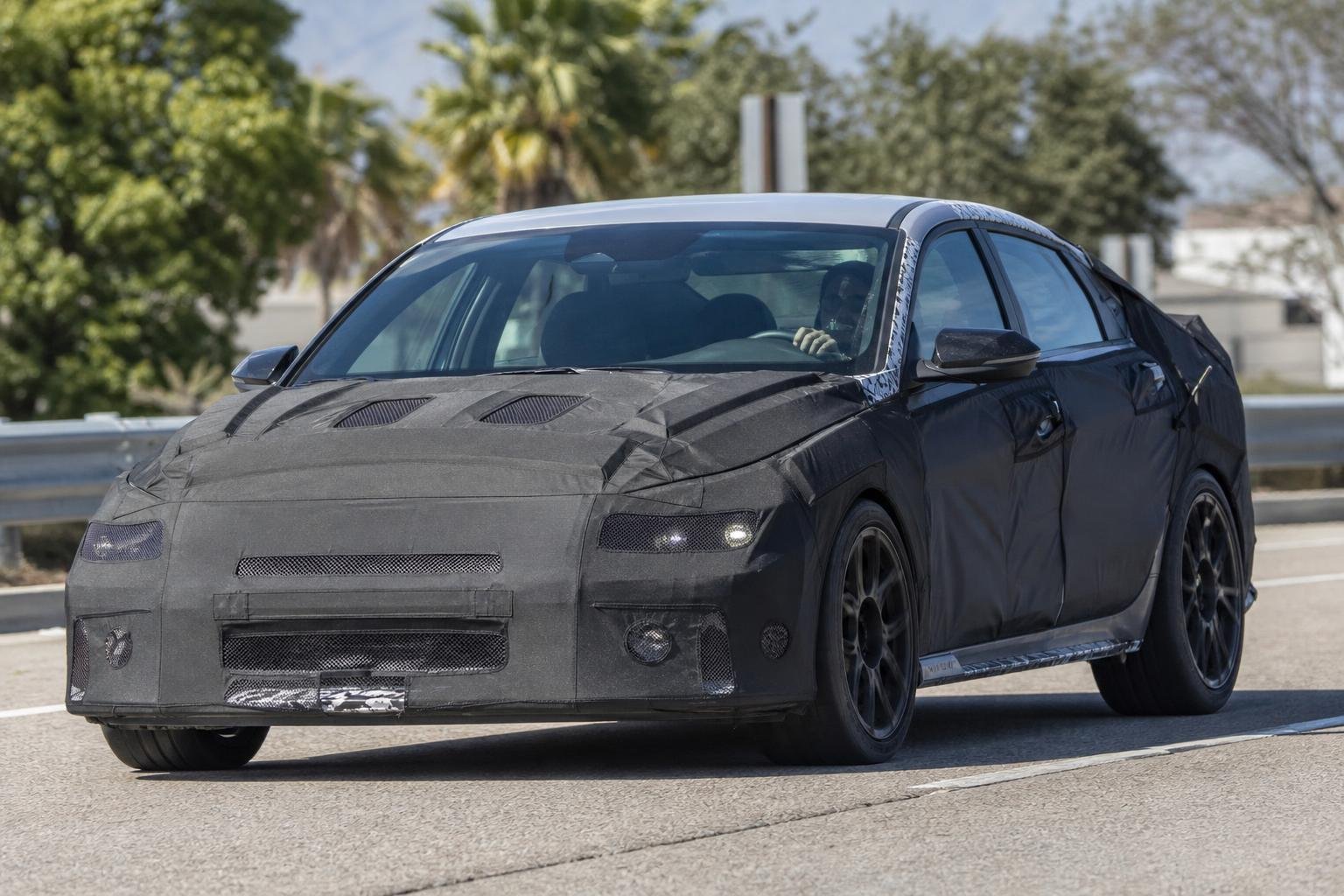

Hyundai appears to be moving quickly on the next Elantra N. The current performance sedan is still a relatively fresh entry in the sport-compact market, yet a heavily camouflaged replacement has already been filmed testing on public roads in South Korea.
The prototype, spotted by Korean YouTube channel Healer TV and reported by Motor1, does not reveal every detail. It does reveal enough to suggest that Hyundai is not treating the next Elantra N as a mild styling exercise. The car appears wider, lower and more deliberately aggressive than the standard sedan, with large exhaust outlets and performance hardware that hint at a meaningful mechanical upgrade.
A sharper Elantra provides a more dramatic starting point
The next Elantra N will share its basic design with the eighth-generation Hyundai Elantra, which recently debuted in South Korea under the Avante name. That standard car already takes a more assertive design approach, with slim lighting elements, sharper surfacing, pronounced fenders and a roofline that gives the sedan a fastback-like profile.
That styling could have made the N version easier to disguise. Instead, the prototype seems to emphasize the car’s most confrontational features. Camouflage surrounds the front end, side skirts and wheel arches, but the visible proportions point to a lower and wider-looking body. The extra visual width is not merely decorative: previous test vehicles reportedly used 275/30ZR19 tires, substantially wider than the 245-section tires fitted to the current Elantra N.
Tire width alone does not guarantee better handling. It can add grip, but it also brings trade-offs involving steering feel, rolling resistance, ride comfort and replacement cost. Still, a move to substantially wider rubber would make sense if Hyundai is increasing the car’s power or asking it to perform more serious track work. The prototype also appears to have a wider track, which could improve stability and give the chassis a more planted stance.
The design changes appear functional, not ornamental
At the rear, two large round exhaust outlets sit near the outer edges of the bumper. Their placement gives the car a more purposeful appearance than the current model, although the camouflage makes it impossible to determine whether the final exhaust design will remain identical.
A larger rear spoiler also appears to be fitted, but the coverings conceal its exact shape. The spoiler may be primarily a visual statement, or it may contribute useful aerodynamic balance at higher speeds. There is not enough visible evidence to determine how much downforce Hyundai intends to generate, and it would be premature to treat the prototype’s camouflaged hardware as final production equipment.
Red brake calipers have appeared on previous test cars. That detail is familiar performance-car theater, but it can also signal more substantial braking components underneath. If Hyundai is pairing more power with wider tires, upgraded brakes would be a logical part of the package rather than an optional flourish.
A larger engine could change the Elantra N’s character
The most consequential rumored change is hidden beneath the hood. Reports have suggested that Hyundai may replace the current Elantra N’s turbocharged 2.0-liter four-cylinder with a turbocharged 2.5-liter four-cylinder.
Hyundai already uses versions of a 2.5-liter turbocharged four-cylinder in other products. The Sonata N Line produces 290 hp and 311 lb-ft of torque, while the Genesis G70 produces as much as 300 hp from a similar setup. Those figures do not confirm what the next Elantra N will make, but they provide an indication of the powertrain technology available within Hyundai Motor Group.
Previous reports have pointed to output above 330 hp for the next Elantra N. If that figure becomes reality, it would represent a substantial increase over the current car’s 276 hp and 289 lb-ft of torque. More power would make the sedan quicker, but it would also raise tougher engineering questions. Hyundai would need to manage front-end traction, heat, drivetrain durability and torque delivery without turning the car into a machine that overwhelms its front tires.
That is where the rumored wider tires, wider track and upgraded brakes become more important. They suggest Hyundai may be considering the entire performance system rather than simply installing a larger engine and calling the job finished.
The manual transmission remains the biggest question
The current Elantra N offers a six-speed manual transmission or an eight-speed dual-clutch automatic. That choice has helped distinguish the car from many newer performance models, particularly as affordable vehicles with a manual transmission continue to disappear.
Hyundai has not confirmed whether either transmission will carry over. The company’s decision will matter beyond the specification sheet. A dual-clutch transmission may be the more effective choice for extracting maximum acceleration and supporting higher output, while the manual gives the Elantra N a level of involvement that cannot be measured by launch-control times alone.
Keeping both would preserve the model’s broad appeal, but it could also increase development cost and complicate certification for different markets. With no official power, pricing or transmission information available, the prototype offers more questions than answers.
Hyundai is making the Elantra N harder to ignore
The test car’s appearance suggests Hyundai is pushing the Elantra N toward a more serious visual and mechanical identity. Wider tires, a broader stance, prominent exhaust outlets and possible brake upgrades all point in the same direction, even if the final specifications remain unconfirmed.
That makes the next Elantra N more interesting than a routine model refresh. Hyundai appears to have an opportunity to turn its compact sedan into an even stronger alternative to increasingly expensive performance cars. The challenge will be preserving the current car’s balance and accessibility while adding the power and hardware that enthusiasts clearly want.
Hyundai has not announced an official debut date, though the next Elantra N could arrive as early as 2027. Until then, this prototype is best viewed as an informed preview—not a final promise. The aggressive bodywork is visible, but the decisions that will define the car are still hidden beneath the camouflage.
Sources: Motor1.

0 Comments