
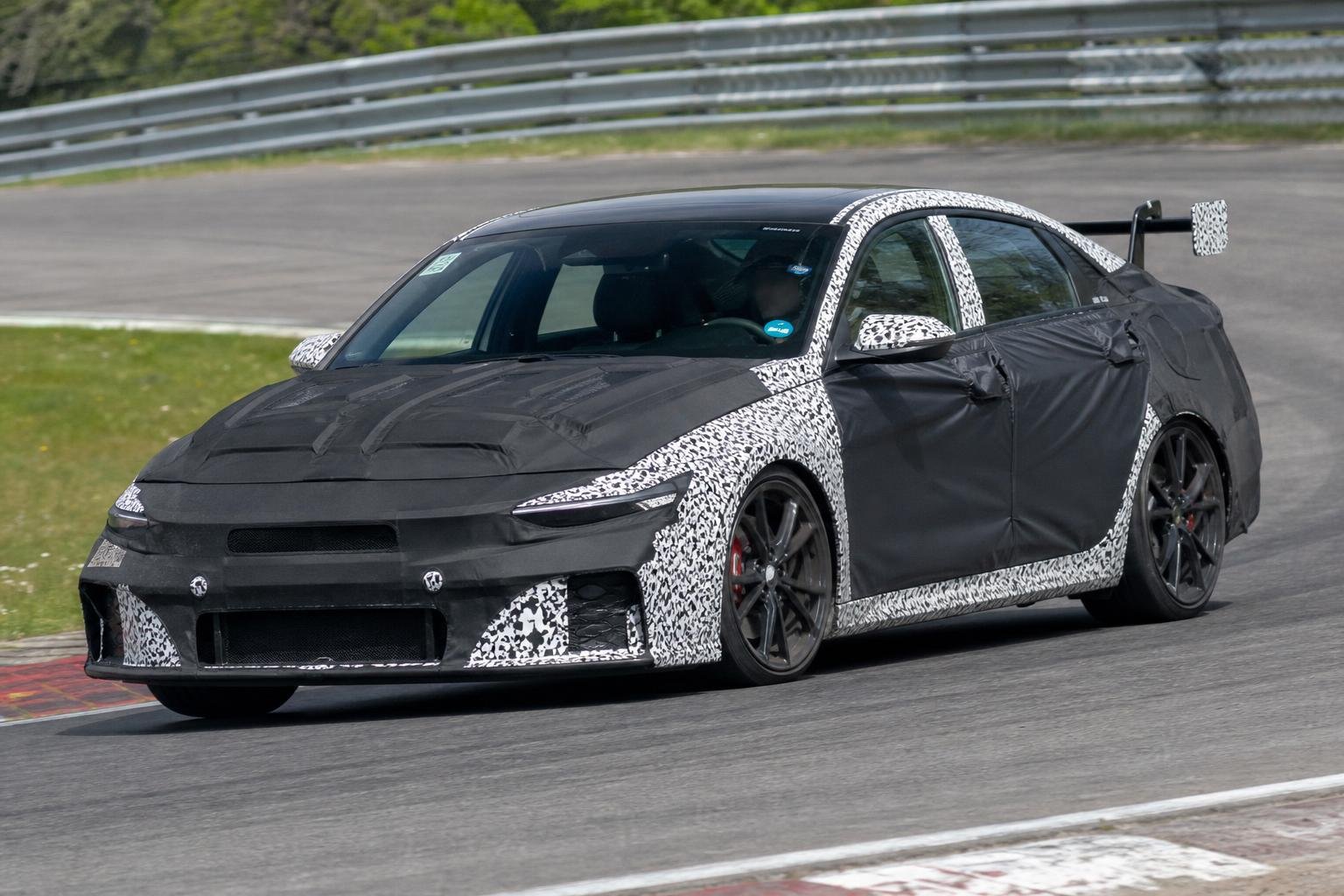

Hyundai appears to be preparing a substantially angrier successor to the Elantra N, and the early prototype already suggests that the company is not interested in making a quiet evolution. A heavily camouflaged test car spotted in South Korea shows a wider stance, more serious-looking bodywork, and large exhaust outlets positioned at the edges of the rear bumper.
The footage, published by Korean YouTube channel Healer TV and reported by Motor1.com, does not reveal Hyundai’s final design or specifications. It does, however, provide a useful early look at the direction of the next performance sedan. The car is expected to share its basic structure with the latest eighth-generation Elantra, known as the Avante in South Korea, while adding the visual and mechanical hardware expected from an N model.
A wider body could be the most important design change
Camouflage hides much of the prototype, but the overall proportions are difficult to miss. The test car appears to have wider fenders, a broader track, pronounced side skirts, and a lower front fascia than the standard sedan. Two large round exhaust outlets sit near the outer edges of the rear bumper, giving the car a more deliberate performance identity than the relatively restrained appearance of an ordinary Elantra.
The current Elantra N already uses an aggressive visual formula, but the next car seems likely to push the low-and-wide theme further. That would fit the character of the latest Elantra, whose sharp lighting, sculpted surfaces, and pronounced fender volumes already give the compact sedan an unusually dramatic presence. Hyundai’s official design material describes the standard model as a blend of three-box practicality and sport-sedan proportions, and the N version appears ready to exploit that foundation rather than disguise it.
A larger rear spoiler is also visible beneath the camouflage, although its final shape remains unclear. Earlier test vehicles reportedly showed red brake calipers and 275/30ZR19 tires—substantially wider than the 245-section tires used by the current Elantra N. Wider rubber can provide a larger contact patch and greater lateral grip, but it also brings trade-offs in ride comfort, tire cost, steering effort, and performance in cold or wet conditions. In other words, this is not merely a styling exercise.
The hardware appears to be moving beyond the current car
Hyundai has not confirmed the prototype’s engine, output, or chassis specifications. The leading expectation is that the current turbocharged 2.0-liter four-cylinder could make way for a turbocharged 2.5-liter engine. Hyundai already uses related 2.5-liter turbo-four powertrains in vehicles such as the Sonata N Line and Genesis G70, where they produce 290 hp and up to 300 hp, respectively.
Those figures do not establish what the next Elantra N will deliver. Earlier reports have suggested output above 330 hp, but Hyundai has not announced that figure and it should be treated as speculation. If the larger engine arrives, the increase would be substantial over the current model’s reported 276 hp and 289 lb-ft of torque. More power would also force Hyundai to address traction, cooling, braking, and front-end weight—particularly if the car remains front-wheel drive.
The current Elantra N is not simply a powerful engine in a compact sedan. Hyundai’s published technical information highlights an electronically controlled limited-slip differential, electronically controlled suspension, a reinforced body structure, integrated drive-axle components, brake-cooling measures, and 14.17-inch front brake discs. Those systems matter because additional horsepower is only useful if the chassis can deploy it repeatedly and predictably.
That is why the apparent tire and track changes may be more revealing than the engine rumor. A wider footprint can improve corner-exit traction and stability, while a wider track can reduce load transfer and help the car feel more planted. The cost is additional mass and rolling resistance, so Hyundai will need to balance grip against steering response and everyday usability.
The manual transmission question is becoming unavoidable
The current Elantra N offers a six-speed manual transmission or an eight-speed wet dual-clutch automatic. Hyundai has not said whether both will return. For a performance sedan that is marketed around driver involvement, the manual is more than a nostalgic option: it is one of the clearest ways the Elantra N distinguishes itself from increasingly powerful automatic-only rivals.
There is at least some reason for cautious optimism. Hyundai’s official announcement for the limited-production 2026 Elantra N TCR Edition confirms that both a six-speed manual and an eight-speed DCT remain part of the company’s performance-sedan strategy. That special edition is not proof that the next-generation Elantra N will use the same transmissions, but it demonstrates that Hyundai has not abandoned the three-pedal format across the nameplate.
The DCT would make the most obvious partner for a stronger engine, particularly in traffic and during repeated hard acceleration. The manual, meanwhile, would preserve the mechanical involvement that helped the Elantra N stand apart in a shrinking market for affordable performance cars. Dropping it could improve production simplicity, but it would also remove one of the car’s most appealing arguments.
Hyundai has not finished revealing the recipe
The prototype may arrive as early as 2027, according to the original report, but Hyundai has not announced an official debut date. Pricing, availability, drivetrain configuration, power output, and final equipment remain unknown.
For now, the clearest message is visual: Hyundai appears to be giving the next Elantra N more width, more tire, and a more assertive body than the current car. That would be a sensible response to the performance sedan’s central challenge. The N badge has to look credible before the driver even reaches the first corner, but it also has to preserve the balance between track hardware and daily-sedan practicality that made the current car compelling.
Hyundai has not yet confirmed whether this prototype represents a revolution or simply a sharper interpretation of the existing formula. Still, the wide tires, enlarged-looking bodywork, and possible 2.5-liter engine suggest that the next Elantra N may be less interested in subtlety than its predecessor—and that is probably the right kind of problem for Hyundai to have.
Sources: Motor1.com; Hyundai Worldwide: The new ELANTRA N Highlights; Hyundai Worldwide: 2026 ELANTRA N TCR Edition; Hyundai Worldwide: ELANTRA Design Highlights.
0 Comments