
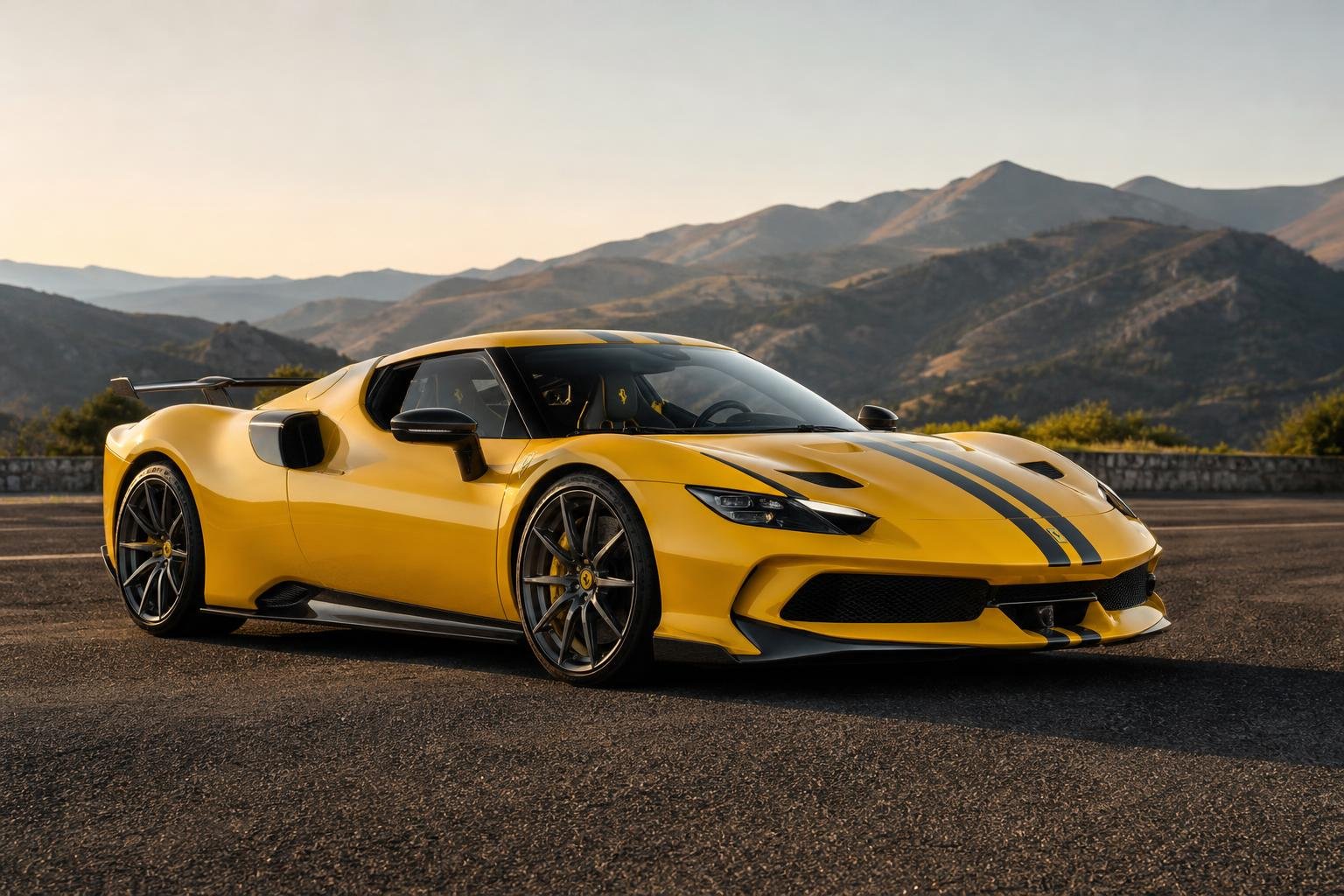

Ferrari’s 296 Challenge Stradale is already an extravagant proposition: a 670-hp, non-hybrid performance car intended to bring serious track hardware to the road. The starting price is roughly $307,000, but Ferrari’s online configurator makes it clear that the real financial damage begins after the base car is selected.
As Motor1 reports, Ferrari offers a deep menu of paint, carbon-fiber, wheel, tire and interior choices for the 296 Challenge Stradale. Some are functional. Others exist because a Ferrari owner should never have to tolerate the indignity of seeing another identical Ferrari at a cars-and-coffee event.
The paint palette is only the beginning
Ferrari lists 35 exterior colors across Standard, Historical, Classic and Special categories. The predictable choices are there, including Rosso Corsa and Giallo Modena, but the more interesting selections are the colors that make the car look less like a conventional supercar and more like a rolling piece of Italian excess.
Giallo Ambra, described in the original configurator exploration as a particularly fancy orange, is a strong choice for the 296 Challenge Stradale. It gives the car an immediate visual identity without relying on stripes, numbers or oversized graphics. That matters because the bodywork is already busy enough to command attention.
Ferrari also offers several livery options, including upper- and lower-body graphics, wing decals and door numbers. On a competition-derived model, adding a livery would normally seem mandatory. Yet the 296 Challenge Stradale’s single-color look may be the more confident choice. A track-inspired Ferrari does not necessarily need to dress like it is waiting for a race start.
Carbon fiber for nearly everything
The configurator’s more predictable indulgence is carbon fiber. Buyers can apply the lightweight material to areas including the front splitter, rear diffuser and engine covers. These parts are not merely decorative, particularly on a car designed with circuit driving in mind, but Ferrari’s configurator also turns carbon fiber into a visual statement.
That distinction is important. On a performance car, reducing mass can improve acceleration, braking, cornering response and tire performance. But without option pricing or published weight savings for each component, it is impossible to determine whether a particular carbon-fiber selection is a meaningful performance upgrade or an expensive way to make the car appear more serious. Usually, it is both—but not in equal measure.
Ferrari even allows customers to replace conventional glass with Lexan, a lightweight polycarbonate. The choice should help reduce weight, although the supplied configurator information does not specify how much. It is the kind of option that makes sense for an owner who intends to prioritize track use, while looking rather theatrical on a car that spends most of its life on public roads.
There are smaller visual decisions, too. Buyers can remove the Prancing Horse badges from the front fenders or replace metal emblems with painted versions. That may sound like a minor detail, but Ferrari’s appeal has always included the ability to obsess over minor details. The badge is not just a badge; it is part of the product’s social volume.
Wheels, tires and brakes reveal the intended use
Ferrari offers six wheel designs for the 296 Challenge Stradale, ranging from light silver to darker gray and black finishes. The configuration also allows buyers to personalize details such as wheel bolts and center caps.
The selected combination here is a set of forged diamond-polished wheels with titanium wheel bolts. It is a suitably dramatic specification, although the finish also highlights one of the awkward truths of track-focused road cars: the most visually delicate options are often the ones owners will worry about most around curbs, debris and imperfect pavement.
Tire selection is more consequential. Ferrari offers Bridgestone and Pirelli options depending on whether the car will be used primarily on the road or track. There are also Pirelli Color Edition tires with yellow or gray accents. Those colored details may appeal to buyers building a fully coordinated car, but passing on them keeps the exterior from becoming too busy.
Brake calipers are available in eight colors, including black, red, yellow and silver. The choice has no shortage of cosmetic significance, but on a car like this, the brakes are also part of the visual language. Bright calipers announce performance intent; black calipers suggest that the owner would rather let the rest of the car do the talking.
The interior choices are restrained—mostly
Compared with the exterior, the 296 Challenge Stradale’s cabin options are relatively subtle. Ferrari offers floor mats with or without logos, 26 stitching colors and 22 colors for the lower dashboard section. Flash Orange stitching was selected to match the Giallo Ambra exterior, creating the kind of coordinated theme that can look intentional or alarmingly committed depending on the owner’s tolerance for matching accents.
The more important decision concerns the seats. Ferrari offers Racing seats and a “Best Weight” option. The supplied material does not provide definitive weight figures or a detailed comfort comparison, although the Racing seats appear to be lighter and likely less comfortable. That makes the choice less straightforward than simply equating one seat with track support and the other with lower mass.
Seven Alcantara colors are available depending on the selected seats. Buyers can also choose from six seatbelt colors, add a central racing stripe and specify additional stitching. These details will not transform the car’s performance, but they do shape how much of the 296 Challenge Stradale’s competition identity reaches the driver’s seat.
The passenger display is an odd luxury
Like most Ferraris, the 296 Challenge Stradale does not use a dedicated center touchscreen. Ferrari does offer an optional passenger display, however, giving the passenger a view of selected vehicle information.
That feature feels slightly out of step with the rest of the car’s stated priorities. Weight reduction, track-oriented tires, racing seats and Lexan glazing all point toward focus. A passenger display points toward entertainment and theater. The contradiction is not necessarily a flaw—Ferrari buyers may want both—but it neatly captures the 296 Challenge Stradale’s position. This is a road-legal performance machine that still has to function as a luxury purchase.
The expensive part is choosing
Ferrari does not publish prices for the individual configurator options. Buyers must contact a dealer to learn what each selection costs, meaning the roughly $307,000 starting price is only the beginning of the conversation.
That makes the configurator less like a simple ordering tool and more like a test of restraint. The 296 Challenge Stradale can be specified as a relatively clean, single-color car or turned into a highly personalized collection of carbon fiber, contrasting trim, track-focused equipment and brightly colored details. Both approaches fit the car. The difficult part is accepting that the most tempting choices are also the ones most likely to make the final bill spectacular.
Ferrari has not made the 296 Challenge Stradale configurable because customers need 35 paint colors or eight brake-caliper finishes. It has done so because exclusivity is part of the product. The car’s performance may justify its engineering choices, but the configurator sells something more personal: the opportunity to make a very expensive Ferrari unmistakably yours.
Sources: Motor1.
0 Comments