
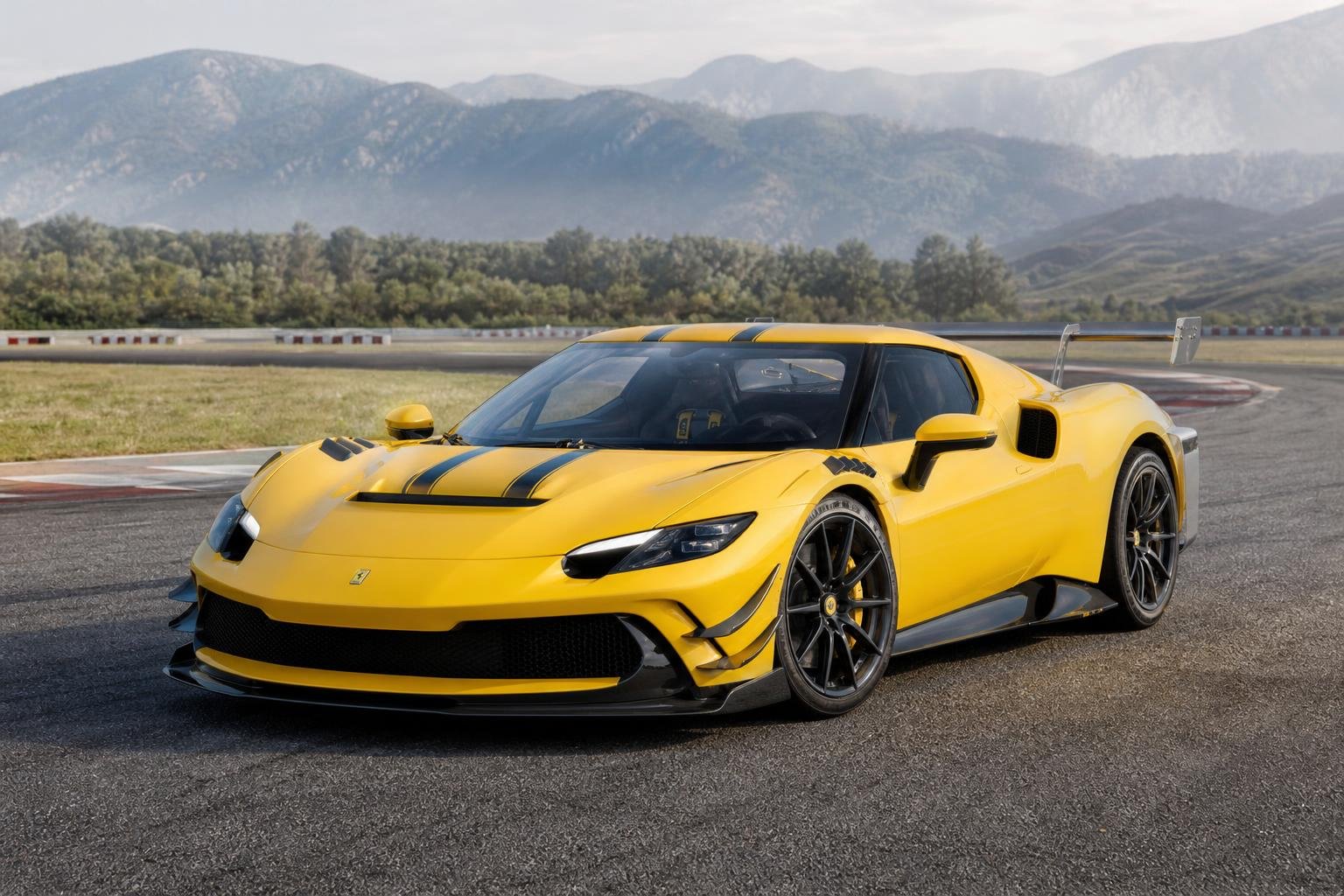

Ferrari has made the 296 Challenge Stradale unusually easy to understand: it is a road-legal supercar built around the logic of a race car, then handed to customers with a configurator capable of making the result even more excessive.
The starting point is already extreme. Ferrari lists the 296 Challenge Stradale at roughly $307,000 before options, with a 670-hp, 2.99-liter twin-turbocharged V6, an eight-speed dual-clutch transmission, and no hybrid system. That last detail is the important one. Removing the electric components helps give the car a dry weight of 2,932 pounds, 309 pounds less than the 296 GTB, according to Ferrari.
Then there is the visual evidence that Ferrari has not designed this as a comfortable grand tourer wearing track-day accessories. The Challenge Stradale produces as much as 1,360.3 pounds of downforce—approximately 1,360 pounds—at 155.34 miles/h, or about 155 mph, a claimed 72 percent increase over the 296 GTB. Its fixed rear wing, enlarged splitter, flicks, vortex generators, underbody and aerodynamic ducts are not subtle—and the configurator gives buyers plenty of ways to emphasize that fact.
Giallo Ambra Is the Correct Kind of Unreasonable
Ferrari offers 35 exterior colors divided among Standard, Historical, Classic and Special categories. Rosso Corsa would be the obvious choice, and Giallo Modena would make a convincing argument, but Giallo Ambra is the more interesting selection. The orange-leaning shade gives the 296 Challenge Stradale enough visual heat without simply repeating the most familiar Ferrari formula.
A car this aerodynamically busy can easily become visually overdecorated. Ferrari offers upper- and lower-body graphics, wing decals, door numbers and other livery choices, but the cleaner approach is arguably the stronger one. The Challenge Stradale already has a large fixed wing, aggressive front aero and a body shaped around airflow. Adding racing graphics could make it look less purposeful rather than more.
The configurator also offers a deep catalog of carbon-fiber parts. The front splitter, rear diffuser and engine covers can all be specified in the lightweight material. Buyers can go further with Lexan windows, a polycarbonate alternative to conventional glass that reduces mass, although the practical benefits of saving a few more pounds on a road car will depend heavily on how often it actually sees a circuit.
Ferrari even lets customers remove the Prancing Horse badges from the front fenders or replace the metal emblems with painted versions. That is a wonderfully Ferrari solution to a problem almost nobody had: how to make an unmistakable Ferrari slightly less obvious.
The Wheels Matter More Than the Paint
Six wheel designs are available, ranging from light silver to dark gray and black. The most convincing configuration pairs Forged Diamond-Polished wheels with titanium wheel bolts. It is a classic combination, but this car does not need an avant-garde wheel design competing with its aero package.
Tire selection is more consequential than the finish. Ferrari offers Bridgestone and Pirelli choices depending on the intended road or track use, including Pirelli options with colored accents. The sensible build skips the yellow or gray tire markings. The less sensible build chooses the tire with the most circuit-focused character and accepts that the car’s behavior—and its compromises—will be shaped as much by the rubber as by the engine.
Eight brake-caliper colors are available, including black, red, yellow and silver. Yellow calipers against Giallo Ambra would be too much. Black would keep the visual focus on the body and the exposed carbon fiber, while silver would lean into the car’s mechanical character.
Inside, Ferrari Knows Who This Car Is For
The interior options are less flamboyant, but they reveal the Challenge Stradale’s priorities. Ferrari offers Racing and “Best Weight” seat choices, with the names making the trade-off fairly clear. The racing seats appear to be lighter and probably less comfortable, while the Best Weight seats presumably prioritize mass reduction. Ferrari does not publish the exact weight difference in the supplied configurator material.
There are seven Alcantara colors, 26 stitching colors, six seatbelt colors, and the option of a central racing stripe. The ideal choice here is Flash Orange stitching to echo the exterior without covering the cabin in decorative contrast. The lower dashboard can also be customized in 22 colors, which is less a design opportunity than a test of restraint.
The cabin’s most revealing details are the parts Ferrari does not try to disguise. The car uses pared-back materials, carbon-fiber door panels and tubular racing seats, while the reduced sound insulation reinforces the engine and exhaust note. The result is closer to a competition environment than the usual supercar lounge.
There is also an optional passenger display. Ferrari’s decision to offer one in a car this focused is faintly hilarious. It may help a passenger follow vehicle information, but it also creates the bizarre possibility of adding entertainment technology to a Ferrari whose entire purpose is to remove distractions. A passenger display in a luxury GT makes sense. In the Challenge Stradale, it feels like an apology for the racing seats.
The Configurator Cannot Hide the Real Compromise
The 296 Challenge Stradale’s most interesting design decision is not a color or carbon-fiber option. It is the rejection of the 296 range’s hybrid assistance. Ferrari says the combustion-only layout creates a more direct connection between the accelerator, engine and rear wheels while reducing weight and complexity.
That choice also means the car gives up the instant low-speed torque and additional output provided by electric motors in other 296 variants. Ferrari quotes 670 hp here rather than chasing the highest possible number. The result is a car aimed less at specification-sheet domination than at repeatable performance, physical feedback and track-focused response.
Ferrari traces the Challenge Stradale name to the 360 Challenge Stradale, introduced in 2003. The new car follows the same basic idea: bring the spirit of a one-make race car onto public roads, while retaining enough equipment and adaptability to remain road legal. It is a narrow brief, and the configurator makes the contradiction visible. Buyers can specify Lexan windows and stripped-down racing seats, then add a passenger screen.
My build would stay with Giallo Ambra, black calipers, Forged Diamond-Polished wheels, titanium bolts, carbon-fiber aero pieces, the lighter-looking interior treatment and orange stitching. No stripes, no door numbers, no colored tire accents and no passenger display. If Ferrari is going to sell a road car this close to a race car, the design should at least be honest about what it is.
Ferrari does not list individual option prices in the online configurator, so the final bill remains a conversation for the dealer. That may be the only part of the process that is not entertaining. The choices are extravagant, occasionally absurd and deeply revealing—but on a Ferrari built around excess, that is precisely the point.
Sources: Motor1; Ferrari; Ferrari Magazine; Ferrari 296 Challenge Stradale; Ferrari History.
0 Comments