
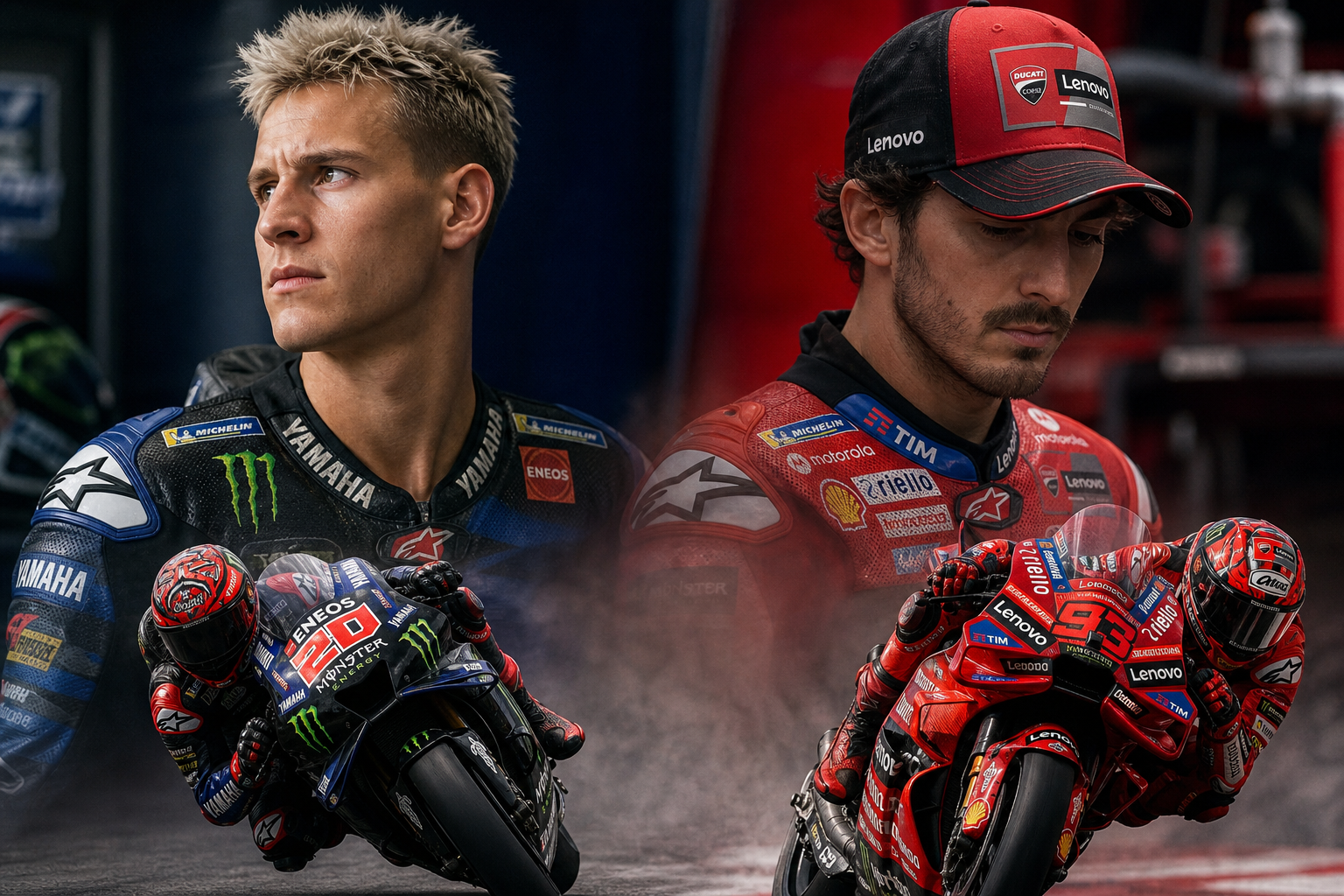

Fabio Quartararo says he doesn’t see his own current situation as comparable to the one Francesco Bagnaia is facing at Ducati, even if the two world champions now find themselves in broadly similar circumstances: both are heading for a team change, and both are trying to navigate difficult runs of form.
The Yamaha rider’s comments come against a backdrop of contrasting fortunes inside Ducati’s garage. Bagnaia, the reigning championship reference point for the Italian brand in recent seasons, has been struggling to explain a slump in performance while Marc Marquez, on the same machinery, has been operating at a far stronger level. That disparity has become one of the more intriguing storylines of the MotoGP season, especially because it comes from a team that entered the year with obvious strength in depth.
Why Quartararo sees a different situation
Quartararo’s point is not that Bagnaia’s frustration is any less understandable, but that the context around the two riders is different enough that direct comparison doesn’t hold up. The Frenchman is a former world champion whose own career has been shaped by Yamaha’s long and often difficult rebuilding process. Bagnaia, by contrast, is dealing with a rare internal comparison at Ducati, where a teammate on identical equipment is delivering the kind of results that magnify every weak weekend.
That distinction matters in MotoGP, where the psychological pressure of a teammate outperforming you on the same bike can be as damaging as any technical problem. When the machinery is shared, riders and teams lose the comfort of explaining everything away with equipment differences. If one rider can consistently make the package work and the other cannot, the questions become much sharper.
Quartararo’s stance also reflects his own experience of riding for a manufacturer that has been trying to regain competitiveness against benchmark opposition. In that setting, the battle is often less about intra-team comparison and more about extracting enough performance from an imperfect package to remain relevant in races and qualifying. That is a very different form of pressure from the one Bagnaia faces when a teammate is winning on the same bike.
Bagnaia’s struggle inside a winning structure
Bagnaia’s form has become a notable talking point because Ducati is still the reference point for the grid in outright performance. When a rider on that bike cannot find answers, the issue is rarely simple. It can be a matter of setup direction, confidence, riding style, or the way a rider is adapting to the evolving character of the machine. When the teammate is Marc Marquez, a rider whose ability to adapt and attack at the limit has defined his career, the comparison only becomes more severe.
For Ducati, the situation is awkward but also revealing. Marquez’s speed reinforces the bike’s underlying competitiveness, while Bagnaia’s difficulty suggests that even the best machinery can expose a rider if the feeling is off. That is one of MotoGP’s persistent realities: the same bike can produce very different results depending on the rider’s confidence and the way the package is working underneath them on a given weekend.
Bagnaia’s inability to explain the slump makes the matter more complicated still. When a rider knows why performance is dropping, there is at least a technical or strategic direction to pursue. When the cause is unclear, the challenge becomes as much mental as mechanical. Riders at this level are used to operating with a strong sense of direction, and uncertainty can be destabilizing.
Both champions are facing change
The parallel between Quartararo and Bagnaia is strongest in the fact that both are world champions who will be moving teams next season. That alone puts them in an unusual position. Riders of that stature are typically central to a manufacturer’s long-term plans, yet both have reached points in their careers where a fresh start appears to be part of the next chapter.
For Quartararo, the move away from Yamaha reflects a broader effort to reset after a period in which progress has been too slow. For Bagnaia, the future is different but equally unsettled, because his current issue is not simply a lack of results but the difficulty of understanding why results have changed so sharply while the garage on the other side of the box is thriving.
That is why Quartararo’s reaction is so telling. He is not looking at Bagnaia’s case through a broad “top rider in trouble” lens. He is looking at the specific demands of a rider trying to survive in a situation where a teammate is demonstrating what the bike can do. For a competitor, that can be infuriating in a way that an external performance deficit is not.
What the Ducati contrast says about MotoGP right now
The Bagnaia-Marquez contrast has become one of the clearest examples this season of how MotoGP success is built on a delicate balance between rider and machine. Ducati may have the strongest package in the field, but that does not mean every rider will interact with it in the same way. A championship-calibre bike can still feel wrong to the person on it if the ride height, grip, braking feel, or corner-entry balance no longer matches the rider’s instinct.
That is what makes the situation so hard to read from the outside. Fans can see the lap times and the finishing positions, but the internal picture is more complex. In one garage, confidence may be high and the bike may feel exactly as expected. In the other, the same hardware may feel unpredictable enough to undermine a rider’s entire weekend.
Quartararo’s comments add an interesting layer to that discussion because he has spent much of his top-class career dealing with the opposite problem: working with a bike that has often lacked outright performance compared with the benchmark. His experience gives him a clear view of how different types of frustration affect a rider, and why Bagnaia’s case is not simply another example of a champion under pressure.
With both riders heading toward change next season, their current struggles also underline how quickly MotoGP careers can shift. A rider can move from title contender to search-for-answers mode in very little time, and the gap between a machine that suits a rider and one that doesn’t can be enough to transform a season. In that sense, the Quartararo-Bagnaia comparison is less about shared labels than about two very different forms of difficulty inside the same championship.
0 Comments