
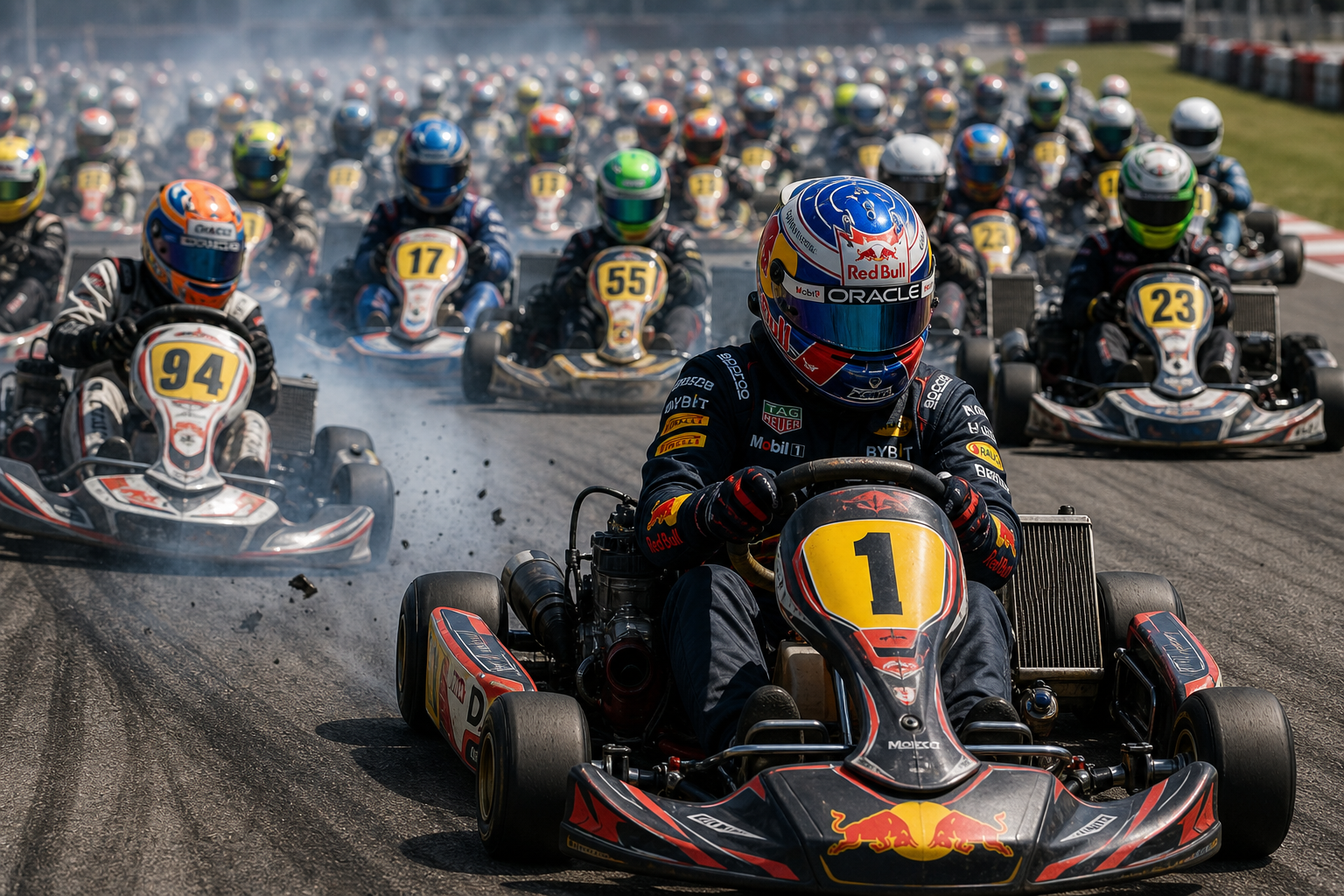

Max Verstappen emerged from a chaotic opening lap to win the Max vs 100 kart race, a spectacle that put one Formula 1 driver against a full grid of 100 karts and delivered exactly the sort of traffic-management challenge the concept promised. Verstappen described the first lap as “carnage” after fighting through the pack, an assessment that hardly needs embellishment given the scale of the event.
A race built around compression and chaos
The premise alone made the event unusual. One driver, Max Verstappen, lined up against 100 kart racers, creating a race environment where outright pace mattered less than positioning, timing, and the ability to avoid incidents in a crowded field. In karting, where margins are tiny and the racing surface offers very little room for error, adding that many competitors can turn even a straightforward lap into a puzzle of braking points and survival.
Verstappen’s reaction after the race suggests the opening stages were exactly that. His description of the first lap as “carnage” points to the density of cars and the difficulty of finding clean air once the race began. With 100 karts on track, the first few corners would have been less about rhythm and more about reacting to traffic, avoiding contact, and waiting for gaps that may not have existed on the initial run.
Why Verstappen’s win stands out
Verstappen is no stranger to high-pressure racing, but this format demanded a different skill set from the one usually associated with Formula 1. There were no strategic pit stops, no tyre offset games, and none of the usual grand prix orchestration. Instead, the challenge was to convert superior pace into position while navigating a field that was likely bunched tightly enough to punish the smallest mistake.
That is what makes the result notable. Beating 100 karts is not a matter of simply having the quickest lap time; it is about surviving the opening phase without getting trapped, delayed, or caught in someone else’s mistake. Verstappen’s ability to come through that kind of traffic and still take victory fits the kind of racecraft that has made him so effective in Formula 1, where managing risk and exploiting gaps is often as important as raw speed.
The challenge of karting at scale
Kart racing looks simple from the outside, but the format can be brutally unforgiving even before the field reaches triple digits. With no suspension to soften mistakes and little bodywork to absorb contact, the consequences of crowding are immediate. A 100-kart race amplifies every one of those traits.
At that scale, the opening lap becomes the central event. Drivers are fighting for space before the field has settled, which is when incidents tend to happen. Verstappen’s “carnage” comment captures the reality of that phase better than any official summary could. Once the pack stretches out, the race likely becomes more manageable, but the first lap can decide whether a front-running driver gets a clear run or spends the rest of the race recovering from damage, delays, or blocked progress.
What the result says about the format
Events like this work because they strip racing down to its essentials. There is no room to hide, and there is little opportunity to build a result through elaborate strategy. The winner is usually the driver who adapts fastest to the circumstances, keeps momentum, and avoids unnecessary risk. Verstappen’s victory suggests he did all of that, but it also reflects the appeal of the concept itself: a simple setup that creates a busy, unpredictable race almost immediately.
For fans, the attraction is easy to understand. The chance to see a top-level driver thrown into a huge kart field offers a rare look at how a proven racer handles disorder rather than controlled pace. In this case, the answer was decisive enough to produce a win, even if the path there was messy from the start.
Verstappen’s reaction fits the result
His post-race description did not suggest a polished, processional victory. “Carnage” is the kind of word drivers usually reserve for races with too much contact, too much congestion, or too many near-misses to count cleanly. That makes it a fitting summary for a 100-kart start, especially in the early laps when the entire field is still bunched together and every move affects the next few rows behind.
Even without a detailed lap-by-lap account, the broad picture is clear: Verstappen had to work through a crowded opening phase and came out on top. In a motorsport format built to create disorder, that is the defining achievement.

0 Comments