
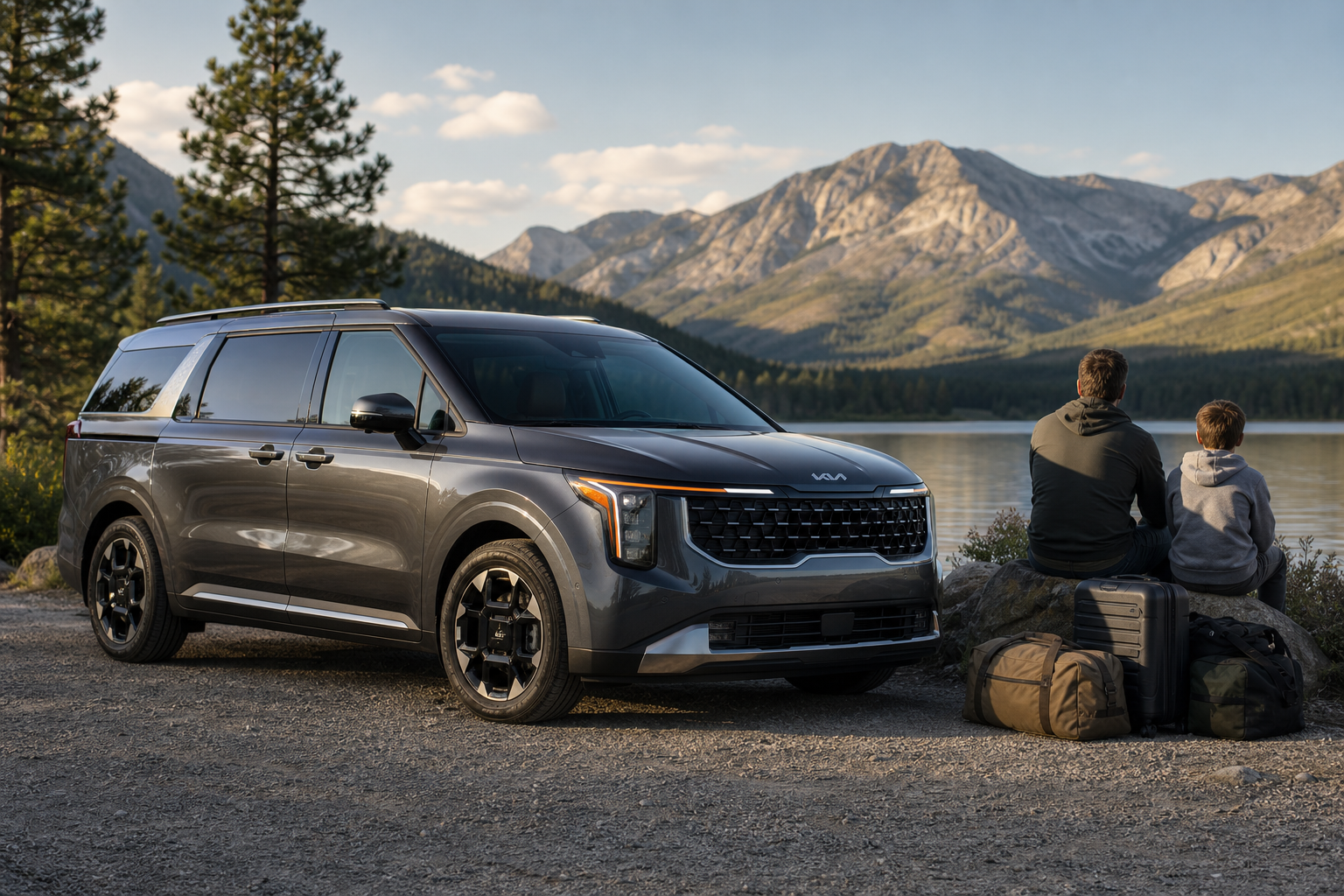

A road trip test that fits the Carnival’s mission
The 2024 Kia Carnival makes its case quickly when it’s asked to do what few vehicles still do well: carry people, luggage, and real-life clutter over long distances without feeling like a compromise. In a recent 700-mile trip, the Carnival averaged 26.2 mpg while serving as transporter, mobile lounge, and quiet refuge for a father-and-son road trip before college changed the daily routine.
That combination matters because the Carnival isn’t trying to be a badge-heavy SUV in disguise. It’s a purpose-built people mover, and Kia has leaned into that honesty. The result is a vehicle that feels especially relevant at a time when traditional minivans have been pushed aside in the market, even though they remain among the most practical vehicles on sale.
Why the Carnival still stands out
The Carnival’s appeal starts with packaging. The shape is more wagon-like than traditional minivan, but the layout underneath follows familiar logic: easy access, a spacious cabin, and the kind of cargo flexibility that family buyers actually use. There’s a reason the van formula survived so long in the first place. Sliding doors make loading simpler in tight parking spots, the cabin swallows gear with less drama than most three-row SUVs, and passengers sit in a space designed around comfort rather than image.
Kia has also given the Carnival a more polished and upscale presentation than the category used to get. Depending on trim, the cabin can feel closer to a well-trimmed crossover than the workhorse vans that shaped the segment’s reputation. That matters for buyers who want utility without giving up a sense of occasion every time they get behind the wheel.
700 miles of real-world use
Long road trips expose the strengths and weaknesses of any family vehicle. In this case, the Carnival’s strengths were the ones that became most obvious over the course of the drive. The miles accumulated with little fatigue, and the average fuel economy of 26.2 mpg was a welcome bonus for a large three-row vehicle carrying the usual mix of people and baggage.
That kind of number will not make the Carnival a fuel-sipping outlier, but it does help explain why the model remains relevant to buyers who actually travel. The 2024 version is still gasoline-powered, but Kia is already preparing a hybrid variant for 2025, which should broaden the van’s appeal for drivers who want better efficiency without moving to a plug-in or a fully electric package.
More space, less stress
One of the Carnival’s biggest advantages is the way it makes family logistics feel manageable. National parks, luggage, a duffel bag, and the usual road-trip odds and ends all fit into a vehicle designed to absorb that kind of use. The cabin isn’t just large; it is shaped for access, with room to move through and around the seats in ways that many SUVs simply cannot match.
That practicality is especially useful when the trip itself is emotionally loaded. A drive before college is the sort of journey where conversation, comfort, and the ability to carry everything needed for the transition matter as much as the destination. The Carnival’s calm ride and generous interior space suit that role well.
The importance of the upcoming hybrid
Kia’s decision to add a hybrid to the Carnival lineup for 2025 is significant because it strengthens the model exactly where many shoppers will be looking: efficiency without abandoning the minivan format. The market has shown that a substantial number of buyers will choose an SUV if they think it delivers style or perceived ruggedness, even when a van would do the job better. A hybrid Carnival gives Kia another argument for staying with the format.
That also makes the current gasoline model a useful preview of what the platform can already do. The 26.2-mpg trip result suggests the Carnival is not wasteful in the real world, even before electrification broadens its range of use cases. For buyers comparing it with three-row SUVs, that can be enough to tip the scales when interior room and convenience matter more than image.
How the Carnival fits in today’s family-vehicle market
The Carnival occupies a space that few manufacturers still treat as a priority, and that gives it a clear identity. It is not built to imply adventure, and it does not need to. Its job is to move people comfortably, carry a lot of their stuff, and do it with less stress than most alternatives.
That straightforward mission is part of the appeal. As families plan road trips, college moves, airport runs, and the constant shuffle of modern life, vehicles like the Carnival make a strong practical argument. The 2024 model shows that a well-executed van can still be one of the best road-trip tools on the market, especially when long-distance comfort and usable space are the priorities.
With the hybrid version on the way, Kia is setting the Carnival up for an even broader audience. But even in current gasoline form, it’s already making the case that the minivan formula still works when it’s executed with enough room, enough refinement, and enough real-world efficiency to make a 700-mile drive feel easy.
0 Comments