
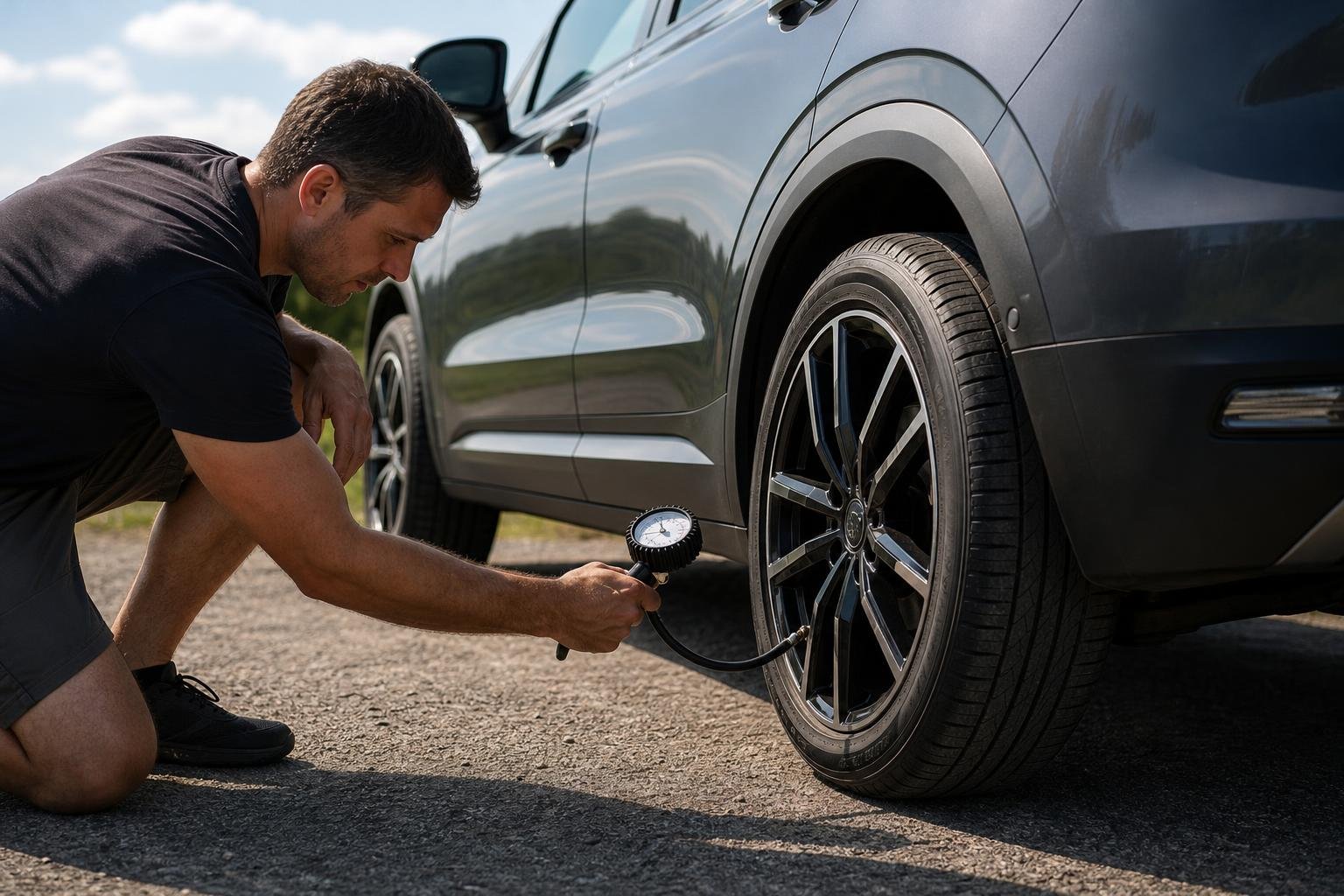

The four tires on a car do not always need the same amount of air. That is not an arbitrary instruction or a detail reserved for high-performance vehicles. Front and rear pressure recommendations are part of the way engineers manage axle loads, steering response, braking stability, tire temperature and ride quality.
Some vehicles call for more pressure at the front, while others specify a higher rear setting. The correct answer depends on the vehicle’s weight distribution, suspension tuning, tire size and expected load. The most important rule is simple: use the cold-tire pressures listed on the vehicle’s tire-information placard or in the owner’s manual.
Weight distribution is the starting point
A tire supports a portion of the vehicle’s weight, and that portion is not necessarily equal at each corner. In a conventional front-engine vehicle, the engine, transmission and related hardware place more mass over the front axle. Front-wheel drive can add further weight to the front because the drive components are concentrated there.
When an axle carries more weight, its tires must support a greater load. Inflation pressure helps control how much the tire’s sidewall and tread deflect under that load. Excessive deflection creates heat and can reduce the tire’s ability to respond consistently, particularly during extended highway driving or when the vehicle is heavily loaded.
That is why a vehicle with a front-heavy layout may specify a higher cold pressure for the front tires. The opposite can also be true. Rear-engine and mid-engine vehicles can place substantially more weight over the rear axle, while some electric vehicles have unusual mass distributions because of their battery packs and motor layouts. In those cases, the rear tires may need the higher setting.
Pressure is also a handling adjustment
Automakers do not select tire pressure strictly from a static weight calculation. They also evaluate how the vehicle behaves while turning, braking and making sudden steering inputs. Tire pressure affects sidewall stiffness, the shape of the contact patch and the speed at which the tire reacts to steering forces.
The front tires usually perform several jobs at once: they steer, transmit braking forces and, in many vehicles, deliver engine torque. The rear tires contribute to braking and cornering stability. Engineers can use different pressures at each axle to create a predictable balance between the front and rear of the vehicle.
Lower pressure allows more sidewall flex. That can increase heat buildup and make steering response feel less precise. Higher pressure reduces flex, but excessive inflation can make the tire less compliant over bumps and may change how consistently it maintains grip. Neither extreme is a useful substitute for the vehicle manufacturer’s tested setting.
The difference may be difficult to detect during routine commuting. It becomes more important when the vehicle is loaded, driven at highway speeds or forced into an emergency maneuver. Using the same pressure at all four corners when the placard specifies different values changes the behavior engineers intended.
A full vehicle can need different settings
Weight distribution changes when people and cargo enter the vehicle. Passengers in the second row, luggage in a trunk, equipment in a cargo area or tongue weight from a trailer can add considerable load to the rear axle. As a result, some tire placards list one set of pressures for normal loading and another for a full passenger or cargo load.
Those instructions should be read as a complete system, not as a suggestion to add a few pounds whenever the vehicle feels heavy. The correct adjustment may apply only to the rear tires, or it may specify different values for both axles. Trucks and SUVs can be especially sensitive to load changes because their intended operating range spans everything from an empty vehicle to substantial cargo or towing duty.
Wheel and tire equipment matters, too. A vehicle may have different recommended pressures for different factory tire sizes or wheel packages. Replacement tires should match the vehicle’s required size, load rating and application. The pressure listed for another trim level is not automatically correct for the vehicle in your driveway.
The number on the tire is not the vehicle setting
One of the most persistent tire-maintenance mistakes is treating the number molded into the tire sidewall as the recommended operating pressure. That figure generally identifies the tire’s maximum inflation pressure under the conditions associated with its load rating. It is not a vehicle-specific tuning recommendation.
A tire can be installed on multiple vehicles with different weights, suspension designs and load distributions. The same tire therefore may require different operating pressures depending on the vehicle. The tire-information placard, normally found on the driver’s doorjamb or door edge, provides the pressure selected for that particular vehicle. The owner’s manual is the backup reference if the placard is missing or difficult to read.
The sidewall maximum and the vehicle’s recommended pressure serve different purposes. Inflating every tire to the sidewall number can leave the tires overinflated relative to the vehicle’s intended setup.
Check pressure before driving
Pressure should be checked when the tires are cold, ideally before the vehicle has been driven for the day. Rolling friction flexes the tires and warms the air inside them, temporarily increasing the gauge reading. Comparing a hot reading directly with the cold pressure on the placard can lead to an incorrect adjustment.
Outside temperature also affects pressure. A cold weather change can produce a lower reading without a puncture, while warmer conditions can raise it. That does not mean drivers should apply a universal seasonal adjustment. Instead, check the tires and compare them with the vehicle’s listed cold values.
Use a reliable gauge, measure all four tires, and match the front and rear readings to the correct positions on the placard. If one tire repeatedly loses pressure, adding air is not a repair; the tire, valve or wheel needs inspection.
Correct pressure protects more than tread life
Inflation errors can affect wear, efficiency and safety. Underinflation generally increases shoulder wear and rolling resistance, while overinflation can contribute to faster wear near the center of the tread. Those patterns are not definitive diagnoses because alignment, suspension condition and driving habits also influence wear.
Low pressure is particularly concerning because greater flexing generates heat. The risk is more serious when the vehicle is heavily loaded or traveling at sustained highway speeds. Maintaining the manufacturer’s front and rear recommendations keeps the tires operating within the conditions used to develop the vehicle’s handling and load-carrying characteristics.
Different front and rear pressures are therefore not a quirk to be corrected with a single number. They are a compact expression of the vehicle’s engineering: where its mass sits, how it responds to steering and braking, and how its behavior changes with passengers or cargo. Read the placard, check the tires cold and follow the values assigned to each axle.



0 Comments