
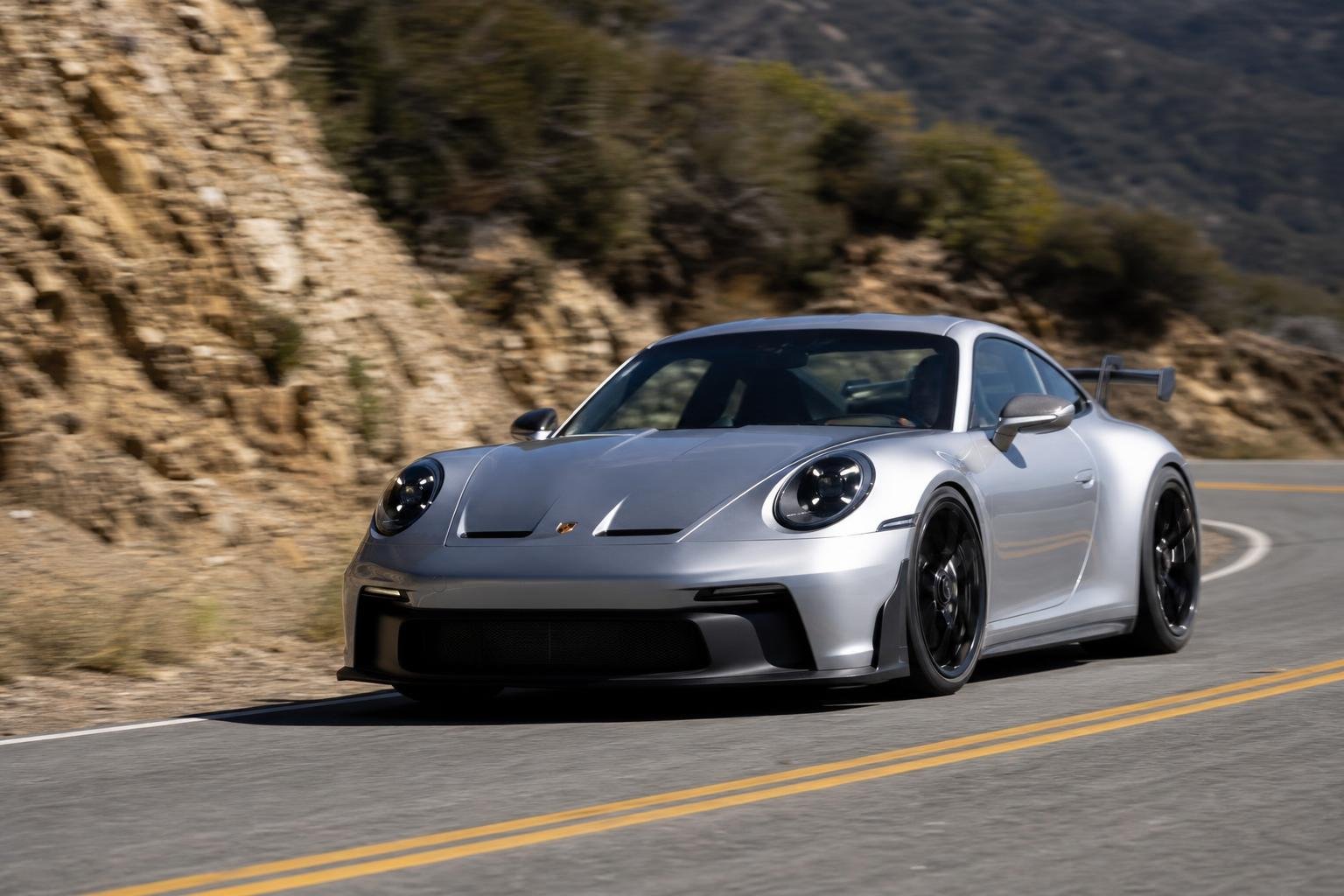

Porsche has filed a patent application for an unusual active-aerodynamic system that would use deployable fins to generate sideways force in a corner. Instead of relying solely on tires, suspension and electronic stability controls, the concept would manipulate airflow around the body to help the car rotate and remain stable at high speed.
The application, published in November 2026 by the German Patent and Trade Mark Office and covered by Motor1, describes movable “rudders” positioned at both ends of the vehicle. One pair would emerge from the front trunk lid ahead of the windshield, while another set would deploy near the rear glass.
How Porsche’s aerodynamic rudders would work
When the driver turns, the fins would pivot into the airflow at an angle. The air striking each surface would create a lateral force, effectively pushing the vehicle’s body toward the inside of the turn. The principle is comparable to a boat’s rudder redirecting water, although the automotive system would be working with air rather than a fluid surrounding the vehicle.
That distinction matters. A conventional aerodynamic device primarily creates vertical load, pressing the tires into the pavement to increase available grip. Porsche’s concept is intended to create a force across the vehicle’s path instead. In theory, that could help the car follow a corner more accurately while reducing the amount of corrective work required from the tires and electronic stability system.
The application says the system could provide “increased lateral acceleration potential at high speeds” and stabilization beyond what its Electronic Stability Program can manage. Those statements are claims contained in the filing, not evidence of a tested production system, but they reveal the engineering problem Porsche is trying to address: controlling the vehicle’s body in fast corners without depending entirely on braking individual wheels or altering torque delivery.
Why the fins are placed at both ends
Positioning the rudders at the front and rear would give Porsche more control over how the aerodynamic force is distributed. A device mounted only at one end could alter the vehicle’s balance in an undesirable way, potentially creating too much response at the front or rear. Splitting the hardware between both ends offers a way to influence the car’s behavior while keeping the aerodynamic center closer to the vehicle’s overall center of mass.
The patent application also describes the fins as a way to help counter body roll. Roll is the chassis movement that occurs when lateral cornering forces compress the suspension on one side and unload the other. Reducing that motion can make a vehicle feel more stable and can help keep the driver’s inputs predictable, although the concept would not eliminate the need for properly tuned springs, dampers, anti-roll bars and tires.
From an engineering perspective, the potential advantage is not simply more grip. An active aerodynamic system could respond to changing conditions while the vehicle is moving, adjusting the force according to steering input and the direction of the turn. That creates another control variable for the vehicle’s software and chassis engineers, alongside braking, motor or engine torque, steering angle and conventional aerodynamic load.
Visibility and crosswinds create serious complications
The rear-mounted fins present an immediate practical problem. A surface large enough to generate meaningful aerodynamic force could also obstruct the driver’s rearward view or interfere with visibility in the side mirrors. That is particularly awkward for a road car, where the system would have to satisfy usability and safety expectations rather than operate only in controlled track conditions.
Porsche has explored another rear-aerodynamic concept involving split wings that move independently. That arrangement approaches the visibility problem from a different direction by creating openings through which the driver could see behind the vehicle. It is not clear whether the two filing concepts are related or intended for the same vehicle.
Crosswinds are an even more fundamental challenge. A fin designed to catch air during a corner can also act like a sail when a gust strikes the vehicle on a straight road. That could introduce an unwanted yawing force, nudging the car away from its intended path. The application’s reference to closed circuits suggests Porsche sees the system primarily as a track-oriented technology, where the environment is more predictable and the driver can tolerate more aggressive aerodynamic behavior.
A patent application is not a production announcement
The rudder system should be viewed as an engineering proposal rather than a preview of an upcoming Porsche model. Automakers routinely file applications to protect development work, evaluate technical possibilities and preserve intellectual property. Many never progress beyond the application stage.
Porsche has nevertheless shown sustained interest in unconventional vehicle systems. Recent filings have explored active aerodynamic concepts, a simulated manual transmission and body graphics that can appear or disappear. Other manufacturers are also investigating increasingly complex ways to control airflow, including fan-based systems intended to increase aerodynamic load.
That broader direction reflects the limits of traditional performance development. As tire grip, power and braking capability continue to improve, engineers need more precise ways to manage the forces acting on a vehicle. Active aerodynamic devices can potentially provide that control, but they also add weight, software complexity, cost and failure modes.
Porsche’s deployable rudders are therefore interesting less because they are guaranteed to appear on a showroom car and more because they show how far active vehicle control may extend. The concept treats airflow as another actuator in the chassis system—one that could help manage cornering forces, but only if Porsche can solve the visibility, crosswind and packaging problems that come with putting movable fins on a road-going body.
Sources: Motor1.



0 Comments