
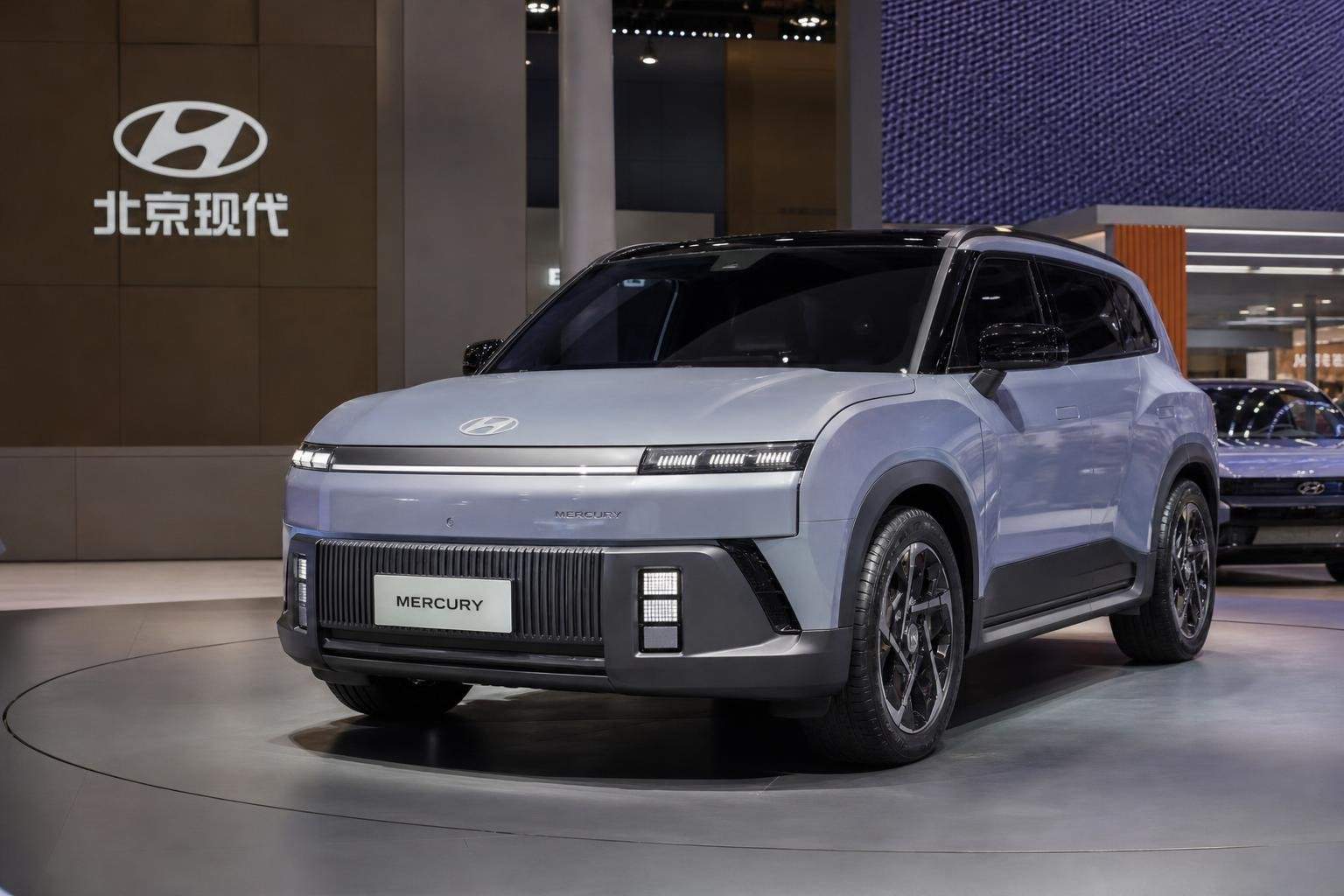

Hyundai is bringing back the Mercury name, but not as a revival of Ford’s discontinued American brand. Instead, the name will identify a small electric SUV concept developed specifically for China, where Hyundai is pursuing a separate strategy for a rapidly changing new-energy vehicle market.
Unveiled at Auto Guangzhou 2026, the Hyundai Mercury is the third vehicle in the company’s China-focused Ioniq Planet lineup. Hyundai says the name comes from the planet closest to the Sun, continuing the celestial naming theme used for its Chinese electric vehicles. A production version is expected to launch in China next year.
The concept’s most important feature may not be its sharp exterior design. Hyundai is also working with CATL on a version of the Mercury that could use a battery-swapping system, allowing drivers to replace a depleted battery rather than wait for it to recharge.
A new Mercury with no connection to Ford
Ford discontinued the Mercury brand in 2011 after more than seven decades in the market. Hyundai’s use of the name is unrelated to that former American marque. In this case, Mercury is part of Hyundai’s effort to establish a distinct identity for vehicles designed around Chinese market preferences.
That separation is visible in the concept’s styling. Although it remains recognizably related to Hyundai’s broader design language, the Mercury does not look like a conventional Ioniq model sold globally. The approach reflects a wider industry trend in China, where international automakers are developing market-specific brands, products and technology strategies rather than simply exporting vehicles created for North America or Europe.
Hyundai has not yet released the production model’s powertrain specifications, battery capacity, driving range or performance figures. Those omissions matter because the Mercury is still a concept, and the final vehicle could differ substantially from the show car. For now, the company is presenting the SUV’s design direction and its potential battery-swapping capability rather than a complete technical specification sheet.
Sharp styling shaped by Chinese regulations
The Mercury Concept is a subcompact SUV finished in a bright Citrine Neon color. Its front end is dominated by a sharp, angular treatment that Hyundai describes as a “shark nose.” The design gives the vehicle a more aggressive appearance than the smooth, efficiency-focused styling used by many electric crossovers.
The show vehicle rides on 20-inch black wheels fitted with Michelin Pilot Sport tires and has substantial ground clearance for a small crossover. At the rear, a large two-piece diffuser and chunky roof spoiler reinforce the concept’s performance-oriented appearance. The spoiler also incorporates a two-piece vertical brake light arrangement.
One detail is more practical than theatrical: the Mercury uses conventional door handles instead of flush-mounted pop-out units. China’s evolving safety requirements have effectively pushed automakers away from hidden exterior handles. That change illustrates how regulations can influence even seemingly minor elements of vehicle design. The result may be less visually seamless than a fully flush door, but it can reduce mechanical complexity and avoid concerns about access during emergencies.
Why battery swapping matters
Battery swapping changes the basic refueling model of an electric vehicle. Instead of connecting the vehicle to a charger and waiting for energy to enter the battery, a driver pulls into a dedicated station where the depleted pack is removed and replaced with a charged unit. Hyundai says the planned Mercury variant would use technology developed with CATL, one of China’s major battery suppliers.
The principal advantage is time. CATL says a battery exchange through its Choco-Swap network takes around 100 seconds. That is close to the routine of filling a conventional gasoline vehicle and substantially faster than even high-power charging, although the exact time required by a production Mercury system has not been announced.
Swapping also addresses a limitation that charging alone cannot completely remove: the time required to replenish a large battery. A driver may not need to own or carry a larger battery if a smaller, standardized pack can be exchanged when necessary. Smaller batteries can reduce vehicle weight and material use, but that benefit depends on widespread station coverage and compatibility between vehicles.
That infrastructure requirement is the difficult part. Battery swapping only becomes convenient when stations are available along the routes drivers actually use. According to the supplied Motor1 reporting, CATL has built more than 2,500 Choco-Swap stations in China and plans to exceed 3,000 by the end of the year. The network is expected to reach 6,000 locations across 297 Chinese cities in 2027.
Those numbers suggest that Hyundai is not evaluating battery swapping in isolation. By partnering with CATL, the company could gain access to an expanding ecosystem rather than attempting to build a proprietary exchange network from scratch. Even so, the Mercury’s usefulness will depend on the final battery format, station compatibility, pricing and the geographic reach of the system.
Mercury is part of a broader China strategy
Hyundai’s plans extend beyond this small electric SUV. The company is preparing a range-extending version of the Ioniq V for China next year, followed by a production model based on the Earth concept in 2028. Two additional new-energy vehicles are scheduled for 2029.
In China, the new-energy vehicle category includes more than battery-electric cars. It also covers range-extended electric vehicles, fuel-cell electric vehicles and plug-in hybrids. Hyundai’s planned lineup therefore appears designed to cover several approaches to electrification rather than committing exclusively to one powertrain architecture.
That flexibility is technically significant. Battery-electric vehicles eliminate tailpipe emissions but depend heavily on charging access and battery cost. Range-extender vehicles can use an engine to generate electricity when the battery is depleted, while plug-in hybrids combine electric driving with conventional propulsion. Battery swapping offers another solution to the charging-time problem, but only where the vehicle and infrastructure are designed together.
The Hyundai Mercury concept is therefore more than a styling exercise. It previews a China-specific electric vehicle that could test whether a global automaker can combine localized design with a battery ecosystem built around rapid exchange. Its success will depend less on the dramatic “shark nose” than on details Hyundai has not yet revealed: the production battery, the ownership model, the swap network and the price.
Sources: Motor1
0 Comments