
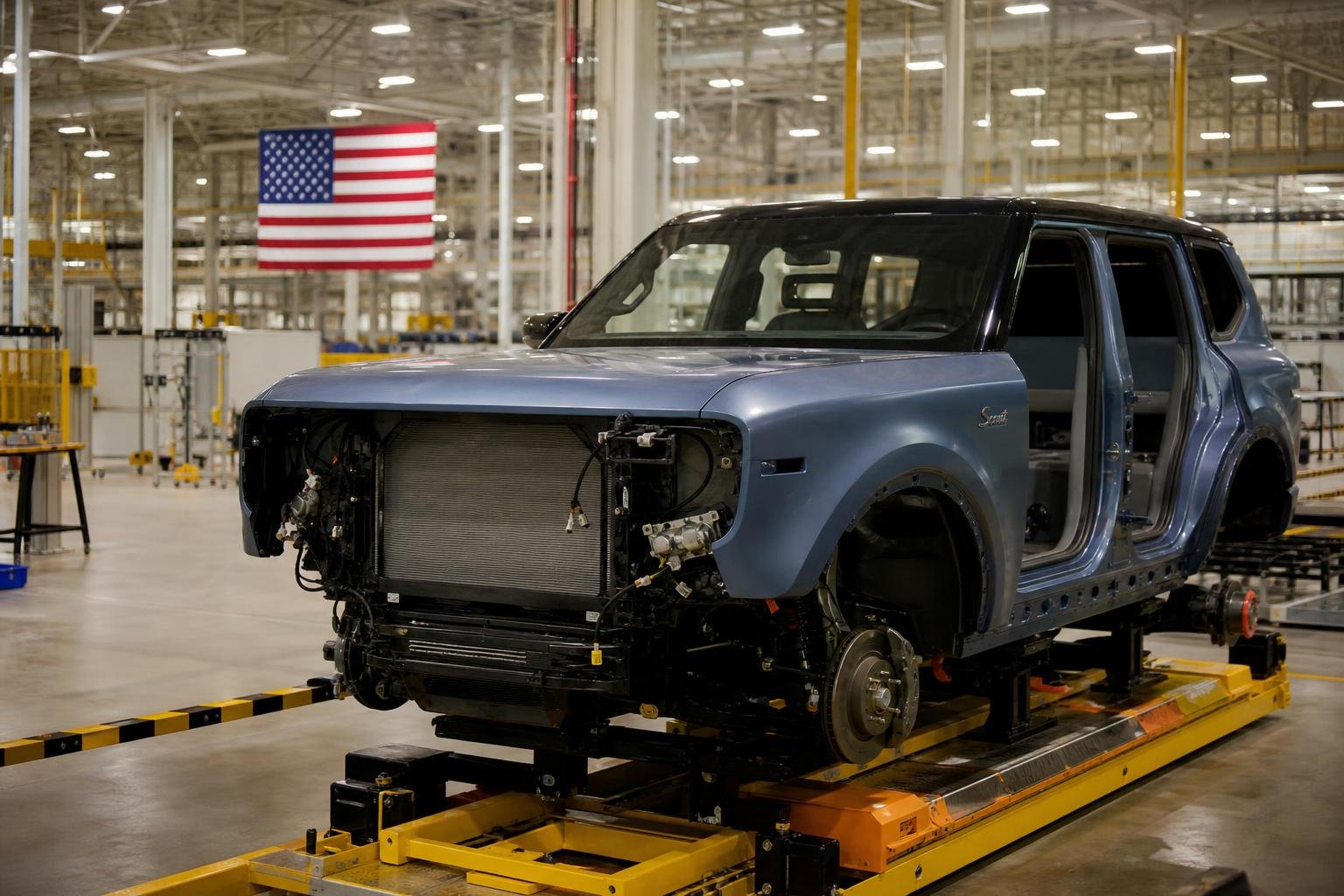

Scout Motors has spent the past few years asking people to believe in a comeback that existed mostly in presentations, prototypes, and reservation pages. That skepticism remains justified. But a visit to the company’s massive Blythewood, South Carolina, production site offers something more convincing than another polished concept reveal: Scout is now building the machinery, workforce, and manufacturing systems needed to produce real vehicles.
The factory is reportedly about 90 percent complete, with construction activity concentrated around the body and paint shops. Scout has also begun producing validation prototypes, placing its stated plan for initial production in 2027 and customer deliveries in 2028 within the realm of possibility. That is not the same as proving the program will succeed, but it is a meaningful change from simply announcing that it will.
A factory is harder to fake than a concept
The Blythewood campus represents an investment of roughly $2 billion from Volkswagen Group. Scout’s own production-center update describes a site spanning more than 1,100 acres, while the company’s factory tour materials describe a considerably larger overall campus. Whatever the final accounting, this is not a small pilot facility intended to assemble a few thousand niche vehicles.
At full capacity, Scout says the plant will be capable of producing up to 200,000 vehicles annually, or approximately 40 vehicles per hour. The body shop alone covers 1.3 million square feet and uses 753 robots. The paint shop is designed to operate with a high degree of automation, while artificial-intelligence systems will help inspect quality and dimensional tolerances.
Those figures are manufacturer projections, not evidence that Scout has achieved production volume. Still, the distinction matters. A startup can make an attractive prototype with outsourced engineering and contract manufacturing. Designing a body shop, installing tooling, qualifying suppliers, hiring thousands of workers, and developing repeatable quality systems is a much less forgiving exercise.
Volkswagen’s involvement is both an advantage and a complication
Scout CEO Scott Keogh has been direct about the benefit of Volkswagen Group’s manufacturing experience. The group operates roughly 150 plants worldwide, giving Scout access to production knowledge that companies such as Rivian and Tesla had to develop while simultaneously launching their own vehicles.
“You could say, ‘Yeah, just hire some dudes and go build a factory,’” Keogh told Motor1. “I think you’ll find out that hiring some dudes and building a factory is not so easy.”
He is right, although Volkswagen’s experience does not make Scout immune to the problems facing the broader group. Volkswagen is managing financial pressure, market uncertainty, and tariff exposure while funding an entirely new American brand and manufacturing operation. The backing makes Scout more credible than a typical startup, but it also subjects the project to corporate scrutiny that a smaller independent company might avoid.
Scout is also drawing on Volkswagen hardware. Keogh said the gasoline engine used as the range extender in the Harvester powertrain will be a modified Volkswagen Group four-cylinder. That approach should reduce the need to develop and validate an engine from scratch, but integrating that engine with the vehicle’s software, cooling, fuel, and emissions systems remains a substantial engineering task.
The range extender creates the most interesting risk
Scout’s Traveler SUV and Terra pickup are planned as body-on-frame vehicles with fully electric and extended-range electric powertrains. The EV versions are projected to offer up to 350 miles of range, while Scout says the Harvester models could target up to 500 miles using a gasoline generator. Those figures are internal targets, not EPA ratings.
The commercial logic behind the range extender is obvious. According to the company, roughly 87 percent of initial reservations favor the Harvester option. Buyers interested in large off-road vehicles may want electric driving around town without depending entirely on charging infrastructure during long trips, towing, or remote adventures.
The engineering logic is less tidy. MotorTrend reported allegations that the range-extended versions have created technical complications, including the packaging of a four-cylinder engine, exhaust, cooling hardware, and fuel tank in the rear of vehicles originally conceived around electric powertrains. Scout has denied that its launch plan has been delayed and says validation vehicles will begin in 2026, but it has not publicly addressed every technical allegation.
There may also be practical trade-offs. MotorTrend reported that the Harvester versions could be limited to 5,000 pounds of towing capacity, compared with projected ratings of up to 10,000 pounds for the Terra EV and 7,500 pounds for the Traveler EV. If accurate, that would make the range extender more useful for eliminating range anxiety than for maximizing towing capability. For a truck and SUV marketed around adventure, that distinction will matter.
Scout’s design is doing much of the brand work
The Traveler and Terra have an advantage that cannot be measured on a production line: They look like Scouts. Their upright proportions, exposed utility, chunky tires, available front and rear lockers, and references to the International Harvester Scout give the brand an identity that many new electric vehicles lack.
That identity extends inside. Scout has shown physical switches and knobs for functions such as climate control and seat heating, along with a modern digital interface developed through the Volkswagen-Rivian partnership. A front bench seat is also under consideration, an unusual feature in a market increasingly dominated by wide center consoles and screen-based controls.
WardsAuto has reported that Scout is using digital-twin development methods, allowing engineers to simulate vehicle dynamics, braking, aerodynamics, and other systems before physical testing. That can shorten development cycles, but simulations do not eliminate the need for extensive real-world validation—especially for vehicles expected to tow, crawl over rough terrain, and operate in extreme temperatures.
The comeback now has consequences
Scout currently employs about 900 people and expects its South Carolina and Charlotte operations eventually to support more than 4,000 workers, including roughly 2,000 manufacturing employees. Building that workforce may be as difficult as installing the robots. Modern vehicle plants require specialized skills in automation, electrical systems, quality control, software, and process engineering, and Keogh acknowledged the broader skills shortage in the United States.
The company is also entering a more crowded market than the one it targeted when the vehicles were first revealed. Rivian already occupies much of the premium electric adventure space, while Ram and Ford are exploring extended-range electric pickups. Every delay gives those competitors more time to refine their products and capture buyers who may have placed a refundable reservation with Scout.
That is why the Blythewood factory matters, but also why it cannot be mistaken for a finished victory. Scout has demonstrated construction progress, produced validation bodies, and assembled a plausible industrial foundation. It still needs to prove that its unusual range-extender packaging works, that its vehicles meet their capability targets, and that the plant can build them consistently at a competitive cost.
For now, Scout has crossed an important psychological line. The comeback is no longer just a design exercise or a nostalgic branding strategy. There are buildings, robots, employees, supplier plans, and prototype bodies in South Carolina. The company still has plenty to prove, but dismissing it as another startup that will never reach production is becoming increasingly difficult.
Sources: Motor1; Scout Motors; MotorTrend; WardsAuto; Kelley Blue Book.
0 Comments