
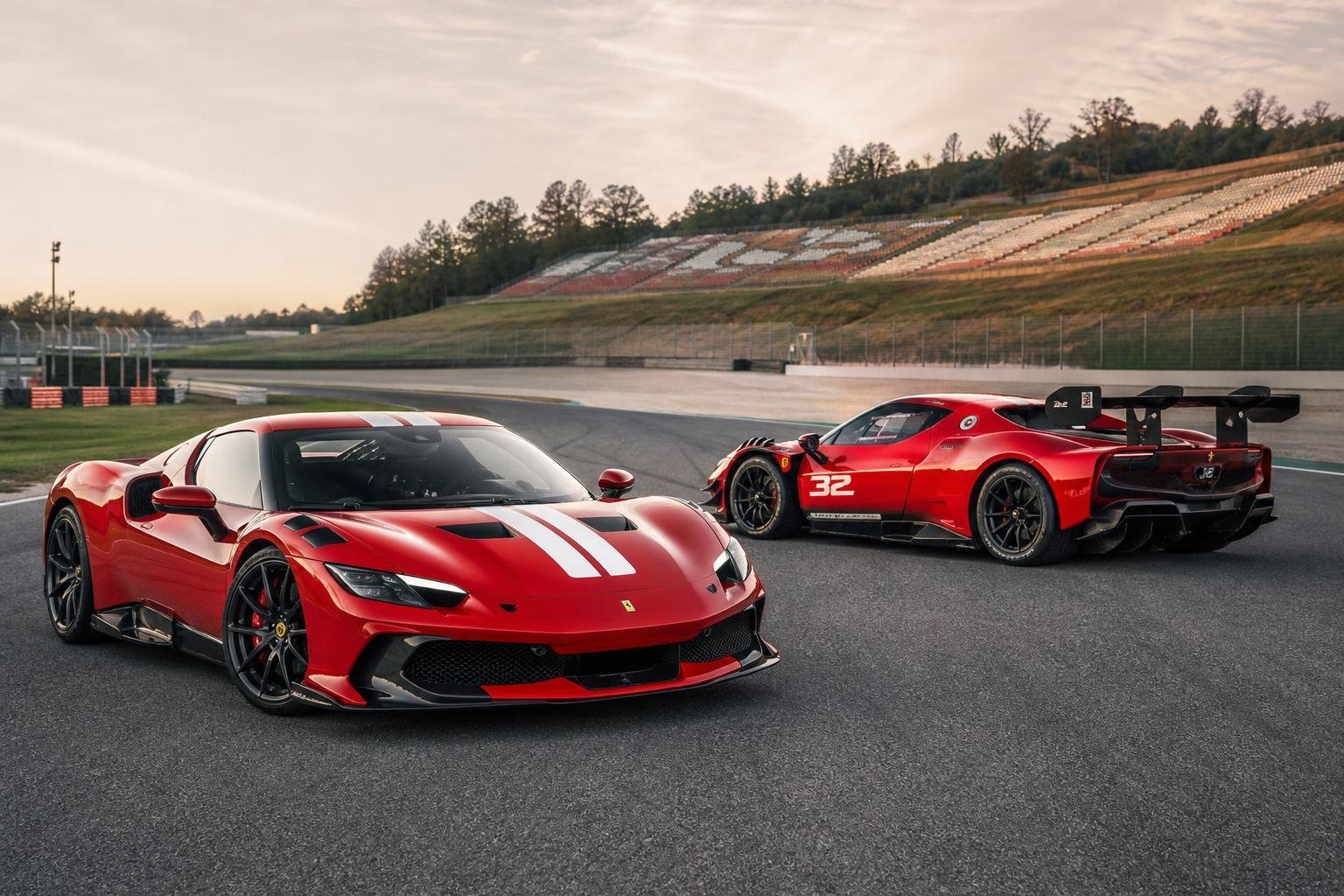

Ferrari has introduced two closely related versions of its 296 platform: the road-legal 296 Challenge Stradale and the track-only 296 Challenge EVO. Revealed at the 2026 Ferrari Finali Mondiali at Circuit de Barcelona-Catalunya, the pair share a non-hybrid, twin-turbocharged V6 architecture but are designed for distinctly different roles.
The Stradale is intended to combine road usability with serious circuit capability, while the EVO will become Ferrari Challenge’s competition car for the 2027 season. Their shared development represents a closer connection between Ferrari’s road cars and its customer-racing program, with both projects emphasizing reduced weight, aerodynamic efficiency and repeatable performance rather than hybrid assistance alone.
A non-hybrid alternative to the 296 GTB
The 296 Challenge Stradale uses Ferrari’s 2,992 cc, 120-degree twin-turbocharged V6 without the electric propulsion fitted to the 296 GTB. The engine produces 670 cv at 8,000 rpm and 545.8 lb-ft of torque at 6,250 rpm. Power is sent to the rear wheels through an eight-speed dual-clutch transmission using racing-derived shift strategies.
Ferrari quotes a 0–62.14 miles/h time of 2.8 seconds, while 0–124.27 miles/h takes 7.9 seconds. Top speed exceeds 186.41 miles/h. The figures put the Stradale firmly in Ferrari’s extreme-performance category, but its most important advantage on a circuit may be its mass: Ferrari claims a 2,932.1 pounds dry weight, 308.6 pounds below the 296 GTB.
Removing the hybrid system changes more than the specification sheet. A lighter car can place less demand on its tires, brakes and suspension, while the Stradale’s non-hybrid configuration gives Ferrari a way to focus the car’s character around the combustion engine, transmission and chassis rather than maximum combined system output.
Aerodynamic performance is central to the Stradale
The Stradale’s bodywork is substantially more circuit-focused than that of the standard 296 GTB. Ferrari lists a fixed rear wing, a redesigned underbody, a front splitter and vortex generators among the main aerodynamic changes. Together, they produce a claimed 1,360.3 pounds of downforce at 155.34 miles/h—72 percent more than the 296 GTB at the same speed.
The rear wing alone accounts for 595.2 pounds of that figure. Such downforce can increase cornering stability and braking confidence, although it also makes the car more dependent on speed and on a carefully controlled aerodynamic balance. The result is a machine whose greatest advantages will emerge on a circuit rather than on ordinary public roads.
Ferrari also gives the Stradale dedicated suspension geometry, semi-active dampers and ABS Evo. Tire choices include specially developed Pirelli P Zero R and P Zero Trofeo RS compounds. The available equipment reflects the car’s dual purpose: it remains road-legal, but its chassis and tire package are aimed at drivers who will regularly use it on track.
Ferrari quotes a 1:18.500 lap at Fiorano. The cockpit is more stripped back than that of the regular 296 GTB, with exposed structural surfaces and a more competition-oriented presentation. A removable, track-only exhaust system is also offered.
The 296 Challenge EVO prepares for longer races
The 296 Challenge EVO is the dedicated racing counterpart. It uses the same basic 2,992 cc non-hybrid V6 architecture but produces 700 hp at 7,500 rpm and is paired with a seven-speed F1 transmission. Ferrari has not provided acceleration or top-speed figures for the competition car.
Compared with the existing 296 Challenge, the EVO increases maximum downforce by 12 percent. Ferrari also describes a Low Drag configuration that reduces minimum drag by 4 percent, giving teams a way to balance cornering performance against straight-line speed according to circuit requirements.
The car’s revisions are not limited to aerodynamic output. Ferrari has recalibrated the traction-control system, electronic differential strategies and brake pedal. Those changes target greater consistency during extended track sessions and reduced tire degradation.
Ferrari reports that the EVO is 0.8 seconds quicker than the outgoing 296 Challenge at Mugello. That improvement should be viewed in the context of customer racing, where predictable handling and tire life can be as valuable as a single qualifying lap.
Ferrari Challenge gains an endurance element
The EVO’s 2027 arrival coincides with a change to the Ferrari Challenge format. Three rounds will feature 40-minute endurance races, with the new format beginning at Mugello during the second event of the season.
Longer races place different demands on a one-make car. Tire management and consistent performance over a greater distance become more important, making the EVO’s revised controls and reduced degradation relevant to Ferrari Challenge’s expanded race format rather than upgrades made solely for headline lap times.
Two interpretations of the same platform
The 296 Challenge Stradale and 296 Challenge EVO show how Ferrari is separating road-car exclusivity from customer-racing purpose while keeping the engineering relationship visible. Both cars use a non-hybrid V6 and claim a 2,932.1 pounds dry weight, but the Stradale combines its track hardware with road legality, whereas the EVO is optimized for regulated competition.
That distinction matters for potential buyers. The Stradale offers the appeal of a Ferrari that can be driven to a circuit and then used seriously once it arrives, although pricing and customer availability have not been announced. The EVO, by contrast, is a purpose-built race car whose value will depend on access to the Ferrari Challenge program, team support and the demands of the 2027 calendar.
Ferrari’s latest 296 derivatives also underline a broader engineering point: outright power is only one part of performance. Weight reduction, aerodynamic balance, electronic calibration and tire management can produce a faster and more repeatable car without relying on a larger engine or additional electric output. The Stradale and EVO apply that philosophy in different environments—one on the road and track, the other exclusively in competition.
Sources: Sports Car Digest.
0 Comments