
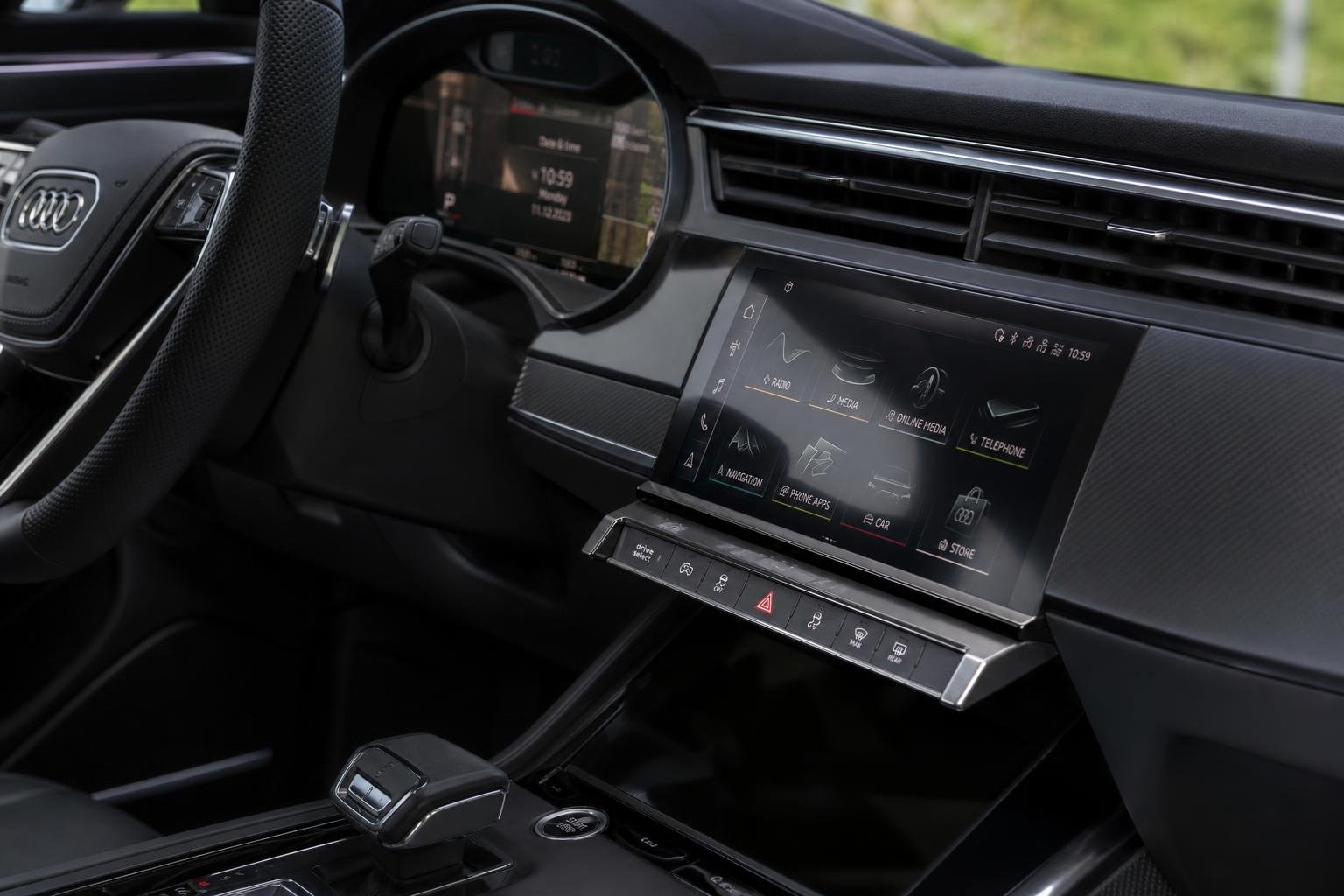

Audi has filed a patent application for an interior switch panel that could combine the clean appearance of a large touchscreen with the usability of physical controls. The proposed motorized bar would remain hidden behind the lower edge of the display until the driver requests it.
The concept has not been confirmed for production, and the patent does not identify a launch model or timetable. Even so, it offers a revealing look at how Audi is trying to resolve one of the central tensions in modern cabin design: customers increasingly expect expansive digital interfaces, while many drivers still prefer buttons and knobs for frequently used functions.
A physical control bar that folds out on demand
According to the patent application, the touchscreen itself remains fixed. Instead, a narrow panel containing physical switches is stored behind its lower edge. When activated, the panel pivots outward and becomes accessible beneath the display. When it is no longer needed, the mechanism folds it back into its concealed position.
The controls could be extended in several ways. The patent describes activation through an on-screen control, voice commands, hand gestures or automatic deployment when the vehicle starts. The panel could also appear in response to particular functions, such as launching a video player.
That approach would allow Audi to keep the dashboard visually minimal during normal driving while still providing tactile controls when they are useful. A driver could potentially operate a function by feel without looking away from the road, something that is difficult when every command is placed inside a flat touchscreen menu.
The digital twin keeps the controls available
When the physical bar is stowed, its functions would not disappear. Audi’s filing describes an on-screen “digital twin” showing virtual versions of the same controls in the same order. The physical and digital interfaces would therefore operate as two forms of the same control system rather than as separate layouts.
In one example, the display could show a row of virtual buttons along its lower edge. Activating the deployment command would remove those virtual controls and bring the physical bar forward. That could give another application, such as video playback, more usable screen area while preserving access to conventional switches.
The patent also suggests that the arrangement could reduce the need for a permanently visible control strip. Audi could use a slightly smaller display or devote more of the panel to navigation, media and other content, while retaining physical access to selected functions when required. The filing does not specify exactly which controls would be included.
Audi is reconsidering the screen-heavy cabin
The proposal arrives as Audi appears to be reassessing the assumption that more screens automatically produce a better interior. The company’s recent cabins have embraced extensive touch interfaces, but that strategy has also made basic operations such as climate adjustment and vent control dependent on menus.
Some newer Audi interiors continue that approach. The Q7, SQ7 and Q9 examples described in the source reporting use large displays for major vehicle functions, including controls that were traditionally handled by dedicated switches or dials. That layout can create a visually clean dashboard, but it may require more attention from the driver and provides less tactile feedback.
Audi design chief Massimo Frascella has criticized oversized screens used primarily as a display of technology, while the company has indicated that future interiors may return to more conventional ergonomics. The retractable panel would fit that direction without abandoning the digital architecture Audi has already invested in.
Why physical controls still matter
Physical controls are not automatically better for every function. A touchscreen can be updated, reconfigured and shared across multiple applications, making it efficient for navigation, media and vehicle settings. It also allows manufacturers to change the interface through software rather than redesigning a large collection of switches.
The weakness is consistency. A physical button occupies the same place every time and can be identified by shape and position. Touch controls can move between menus, disappear behind graphics or require the driver to look down to confirm that a command has been selected. This is particularly relevant for climate settings, audio volume and other tasks performed while driving.
A retractable panel attempts to divide those responsibilities. The screen would handle flexible, information-rich functions, while the physical bar would provide tactile access to a smaller group of frequently used commands. The digital twin would preserve access when the bar is hidden, although the usefulness of that arrangement would depend heavily on the final control layout and response speed.
The engineering challenge is more than packaging
Hiding the switches behind the screen would create a more complicated system than either a fixed button panel or a conventional touchscreen. The motor, hinges, wiring and position sensors would all have to operate reliably in a vehicle exposed to vibration, dust, temperature changes and repeated use.
The mechanism would also need to deploy without interfering with the driver’s hand, obstructing the screen or creating unwanted noise. If the panel failed while retracted, the digital controls would need to remain available. If it stopped while partially extended, Audi would need a safe and practical method for restoring or bypassing it.
Those considerations help explain why a patent should not be treated as a production announcement. Automakers routinely patent ideas that never reach showrooms, either because the cost and durability requirements are too high or because the feature does not fit a vehicle program. Audi has not announced that this system will be used in a specific model.
A possible compromise between two interior philosophies
Audi’s filing is significant less because it guarantees a new feature than because it reflects the industry’s broader search for a middle ground. Screen-only interiors offer flexibility and a modern visual identity, but they can compromise straightforward operation. Traditional controls improve tactile usability but require more space and limit the ability to reorganize the interface.
The retractable switch bar tries to deliver both benefits, though at the cost of added mechanical complexity. Its success would depend on whether the mechanism feels natural enough to use and robust enough to survive the life of the vehicle. For now, Audi’s patent shows that physical controls may be returning to the conversation—but perhaps not in the permanently exposed form drivers remember.
Sources: Motor1.com; TMCARS News.


0 Comments