
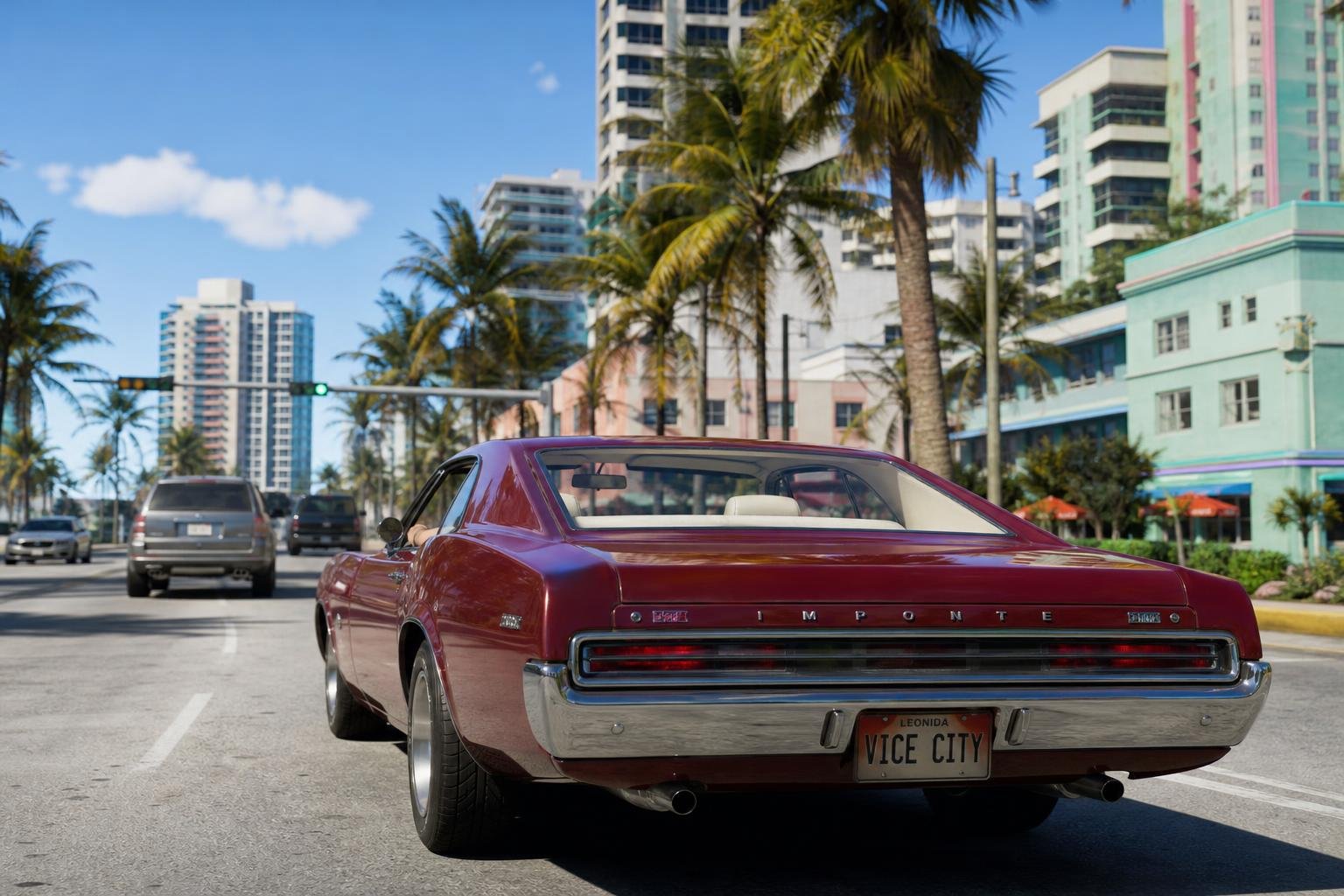

Grand Theft Auto 6 treats its vehicles as part of Vice City’s culture, not merely disposable tools for getting from one mission to the next. Early hands-on impressions point to a game where driving, customizing, fueling, charging and even stealing a car are more involved than they were in GTA 5.
That shift matters because cars have always been central to the series’ identity. They provide transportation, escape routes and comic chaos, but they also reflect the world around the player. In GTA 6, Rockstar appears to be pushing that idea further by making vehicle use feel more like a system than a collection of driving sequences.
A driving model between arcade fun and realism
According to early gameplay impressions from Motor1, the driving model sits between the highly forgiving feel of GTA 5 and the heavier, more demanding physics that made GTA 4 memorable to many players.
The most noticeable change is the way vehicles communicate their weight. A work truck does not respond like a sports car, and that difference affects more than acceleration. Braking distances require greater attention, particularly when a player is moving quickly through traffic or trying to escape a police pursuit. The result is still designed for an action game, but it asks the player to account for momentum rather than treating every vehicle as a similarly responsive machine.
Damage modeling also appears to have become more consequential visually. More areas of the bodywork deform after a collision, making crashes easier to read and giving individual impacts a stronger physical presence. That does not necessarily turn GTA 6 into a driving simulator, but it does reinforce the impression that the vehicle beneath the player has mass and structure.
Fuel and charging add a small ownership burden
One of the clearest changes is the addition of fuel management. A gauge appears in the vehicle display, and when the tank falls below roughly one-quarter full, a warning directs the player toward a nearby gas station. Pulling up to a pump triggers a short refueling animation before the vehicle is ready to continue.
Electric vehicles follow the same basic logic through charging stations placed around the map. The process is intentionally brief, so players are not forced to wait through a realistic charging session. That compromise is sensible for a game built around constant movement, but the mechanic still gives different powertrains a visible role in the world.
Fuel requirements could also change how players think about a car during missions. In earlier games, the best vehicle was often simply the fastest or most durable one available. In GTA 6, a low fuel level may make a familiar car less useful than a nearby alternative, especially when the player is far from a station or trying to avoid attention. It is a small layer of planning, but one that makes the map feel more connected to the vehicles moving through it.
Customization goes beyond cosmetic upgrades
Vehicle modification returns with a broader range of adjustments. Players can make engine and body changes, while some vehicles reportedly offer more specific alterations involving the roof and chassis. Pickup trucks, in particular, appear to receive additional structural customization options.
Those details give the car scene more personality. A modified vehicle is no longer only a faster version of a stock model; it can also become part of a player’s preferred way of moving through Vice City. The system’s importance will depend on how much each upgrade changes performance, but the expanded menu suggests that Rockstar wants customization to feel integrated into gameplay rather than limited to an appearance shop.
The vehicle controls are more interactive, too. From inside the car, players can operate the windows, headlights, hazard lights and turn signals. They can also leave the vehicle and open the hood or trunk. These features may sound minor, yet they help establish the car as an object with individual functions instead of a static cockpit wrapped around a driving animation.
The trunk becomes part of the player’s strategy
The trunk has a practical role beyond visual detail. It can store weapons and clothing, allowing players to carry additional equipment and change outfits during an escape. That creates a direct connection between vehicle use and evading the police: the right car can serve as transportation, storage and part of a disguise strategy.
This is a distinctly GTA approach to automotive realism. Rockstar is not adding detail simply to imitate real-world ownership. It is turning familiar vehicle features into tools for improvisation. A trunk matters because it supports the player’s choices, not because the game expects players to inspect it after every drive.
Stealing a car is no longer equally easy
Vehicle theft also appears to be more varied. A smartphone application can identify cars on the street and provide information about their anti-theft systems. Older, simpler vehicles are comparatively easy to take, while newer cars may require additional steps, such as cloning a key or unlocking relevant skills.
That change gives the traffic around Vice City a more believable hierarchy. In previous games, most parked cars were effectively available if the player was willing to break a window or pull a driver from the seat. In GTA 6, technology becomes another distinction between an aging runabout and a modern luxury vehicle.
It also introduces a useful complication during missions. A high-end car may be faster or better protected, but it might take longer to access. When police are already nearby, the technically superior vehicle is not automatically the smartest choice. Sometimes the unremarkable older car is the one that keeps the situation moving.
Cars help make Vice City feel lived in
The larger significance of these features is cultural rather than purely mechanical. Cars are one of the ways players read an open world. A vehicle’s design, condition, technology and availability can suggest who lives in a neighborhood, what kind of work they do and how much money they have. A game that gives those vehicles different behaviors makes the city feel less like a backdrop populated by interchangeable props.
That fits GTA 6’s broader emphasis on a dense, reactive world. As TechRadar’s review observes, the game’s open-world appeal comes from the combination of major missions and smaller unscripted moments. Cars are central to that structure because they carry players between those moments and often become the setting for them.
Early impressions cannot answer how balanced the fuel system, theft mechanics or customization options will feel across the full game. They do show a consistent design direction, however: Rockstar is making vehicles more expressive, more differentiated and more useful to the player’s story. In Vice City, the car is no longer just the thing that gets you to the next scene. It is part of the scene.
Sources: Motor1; DriveScope on YouTube; TechRadar.

0 Comments