
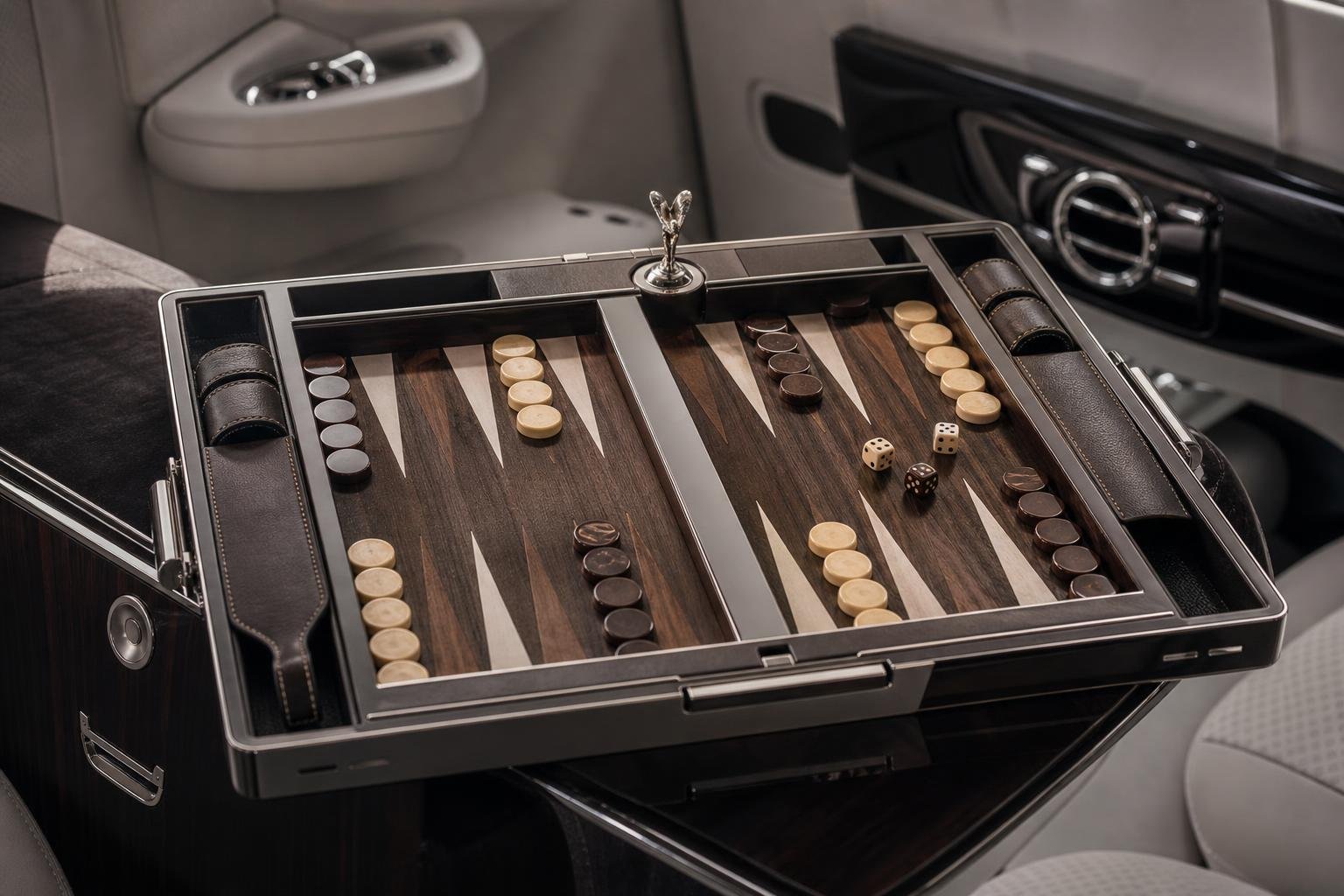

Rolls-Royce has extended its automotive design language beyond the garage with a bespoke Backgammon Set, turning a familiar board game into a carefully engineered luxury object. Developed at the marque’s Home at Goodwood, the set took more than a year to create and is available to order through Rolls-Royce showrooms and Private Office boutiques.
The project reflects a broader idea about modern luxury: exclusivity is not limited to the product that first established a brand’s reputation. For Rolls-Royce, the appeal is in carrying its materials, craftsmanship and visual identity into the spaces where clients actually spend time. In this case, that means a game intended for social gatherings rather than a vehicle cabin.
A car-inspired object with its own history
Rolls-Royce says the Backgammon Set draws inspiration from a 1938 Wraith that featured a backgammon board in its rear passenger compartment. That detail gives the new object more historical grounding than a simple branded accessory. Backgammon was already associated with travel, leisure and private spaces long before Rolls-Royce adapted it to a contemporary luxury setting.
The marque describes backgammon as a game with roughly 5,000 years of history. Its continued presence in a Rolls-Royce project creates a connection between an ancient pastime and the company’s modern approach to bespoke design. The set is not trying to make backgammon futuristic. Instead, it treats the game as a durable cultural object worthy of the same level of attention given to a vehicle interior.
Jabran Syed, an accessories designer at Rolls-Royce Motor Cars, said the game has long been part of many clients’ lives and had appeared inside a Rolls-Royce as far back as 1938. That observation helps explain the project’s purpose: the company is not presenting backgammon as a newly discovered luxury trend, but as an existing part of its clientele’s lifestyle.
The hinge does most of the talking
The set’s most distinctive mechanical feature is its central hinge. Rolls-Royce says the hinge is machined from a single billet of aluminum, then hand-polished and anodized. A self-centering Spirit of Ecstasy remains upright as the case opens, turning the company’s familiar mascot into a functional part of the object rather than a simple decorative emblem.
Opening the case also rotates a central spine in the opposite direction, revealing the playing surface and the stored game pieces. That movement is important because it gives the set a sense of occasion. A conventional board can simply be unfolded, but this design makes the act of opening it part of the experience. The mechanism communicates the same kind of engineered presentation Rolls-Royce uses in its vehicles, where doors, storage compartments and controls are expected to operate with deliberate smoothness.
There is also a cultural distinction here. A game board is usually judged by whether it is easy to use and durable enough for repeated play. Rolls-Royce adds another layer: the object must also perform as a display piece when the game is not in progress. The hinge, finish and storage arrangement are therefore doing two jobs at once—supporting practical use and reinforcing the set’s visual identity.
Wood, leather and metal replace ordinary game-night materials
The playing surface uses book-matched walnut cut at a 55-degree angle. Book-matching mirrors adjoining pieces of veneer so the grain forms a balanced visual pattern. Rolls-Royce combines Royal Walnut and Smoked Eucalyptus marquetry for the points, bringing the board closer to the decorative woodwork found in a bespoke cabin.
The interior is lined with Sunset and Sunrise natural-grain leather. Those colors are part of the palette Rolls-Royce uses for bespoke automotive details, but here the leather surrounds a game board instead of a seat, door panel or armrest. The result is an object that borrows the atmosphere of a Rolls-Royce interior without attempting to imitate an entire vehicle.
The playing pieces are machined from a bauxite-infused composite and finished in Deep Night Sky black and Antarctica white rather than painted or dyed. The set also includes a hexagonal anodized-aluminum die and dice shakers with leather-trimmed bases.
Its tournament-size format matters as well. The set is not merely a miniature novelty intended to sit on a shelf. It is designed around a full-size playing experience, while still incorporating the storage and folding architecture needed to make the object practical to transport and display.
Luxury as a shared experience
Rolls-Royce’s Bespoke Collective has previously applied its automotive design and craftsmanship to non-automotive objects, including furniture and musical instruments. The Backgammon Set follows that pattern, but it has a particularly social character. A car is often experienced privately or with a small group of passengers; a board game requires people to gather around it.
That makes the set a useful expression of luxury as an activity rather than a possession. Its value is not only in the walnut, leather or machined aluminum, but in the ritual of opening the case, arranging the pieces and spending time with another person. For a brand associated with highly individualized vehicles, the game also offers a rare object designed explicitly for shared use.
Rolls-Royce has not announced a price. Clients interested in commissioning one must contact a Rolls-Royce showroom or Private Office boutique, and the final cost will reflect the bespoke nature of the materials and construction. Without a published figure, it is impossible to compare the set with high-end game boards on price alone.
What is clear is the role the Backgammon Set plays in Rolls-Royce’s design culture. It takes a recognizable piece of automotive history, combines it with the brand’s current craftsmanship and gives it a purpose beyond transportation. The result is extravagant, but not random: it is a compact statement that, for Rolls-Royce, the luxury experience can continue long after the car is parked.
Sources: Motor1

0 Comments