
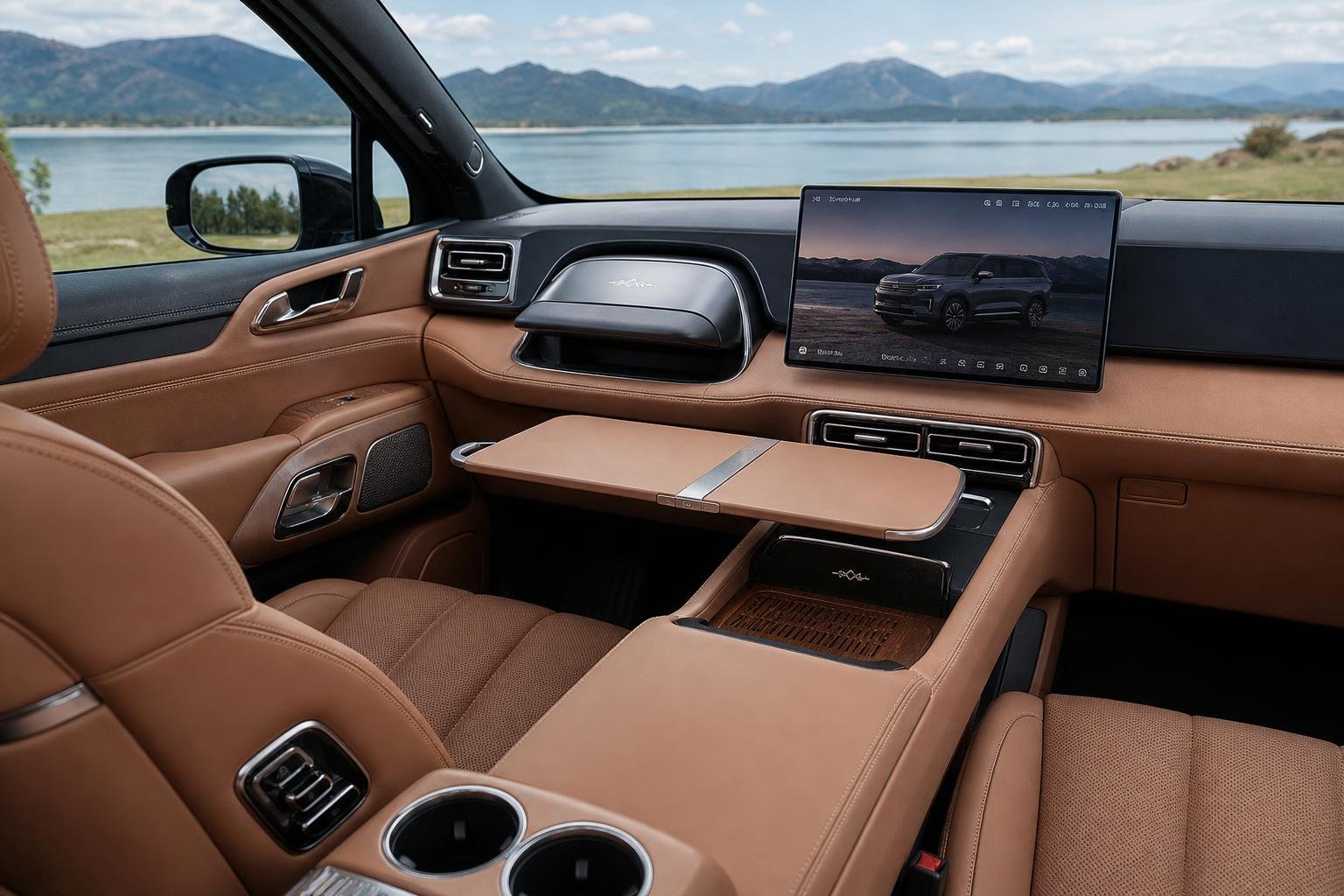

BYD’s Fangchengbao Tai 9 is a large plug-in hybrid SUV with an unusual party trick: its steering wheel can fold into the dashboard when the vehicle is parked. The feature is not intended to let the SUV drive itself. Instead, it creates more usable space for passengers who want to relax, eat or work inside the vehicle.
The Tai 9 is sold in China under Fangchengbao, one of BYD’s premium-oriented brands. With six seats, a plug-in hybrid powertrain and a cabin designed to function as a comfortable “third space,” it reflects a growing trend in the Chinese market toward vehicles that are useful even when they are not moving.
How the Tai 9’s folding steering wheel works
The mechanism is possible because the Tai 9 uses steer-by-wire rather than a conventional mechanical steering column. In a traditional vehicle, the steering wheel is physically connected to the front wheels through a column, so moving it out of the way would be difficult. With steer-by-wire, electronic signals communicate the driver’s steering input to the steering system.
On the top-spec Foldable Smart Cabin version, the D-shaped steering wheel rotates through approximately 180 degrees and folds into a compartment in the dashboard. The process takes around 10 seconds. Once the wheel is stored, a panel closes over it and a tray table can be deployed in the newly cleared area.
The wheel only retracts when the SUV is stationary. That restriction is important: the feature is a convenience function for parked use, not a claim that the Tai 9 can operate without a driver. The steering wheel remains in its normal position whenever the vehicle is being driven.
According to reporting from Electrek, the folding assembly is designed for up to 80,000 operating cycles. That figure is a manufacturer-related claim rather than an independently verified long-term durability result, but it indicates that BYD views the system as a production feature rather than a short-lived show-car gimmick.
A lounge feature rather than an autonomous-driving system
Images of the Tai 9 show the driver’s seat reclined while the steering wheel is stowed, leaving room for a small table. Electrek reports that the seat can recline to 165 degrees and that Fangchengbao describes roughly 80 percent of the driver’s area as usable after the wheel is hidden.
That approach fits a distinct direction in China’s premium vehicle market. Large SUVs are increasingly being marketed as private spaces for resting, watching entertainment or waiting while the vehicle charges. Features such as reclining seats, folding tables, large screens, premium upholstery and built-in refrigerators can be as important to buyers as driving performance.
The Tai 9’s concept is similar to the cabin-focused layouts seen in vehicles such as the Zeekr Mix and other Chinese electric and hybrid models. In this context, the folding wheel has a practical purpose: it removes an obstacle from the driver’s workspace. It does not currently transform the SUV into a self-driving lounge.
Steer-by-wire is the technology underneath
The more consequential part of the system may be the steering architecture itself. Steer-by-wire allows manufacturers greater freedom in positioning the steering wheel and designing the dashboard, but it also requires extensive electronic redundancy and fail-safe measures because there is no traditional steering shaft providing a direct mechanical connection.
That makes the Tai 9 notable even if some buyers view the folding mechanism as a novelty. BYD is applying the technology to a production family SUV rather than limiting it to a concept vehicle. The company’s system also avoids the controversial yoke-style wheel used by some vehicles with advanced electronic steering. When deployed, the Tai 9 has a conventional full-rim wheel with physical controls.
The feature should not be confused with automated driving. The source reporting states that China’s rules do not currently permit commercially sold vehicles to offer unrestricted eyes-off, hands-off driving. The Tai 9 still requires a driver to control it on the road, regardless of whether the steering wheel can disappear while parked.
Six seats and 536 horsepower
The Tai 9 is among Fangchengbao’s largest SUVs, measuring approximately 207.48 inches long with a 123.23-inch wheelbase. Its six-seat, 2+2+2 layout provides individual second-row seating rather than a conventional three-person bench.
Power comes from a plug-in hybrid system combining a 1.5-liter turbocharged gasoline engine with electric motors on the front and rear axles. Reported combined output is 400 kilowatts, or about 536 horsepower, and the SUV is said to accelerate from 0 to 62.14 miles/h in 4.8 seconds.
A 66.48-kilowatt-hour Blade battery provides a reported 192.63 miles of WLTC electric range. The battery also supports BYD’s flash-charging technology, with the company claiming that it can charge from 10 to 97 percent in approximately nine minutes under suitable conditions. Actual charging time will depend on the charger, temperature and battery state.
Pricing and availability
Reported Chinese-market pricing starts at 279,900 yuan, with higher versions listed at 299,900 yuan and 329,900 yuan. That places the range at roughly $42,000 to $49,500 using the conversions cited in the source reporting. The folding steering wheel is reserved for the most expensive trim.
BYD has not announced an export program for the Tai 9. That means the vehicle’s most unusual feature is currently a China-market showcase for the company’s approach to premium hybrid SUVs, rather than a technology international buyers can expect to order soon.
Why the folding wheel matters
On its own, a steering wheel that folds away may seem like an expensive solution to a problem most drivers do not have. Its value depends on how often owners use their vehicles while parked and whether the extra cabin flexibility justifies the added complexity.
But the Tai 9 demonstrates how steer-by-wire could change interior design before fully autonomous driving becomes common. Removing the mechanical steering column gives designers more freedom to create adjustable, multifunctional cabins. For now, BYD is using that freedom to make a parked SUV feel more like a lounge. In the future, the same architecture could support more substantial changes to how drivers interact with their vehicles—provided safety systems and regulations develop alongside it.
0 Comments