
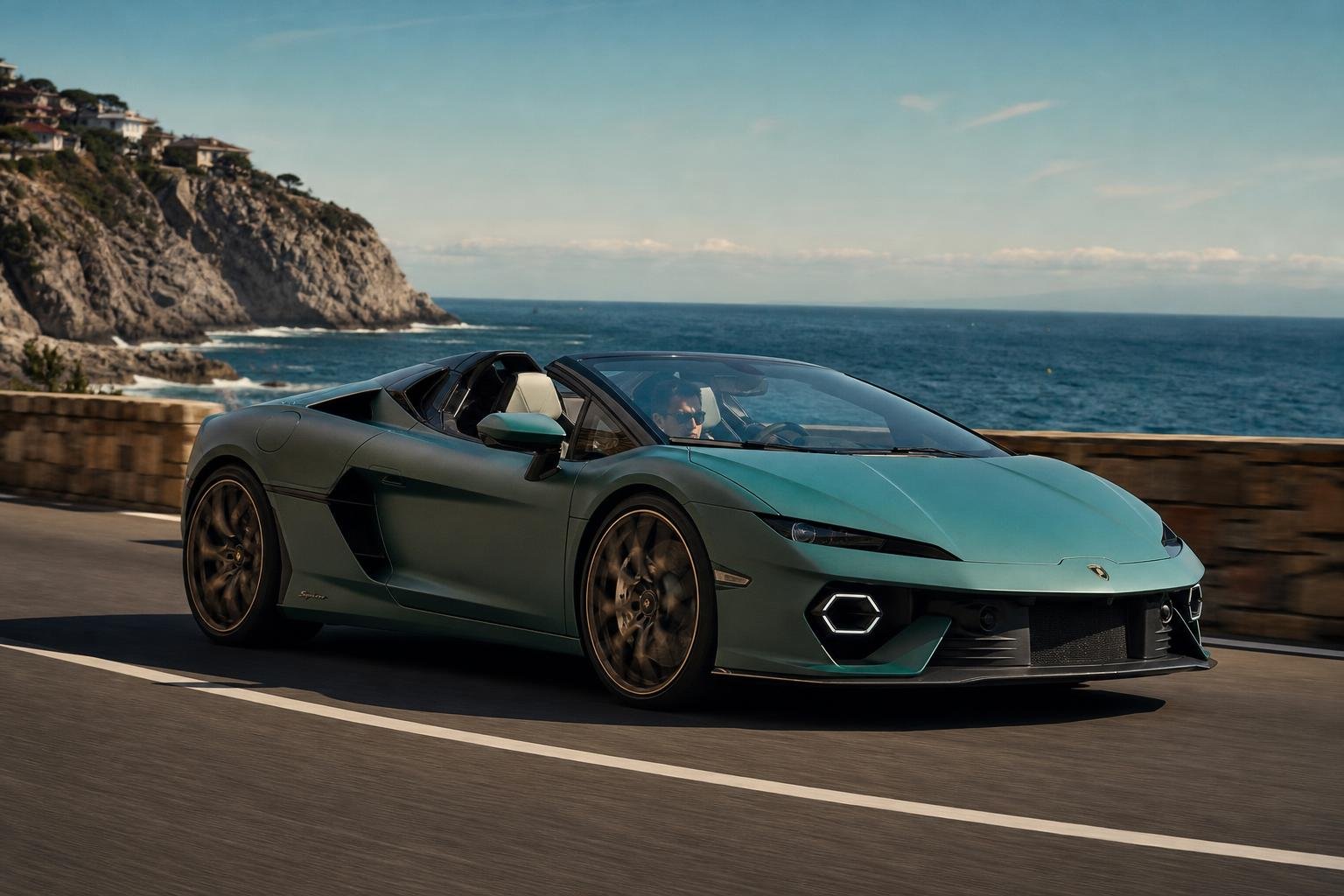

Lamborghini is bringing the Temerario Spyder into the virtual showroom with a new Apple Vision Pro experience that lets users examine the hybrid supercar in full-scale spatial detail. The interactive presentation focuses on the convertible’s most difficult-to-demonstrate features, including its unusual retractable hardtop, electrified powertrain and selectable driving modes.
The digital experience arrives ahead of customer deliveries. Lamborghini unveiled the Temerario Spyder in Los Angeles, with first deliveries expected in spring 2027, according to the company and Motor1.com. The automaker is using Apple’s spatial-computing platform to give prospective customers a closer look at the car before many of them have an opportunity to see one in person.
A virtual look inside the Temerario Spyder
The updated application builds on four core sections already created for the Temerario experience: the interior, powertrain, aerodynamic performance and the design process developed by Lamborghini Centro Stile. Users can inspect the vehicle using eye and hand controls, rotate around its components and view the car either at full scale or in a more immersive virtual environment.
Two modules are specific to the Spyder. The first animates the operation of the retractable hardtop, showing how the roof moves vertically and stores behind the passenger compartment without blocking the view of the engine. That arrangement is central to the car’s design because it allows Lamborghini to preserve the visible engine area while avoiding the visual bulk of a conventional folding-roof system.
The second module compares the Spyder’s four driving-mode configurations. Lamborghini says the virtual presentation illustrates changes in power delivery, dynamics and handling behavior as the driver moves between them. The feature does not simulate driving performance, but it provides a visual explanation of systems that are otherwise difficult to understand from a static vehicle.
The engineering behind the unusual roof
The Temerario Spyder is the first Lamborghini Spyder to use a retractable hardtop. According to Lamborghini, the fully electric system uses 10 electric actuators and a patented vertical-stowing mechanism that eliminates traditional electro-hydraulic circuitry. The roof can open or close in 17 seconds at speeds of up to 31 mph.
Packaging a rigid roof into a mid-engine supercar presents a more complicated challenge than simply removing the roof from a coupe. The mechanism must fit behind the occupants without obstructing the engine, while the added structure and moving components must not compromise the car’s balance. Lamborghini says storing the roof vertically lowers the center of gravity by 0.12 inches when open and leaves weight distribution unchanged.
The company also says the all-aluminum spaceframe delivers a 6 percent increase in static torsional rigidity, a 9 percent improvement in dynamic bending stiffness and a 6 percent increase in dynamic torsional rigidity compared with the Huracán Spyder. Those figures are manufacturer claims rather than independent test results, but they explain why the roof module is more than a styling exercise.
An electronically adjustable rear window gives the occupants additional control over airflow and engine sound. The Spyder also offers an integrated three-level neck warmer, making the open-top configuration more usable in cooler conditions. These details show that Lamborghini is treating the roof as part of the car’s overall driving experience rather than as a purely visual accessory.
A 920-CV hybrid powertrain
Underneath the bodywork, the Temerario Spyder uses Lamborghini’s High-Performance Electrified Vehicle architecture. Its 4.0-liter twin-turbocharged V8 works with three axial-flux electric motors: one mounted at the rear and two driving the front axle.
Lamborghini quotes a combined output of 920 CV, equivalent to 677 kilowatts or approximately 907 horsepower. The V8 itself produces 800 CV and can reach 10,000 rpm, with the engine speed limit extended to 10,250 rpm when Launch Control is activated. The manufacturer’s figures give the Spyder a claimed 0-to-100-km/h time of 2.8 seconds, a 0-to-200-km/h time of 7.3 seconds and a top speed of 213.13 miles/h.
The electric motors also allow the Temerario to operate in a quieter, lower-emission mode when conditions permit. Lamborghini says the car can operate purely on electric power at up to 190 CV in its Città setting. Across the available driving and hybrid strategies, the system combines Città, Strada, Sport, Corsa and Corsa ESC Off modes with Recharge, Hybrid and Performance settings. A three-level Drift Mode is also available for controlled oversteer.
That complexity helps explain why Lamborghini has included a mode-comparison tool in the Vision Pro application. A conventional walkaround can show the engine and cabin, but it cannot easily communicate how software, electric torque and chassis calibration alter the character of the same car.
The Spyder continues Lamborghini’s open-top tradition
The Temerario Spyder also extends a long-running Lamborghini tradition. The company traces its open-top lineage to the 1976 Silhouette, followed by the Jalpa and roadster interpretations of the Diablo and Murciélago. Lamborghini introduced its first series-production Spyder in 2005 with the Gallardo Spyder, which used a fully automatic fabric roof. The Huracán later continued the compact open-top supercar formula.
The Temerario introduces a different interpretation of that history. Its roof is rigid and electrically operated, integrated into a hybrid supercar that combines a high-revving flat-plane V8 with all-wheel-drive electric assistance. Lamborghini’s design team has also placed emphasis on the two streamlined hexagonal cowls behind the seats, which visually extend the cabin toward the tail while showcasing the engine-cover surfaces.
The result is a car in which the mechanism itself becomes part of the product story. Apple Vision Pro gives Lamborghini a way to make that story visible, showing the roof’s movement, the engine layout and the relationship between the car’s different driving systems before a customer ever drives it.
Why the virtual experience matters
For a mainstream vehicle, a digital presentation might be a useful supplement to a dealership visit. For a low-volume supercar with a complex hybrid powertrain and a highly personalized buying process, it can serve a more important role. Customers are often making decisions about expensive engineering features, materials and specifications long before a finished car is available to inspect.
The experience is also consistent with Lamborghini’s wider move toward electrification. The Temerario is the second model in the company’s High-Performance Electrified Vehicle range, after the Revuelto, while Lamborghini has also developed related digital experiences for the Revuelto and Urus SE. Rather than presenting electrification only through efficiency figures, the automaker is using spatial visualization to explain how electric motors contribute to performance and vehicle behavior.
The Apple Vision Pro application cannot replace a test drive or communicate the sound, heat and vibration of a 10,000-rpm V8. It can, however, make hidden engineering easier to understand. In the case of the Temerario Spyder, that may be particularly valuable: the car’s defining feature is not simply that its roof opens, but how that roof opens without abandoning the mechanical drama Lamborghini wants its customers to see.
Sources: Motor1.com; Automobili Lamborghini: Apple Vision Pro experience; Lamborghini Temerario Spyder technical details; Lamborghini Spyder heritage; Lamborghini Temerario technical overview.
0 Comments