
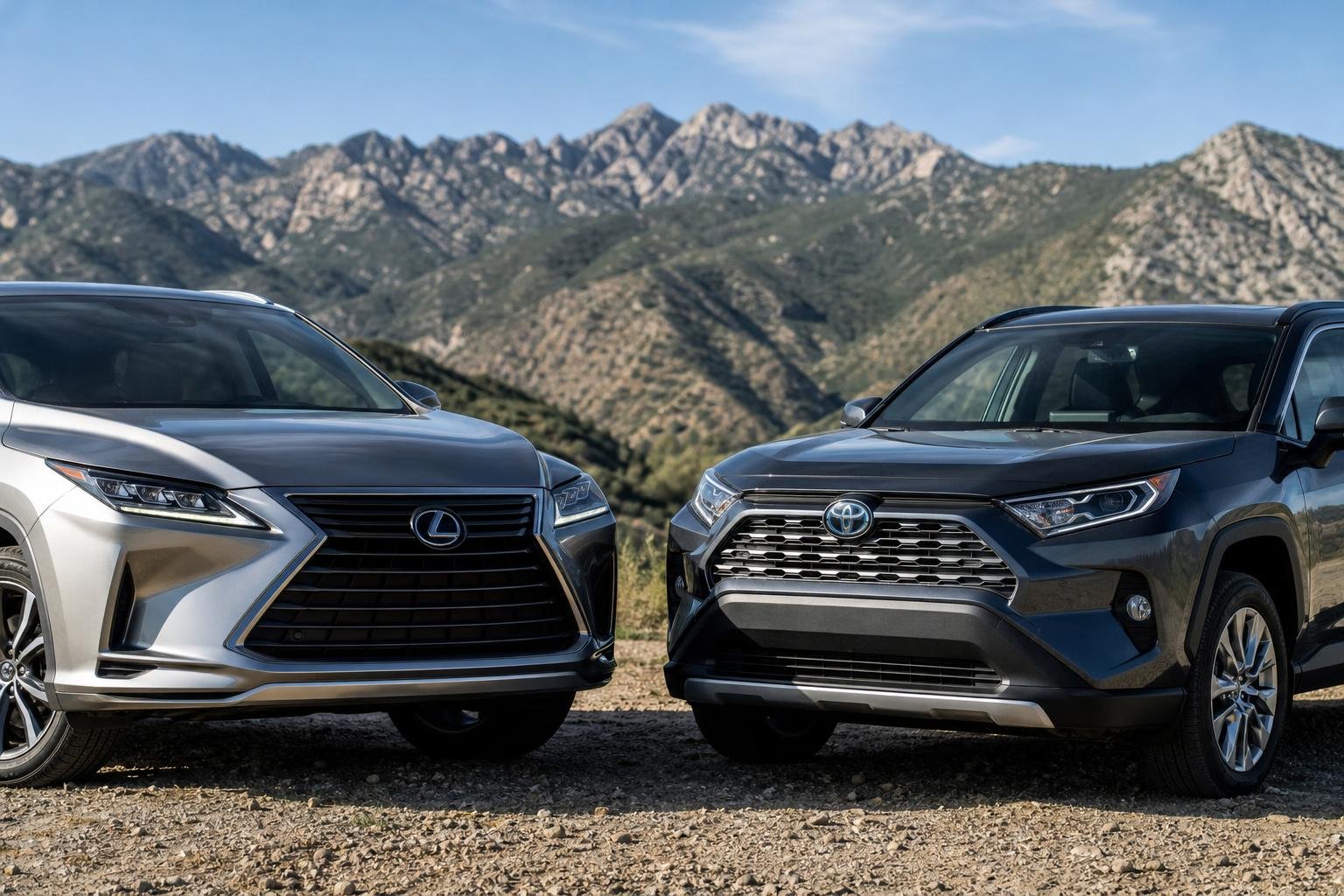

Lexus and Toyota share far more than a parent company. The two brands frequently use related engines, hybrid systems and vehicle architectures, particularly in SUVs and family sedans. But that does not mean a Lexus powertrain is always identical to the Toyota unit carrying a similar displacement.
The real answer depends on the engine family, the vehicle application and the level of tuning. In some cases, Lexus buyers are receiving a closely related version of a Toyota engine in a quieter, more heavily insulated vehicle. In others, Lexus has used a dedicated performance engine developed specifically for one of its flagship models.
Why Toyota and Lexus share engines
Sharing powertrains allows Toyota Motor Corporation to spread development and manufacturing costs across a much larger number of vehicles. It also gives both brands access to mature engine technology, established supply chains and components that have already been tested in a variety of applications.
That strategy is particularly visible in the brands’ crossovers and SUVs. The naturally aspirated 2.5-liter four-cylinder used in Toyota hybrid applications also appears in Lexus models such as the NX 350h. Related versions of the same basic engine family are used in vehicles including the Toyota RAV4 Hybrid, while the Toyota Camry and Lexus ES hybrid sedans follow a similar pattern.
The relationship is not limited to four-cylinder engines. Toyota’s turbocharged 2.4-liter four-cylinder is used in larger products such as the Grand Highlander and Lexus TX, while the twin-turbocharged 3.4-liter V6 serves in Toyota’s Tundra and Sequoia and in Lexus’s GX and LX SUVs.
The same engine family does not always mean the same specification
Even when two vehicles use engines with a common design, their hardware, software and supporting systems can differ. Engine-control calibration affects throttle response, boost delivery, shift behavior, emissions performance and the way torque is delivered through the transmission.
Manufacturers can also alter cooling systems, exhaust hardware, intake routing and accessory systems to suit the vehicle. A powertrain in a body-on-frame pickup has different demands from one in a luxury crossover, even if both engines belong to the same family.
That is why displacement alone is a poor way to compare Toyota and Lexus engines. Two 2.5-liter hybrids may share important mechanical components while producing different system outputs or delivering power with a different emphasis. Toyota generally positions its vehicles around efficiency, practicality and broad usability. Lexus typically places greater emphasis on smoothness, quiet operation and a more polished response.
Where the Lexus difference is most noticeable
The largest difference is often experienced outside the engine itself. Lexus vehicles are engineered as luxury products, so the powertrain is integrated into a package designed to reduce vibration, harshness and unwanted noise.
Additional sound insulation, more substantial interior materials and different suspension tuning can make a shared engine feel significantly more refined. A Lexus may use the same basic engine architecture as a Toyota, yet the occupants may hear less mechanical noise and experience smoother transitions between regenerative braking, engine operation and acceleration.
Transmission programming and accelerator mapping also influence the impression of performance. A Lexus calibration may prioritize progressive response and unobtrusive gear changes, while a Toyota application can be tuned more directly around fuel economy, load-carrying ability or everyday responsiveness. Neither approach is automatically better; they reflect different buyers and vehicle missions.
Hybrid systems add another layer of complexity
Comparing hybrid powertrains is more complicated than comparing gasoline engines. Total system output depends on the gasoline engine, electric motors, battery capacity, inverter hardware and control software. The same basic combustion engine can therefore be part of a different hybrid system in another model.
The Lexus NX 350h and Toyota RAV4 Hybrid illustrate the broader relationship. Both use a 2.5-liter four-cylinder hybrid foundation, but vehicle weight, electric assistance, drivetrain configuration and calibration affect the final driving experience. Lexus hybrids are commonly tuned to feel quieter and more deliberate, while Toyota’s versions are usually optimized for practical efficiency and value.
For buyers, this means an engine comparison should include the complete powertrain rather than focusing only on the gasoline engine’s displacement or cylinder count. Fuel economy, all-wheel-drive hardware, towing requirements and battery warranty coverage may matter more than a small difference in peak output.
Lexus has also developed engines Toyota did not use broadly
Shared technology does not define every Lexus. The brand’s most memorable performance models received engines that were created for distinctly different purposes.
The Lexus LFA used a naturally aspirated 4.8-liter V10 developed with Yamaha. Its high-revving character, compact design and detailed construction were central to the identity of the supercar. The engine was assembled in Japan using a highly controlled, specialist-oriented production process, and the LFA was built in a limited run of 500 vehicles.
Lexus also used the naturally aspirated 5.0-liter V8 known as the 2UR-GSE in the IS F, RC F, GS F and LC 500. That engine gave Lexus a performance identity separate from Toyota’s mainstream sedans, crossovers and trucks. Its character was defined by linear response and high-revving delivery rather than the low-speed torque emphasis common to a turbocharged truck engine.
Not every performance Toyota or Lexus engine is exclusive to one badge. Toyota’s turbocharged 1.6-liter three-cylinder, used in the GR Yaris and GR Corolla, also powers the Lexus LBX Morizo RR in markets where that model is sold. This is a useful reminder that component sharing can work in both directions: Lexus may borrow a Toyota performance engine, just as Toyota can provide the engineering foundation for a Lexus product.
What this means for buyers
A Lexus badge does not guarantee a completely unique engine, and a Toyota badge does not mean the vehicle uses a lesser mechanical design. In many cases, the major distinction is the way the powertrain is calibrated and integrated into the vehicle.
Shared engines can also offer practical advantages. A widely used engine family may have an established service network and broad parts availability. However, maintenance costs can still vary because Lexus vehicles may use more complex suspension, electronics, hybrid equipment and luxury features. Parts, labor rates and dealer pricing are determined by the individual model, not simply by the engine’s Toyota origins.
The best comparison is therefore model-to-model. Buyers should examine the exact engine code, hybrid configuration, transmission, output figures and towing rating rather than assuming that a Lexus and Toyota with similar names or displacement are mechanically identical.
The badge tells only part of the story
Toyota and Lexus share engineering resources because doing so makes technical and commercial sense. That creates genuine overlap, especially among hybrid four-cylinders, turbocharged engines and body-on-frame SUV powertrains. Yet calibration, supporting hardware, vehicle structure and cabin refinement can produce a meaningfully different experience.
At the top of the range, Lexus has also demonstrated that it can develop engines with a character and purpose Toyota’s mainstream lineup does not require. The result is a broad spectrum: some Lexus engines are carefully adapted Toyota units, while others are exclusive performance powertrains. The correct answer is not that Lexus engines are the same as Toyota engines, but that the relationship changes from one model to the next.
Sources: Carscoops; EngineCrux; Motor & Wheels.



0 Comments