
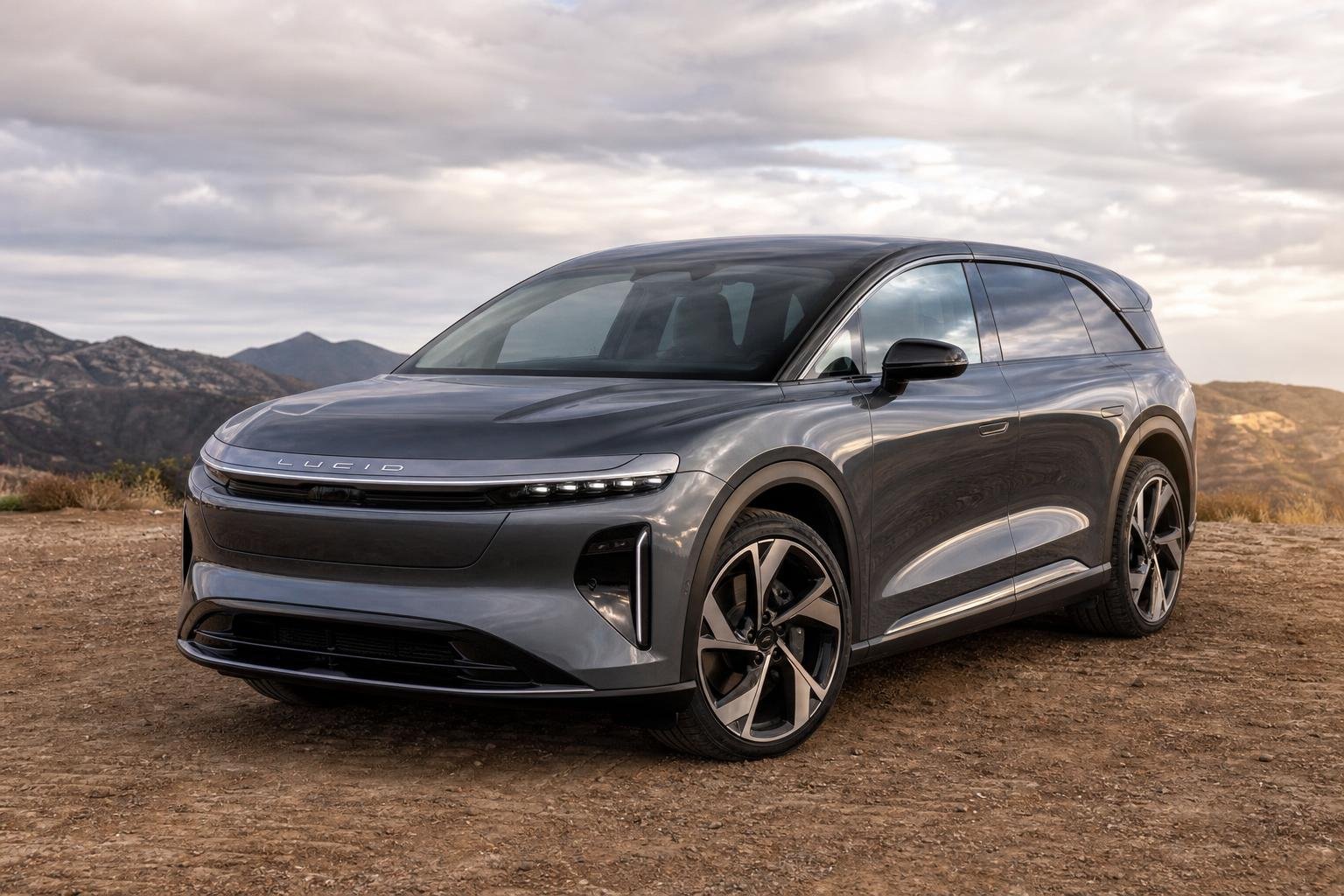

The 2026 Lucid Gravity Grand Touring is an unusual answer to a familiar luxury-car problem: how do you give a family SUV genuine space without making it slow, clumsy or forgettable? Lucid’s solution is a large electric vehicle with three-row practicality, sports-car performance and a design that sits somewhere between a sleek crossover and a futuristic minivan.
That combination is not merely a marketing exercise. The Gravity Grand Touring produces 828 horsepower and 909 pound-feet of torque, reaches 60 mph in a claimed 3.4 seconds and can travel as far as 450 miles in its most efficient five-seat configuration. It is also quiet, comfortable and remarkably agile for a vehicle weighing close to 6,000 pounds. The compromises are found elsewhere: a high price, an unconventional steering wheel and software that still feels like it is catching up with the hardware.
A family SUV with supercar acceleration
Lucid offers the Gravity in Touring and Grand Touring forms. The Touring produces 550 hp, makes 811 lb-ft of torque and is claimed to reach 60 mph in four seconds. The Grand Touring adds considerably more urgency through its dual-motor, all-wheel-drive powertrain.
Electric performance is hardly rare today, but the Gravity’s acceleration is notable because it arrives in a vehicle designed to carry people and luggage. Selecting the more aggressive drive settings turns an otherwise calm luxury SUV into something genuinely startling. Throttle response is immediate, and the Grand Touring can overwhelm passengers long before it runs out of performance.
More important, the Gravity is not limited to straight-line speed. Test driving found that it remains composed through corners, with a confidence that belies its size. The optional Dynamic Handling package adds a $3,900 combination of triple-chamber air suspension and rear-wheel steering. The suspension helps control body motion while preserving a supple ride, while rear steering improves maneuverability in parking lots and sharpens the vehicle’s response on winding roads.
Braking hardware is equally serious. Six-piston front calipers work with 15.4-inch rotors, while four-piston rear calipers clamp 15.3-inch discs. That equipment gives the Gravity strong stopping authority and helps make its considerable mass feel less intimidating during fast driving.
Minivan practicality without sliding doors
Lucid calls the Gravity an SUV, and technically it is one: the rear doors open conventionally rather than sliding. Yet the vehicle’s upright seating position, broad cabin and flexible seating give it more in common with a premium people mover than a conventional performance crossover.
Buyers can choose five- or seven-seat layouts. In the two-row version, folding the rear seats creates 111.9 cubic feet of cargo space. The 8.1-cubic-foot front trunk increases total storage to 120 cubic feet, exceeding the Toyota Sienna’s stated 101-cubic-foot maximum and approaching the 123.1 cubic feet available in a long-wheelbase Ford Expedition MAX. That comparison illustrates the Gravity’s appeal: it offers substantial carrying capacity without requiring a full-size truck-based SUV.
The seven-seat version is more useful than many three-row electric SUVs, although the rearmost seats are best suited to children or shorter adults on longer journeys. Lucid says the optional third row can accommodate adults, and the flat-folding seats provide useful flexibility when passengers give way to cargo. The second row also benefits from a flat floor, generous legroom and available folding tray tables.
With all seats occupied, cargo room is naturally more limited, making the frunk particularly useful for smaller bags and charging equipment. That blend of passenger comfort and load flexibility is central to the Gravity’s identity. It is not simply a fast SUV with occasional third-row seating; its packaging is one of the reasons the vehicle exists.
A high-tech cabin with too many touch points
The Gravity’s interior aims for modern luxury rather than traditional SUV ruggedness. A 34-inch upper display stretches across the driver’s field of view, while a 12.8-inch central screen handles navigation, media, vehicle settings and other functions. The graphics are sharp and the presentation feels suitably premium.
There are some welcome physical controls for functions such as temperature, fan speed and volume. However, many other adjustments require the center display or steering-wheel touchpads. That arrangement looks clean but can demand more attention than conventional switches, especially while driving.
The squared-off steering wheel is another divisive choice. Its upper profile improves visibility of the driver display, and it is less extreme than a full yoke, but the unusual shape can make hand-over-hand steering awkward during tight turns. A conventional circular wheel would likely be easier to use in a vehicle this large.
Independent test impressions have generally praised the Gravity’s materials, ride quality and screen presentation, while also describing the interface as less intuitive than the best systems in the class. The broader concern is software maturity. Owners and reviewers have reported technical issues, and Lucid has relied heavily on over-the-air updates to address smaller faults and roll out broader improvements. That is a positive sign for a young manufacturer, but customers spending six figures should not have to feel like early adopters.
Range and charging are genuine strengths
The Gravity Grand Touring uses a 123.0-kilowatt-hour battery and a 926-volt electrical architecture, exceeding the 800-volt systems common among many competitors. It has a native NACS charging port and supports charging rates of up to 400 kilowatts under suitable conditions.
Lucid estimates up to 450 miles of EPA range for a five-seat Grand Touring fitted with the smaller 20- and 21-inch wheel combination. Range falls to a stated 386 miles for a seven-seat model with larger 22- and 23-inch wheels and stickier Pirelli P Zero summer tires. Lucid also claims that a 400-kW charger can add up to 200 miles in less than 11 minutes, although actual results depend on the charger, battery temperature, state of charge and vehicle configuration.
That efficiency and charging performance may be more valuable than the acceleration. The Gravity’s large cabin makes it a plausible long-distance family vehicle, and its range reduces the planning burden that still accompanies many large electric SUVs.
Expensive, impressive and not entirely finished
The 2026 Gravity Touring starts at $81,750, while the Grand Touring starts at $100,750. The reviewed vehicle carried an as-tested price of $124,900 after options. The seven-seat configuration adds $2,900, and equipment such as the Dynamic Handling package can raise the final price quickly.
That places the Gravity against expensive electric SUVs from established luxury brands, including the BMW iX, Cadillac Vistiq, Mercedes-Benz EQS SUV, Tesla Model X and Volvo EX90. Lucid’s advantage is the unusual combination of range, power and cargo capacity. Its disadvantage is that the company has a smaller service and support footprint, while software and ownership concerns remain harder to dismiss at this price.
The Gravity Grand Touring is therefore a remarkable second model for Lucid. It demonstrates that a three-row electric SUV can be genuinely enjoyable to drive without sacrificing the space families actually need. Its strengths are substantial: extraordinary acceleration, long range, a polished ride and clever packaging. Its weaknesses—touch-heavy controls, unconventional ergonomics and technical teething problems—are equally real.
For buyers willing to accept those limitations, the Gravity offers something few rivals can match: the usefulness of a family hauler with the responses of a high-performance sedan. It may look like a minivan from certain angles, but on the road, it behaves like something far more exotic.
Sources: Motor1; Lucid Group; Car and Driver; Mike’s Steering Column.
0 Comments