
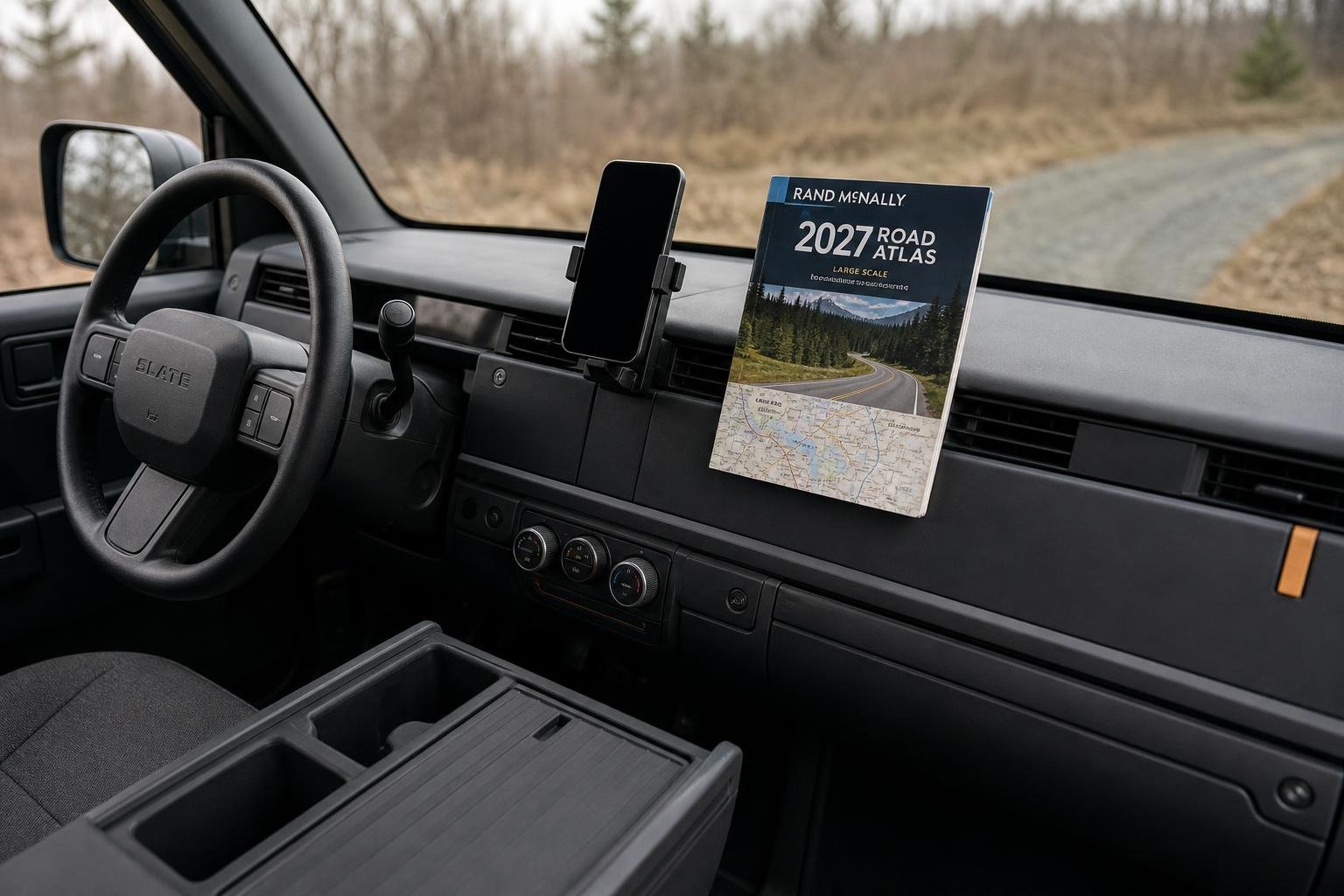

Slate has found a wonderfully literal way to add navigation to its deliberately low-tech electric pickup: sell owners a paper road atlas. The startup’s $30 “Screenless GPS” is a Rand McNally 2027 Road Atlas, offered in limited quantities through Slate’s online store.
The joke works because the Slate Truck does not have built-in navigation—or a conventional infotainment system at all. Instead, owners will receive a phone mount and can use navigation apps on a device they already own. The atlas is therefore less a serious alternative to Google Maps than a carefully chosen accessory that reinforces Slate’s broader product philosophy.
A map that fits Slate’s anti-screen strategy
Slate says the atlas is “the original navigation system,” and the company’s description highlights the practical advantages of paper: no startup time, subscription fees, software updates or battery to recharge. It also cannot lose cellular service, freeze during an update or issue a questionable route instruction.
Those advantages are mostly humorous in 2027, when smartphone navigation is more convenient and usually more capable than a paper map. A physical atlas cannot provide live traffic, charging-station availability, road closures or turn-by-turn directions. It also requires drivers to plan routes and interpret roads themselves—something that is useful in an emergency but hardly a replacement for modern navigation on everyday trips.
Slate’s official position is not that technology is inherently bad. The company says owners should use the devices and solutions they already know rather than pay for another screen, interface and connected-services ecosystem inside the vehicle. The map turns that argument into a tangible, $30 conversation piece.
The Slate Truck is intentionally different
The atlas makes more sense when viewed alongside the truck itself. Slate is developing a compact rear-wheel-drive electric pickup with a single 181-horsepower motor, a claimed 205-mile range and a battery reported at either 63 or 65 kWh, depending on the source and specification. The company has also cited a 2,000-pound towing capacity and a 1,550-pound payload rating.
The vehicle is designed to avoid many features that have become standard in more expensive cars. Its base configuration uses unpainted composite body panels, steel wheels, manual windows and physical climate controls. There is no large central touchscreen, and the truck can be converted into a five-passenger SUV using an available kit.
That approach allows Slate to sell the truck as a customizable starting point rather than a fully optioned vehicle. Buyers can add accessories, wraps and conversion equipment later, potentially spreading the cost of personalization over time. The concept is closer to buying a simple tool and modifying it than ordering a conventional pickup with a fixed trim hierarchy.
Affordability is the real point
Slate’s strategy is aimed at one of the electric vehicle market’s biggest weaknesses: price. The company initially promoted a starting figure below $25,000, while more recent reporting places the truck in the mid-$20,000 range. CarGurus lists a $26,400 price including destination, while Car and Driver reports an MSRP range of $26,400 to $33,400. Exact final pricing and equipment details may change as production approaches.
Even at that level, the truck would occupy a part of the new-vehicle market that has become increasingly difficult to reach. A simple body, limited factory configuration and the absence of an expensive infotainment system can reduce both manufacturing complexity and the amount of hardware included in the base vehicle.
That does not mean the Slate will be inexpensive in every configuration. An SUV conversion, cosmetic accessories, upgraded convenience features and other add-ons could raise the transaction price considerably. The key difference is that the buyer can decide which features matter instead of paying for a long list of bundled options.
Phone navigation keeps the compromise manageable
For most owners, the included phone mount will be more important than the atlas. A smartphone provides familiar mapping software without requiring Slate to develop and maintain its own navigation platform. It also gives drivers access to live traffic and charging information, both of which are particularly relevant in an electric vehicle.
The trade-off is that the driving experience depends more heavily on the owner’s phone. Drivers must provide the device, maintain its battery and manage navigation themselves. A phone mounted in the cabin can also be less integrated than a factory display, and the arrangement may not appeal to buyers who expect every function to be built into the vehicle.
Still, this is a deliberate compromise rather than an omission hidden behind marketing language. Slate is selling a truck that asks customers to bring some of their own technology, just as it asks them to accept manual windows, a basic interior and a limited set of standard features.
A small accessory with a larger message
The screenless GPS is unlikely to become a major revenue stream for Slate. Its value is symbolic. The atlas gives the company a playful way to explain that the truck is not missing modern features by accident; it is designed around the belief that many buyers would rather choose their own devices and avoid paying for technology they may not use.
That idea will face a practical test when production begins. Buyers may appreciate a lower purchase price and simpler controls, but they will also judge the truck on comfort, safety, charging convenience, service support and real-world range. A paper map can demonstrate Slate’s commitment to minimalism, but it cannot compensate for shortcomings in those areas.
For now, the atlas is an unusually effective piece of product marketing. It is useful in a pinch, compatible with every vehicle on the road and perfectly aligned with a pickup that treats simplicity as a feature rather than a deficiency.
Sources: InsideEVs; Car and Driver; CarGurus; ABC News.

0 Comments