
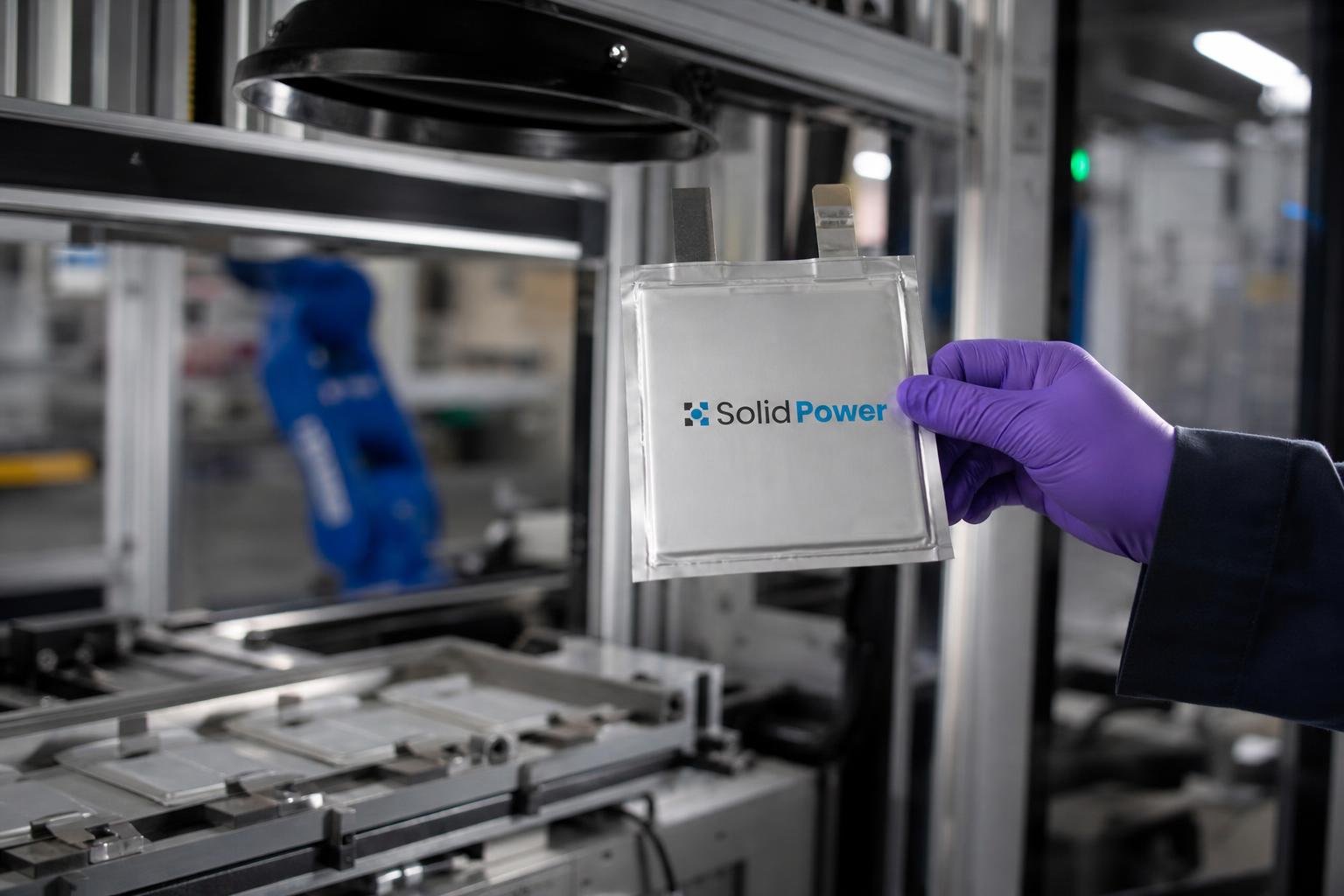

Solid Power believes the United States may have another opportunity to challenge Asia’s dominance of the battery industry—not by catching up with conventional lithium-ion cells, but by commercializing the next generation of battery technology.
The Colorado-based company is developing sulfide-based solid electrolytes for automakers and cell manufacturers, including Ford, BMW, Samsung SDI and SK On. Its strategy is different from that of startups attempting to manufacture complete batteries: Solid Power wants to supply a critical material that established battery companies can integrate into their own cell designs and production systems.
A different approach to the solid-state race
Solid Power President and CEO John Van Scoter told InsideEVs that all-solid-state batteries could give American companies a path back into a market now led by Asian manufacturers.
“All solid-state batteries can be the way that [the U.S.] can get back in and be competitive in the battery industry,” Van Scoter said.
The company’s argument rests partly on manufacturing compatibility. Rather than building a complete battery cell from scratch, Solid Power develops the electrolyte—the material that allows lithium ions to move between the cathode and anode. Conventional lithium-ion batteries generally use a liquid electrolyte, while solid-state designs replace it with a solid material.
Solid electrolytes are being developed in several forms, including polymers, oxides and sulfides. Sulfides can offer ionic conductivity closer to that of liquid electrolytes, but they are sensitive to moisture and can create difficult manufacturing conditions. Oxide electrolytes are generally more stable but can present challenges at the interfaces between the electrolyte and electrodes.
Solid Power is betting on a flexible sulfide formulation that it says can be processed using standard lithium-ion roll-to-roll equipment. If that claim holds up at commercial scale, battery manufacturers could potentially adapt existing production infrastructure instead of constructing entirely new factories.
The Mobius pilot line is the next test
Solid Power recently commissioned its Mobius pilot production line at its facility in Thornton, Colorado. The line is intended to manufacture solid electrolyte for customers and development partners, rather than complete automotive battery packs.
According to the company, Mobius is expected to add 45 metric tons of annual electrolyte capacity. Combined with existing facilities, Solid Power expects total pilot capacity to reach 75 metric tons per year. That output is small compared with the volumes required for mainstream electric vehicles, but it is designed to support customer testing, process development and qualification work.
This stage is important because laboratory performance does not automatically translate into a reliable automotive product. Cell manufacturers must demonstrate consistent coating, stacking, sealing and quality control across thousands of cells. Small defects or poor contact between layers can reduce capacity, shorten service life or create safety problems.
Solid Power received a $50 million U.S. Department of Energy grant in 2024 under the Bipartisan Infrastructure Law. The funding reflects the strategic importance of domestic battery technology, although government support alone cannot resolve the engineering and economic challenges involved in mass production.
Energy-density claims depend on the complete cell
Solid Power says its electrolyte can support an energy density of up to 390 watt-hours per kilogram when paired with a silicon anode and a nickel-manganese-cobalt cathode. With a lithium-metal anode, the company has cited a potential figure of 440 Wh/kg.
Those numbers are substantially higher than the roughly 250-to-280 Wh/kg range cited in the source report for modern NMC lithium-ion batteries. Higher cell-level energy density could allow automakers to deliver greater driving range without adding battery mass, or maintain current range while reducing pack size and weight.
However, these figures should not be interpreted as guaranteed specifications for a future production vehicle. Solid Power supplies the electrolyte, while the battery manufacturer determines the final electrode chemistry, cell format, pressure requirements, thermal system and pack design. Van Scoter acknowledged that the complete cell design ultimately determines energy density, cycle life and other performance characteristics.
Solid-state batteries are also not automatically immune to every battery failure mode. Dendrites—needle-like lithium structures that can grow through a cell and cause short circuits—remain a major technical concern, particularly when lithium-metal anodes are used. Solid Power says it has invested heavily in addressing dendrite formation, but long-term durability must be demonstrated under automotive operating conditions.
BMW provides an early demonstration
Solid Power’s technology has already moved beyond laboratory samples. BMW has shown a prototype i7 equipped with a solid-state battery using Solid Power’s electrolyte and a silicon anode.
BMW, Samsung SDI and Solid Power have also established a three-way development arrangement. Under that structure, Samsung SDI is expected to manufacture the cells, BMW will develop the modules and battery packs, and Solid Power will supply the solid electrolyte.
The division of responsibilities illustrates why Solid Power’s business model could be significant. A battery startup does not necessarily need to compete directly with the largest cell manufacturers if it can provide a material that fits into their existing development and production ecosystems. The approach may also allow automakers to work with multiple suppliers while limiting the risk of committing to a single vertically integrated technology.
Solid Power has completed joint development agreements with Ford and BMW and is now focusing more heavily on battery manufacturers, according to the company. It expects solid-state batteries to appear first in selected premium vehicles toward the end of this decade, with wider adoption potentially following in the early 2030s.
All-solid-state cells will not arrive all at once
The industry’s near-term battery roadmap is likely to include several technologies marketed under similar names. Semi-solid and quasi-solid cells, which retain some liquid or gel-like material, are easier to manufacture and are already being pursued for early vehicle applications. They can offer improvements over conventional lithium-ion batteries without requiring the full manufacturing transition demanded by an all-solid-state design.
That distinction matters for consumers. A semi-solid battery may improve range or reduce pack weight, but it should not be treated as proof that the most ambitious lithium-metal solid-state designs are ready for mass-market use. Industry observers have described semi-solid systems as a practical bridge while companies continue solving the interface, pressure, durability and production problems associated with fully solid cells.
Solid Power also expects early demand to come from applications such as drones, defense systems and humanoid robots. These markets may accept higher costs or smaller production volumes, while placing a premium on energy density and compact packaging. Qualification cycles may also be shorter than those required for a passenger vehicle expected to operate reliably for many years.
Why the manufacturing strategy matters
The United States did not establish the same scale in conventional lithium-ion battery manufacturing as China, South Korea and Japan. Solid-state technology therefore represents both an engineering challenge and an industrial reset. If American companies can develop a commercially useful electrolyte, license the technology and manufacture it domestically, they may be able to compete in a higher-value part of the battery supply chain without matching Asia’s existing volume immediately.
That opportunity remains conditional. Pilot production is not mass production, and a compatible process on paper still must deliver high yields, stable costs and consistent performance. Solid-state batteries will also compete against improving lithium-ion cells, silicon-enhanced anodes and semi-solid designs that may reach vehicles sooner.
Solid Power’s progress is consequently best viewed as an important manufacturing experiment rather than a guarantee that solid-state batteries will dominate the next decade. Its electrolyte-focused strategy could help American companies participate in the battery transition, but the decisive test will come when automakers and cell manufacturers must produce reliable, affordable cells at automotive volumes.
Sources: InsideEVs; MotorTrend; CNBC.

0 Comments