
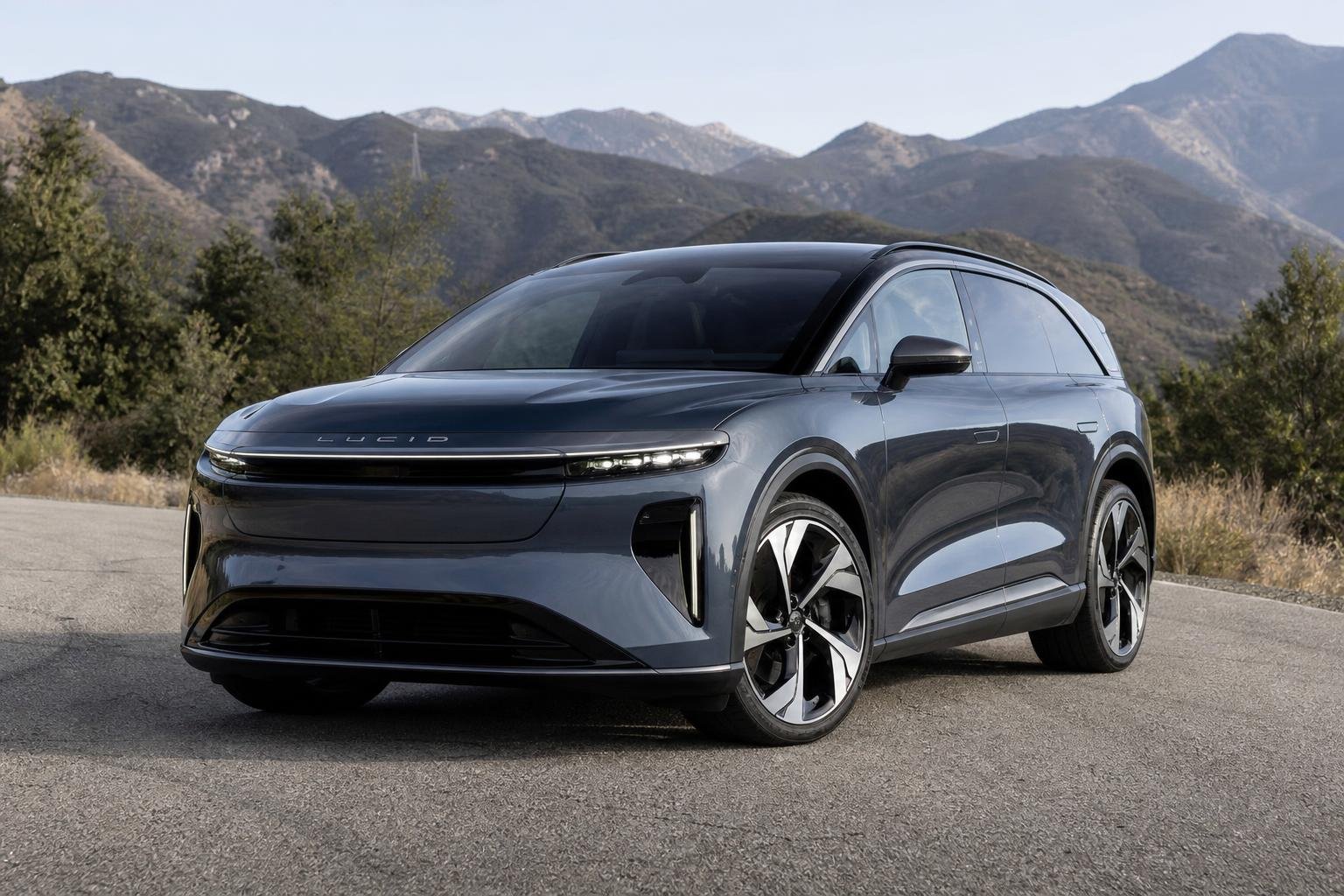

The 2026 Lucid Gravity Grand Touring is an unusual answer to a familiar luxury-SUV question: can one vehicle provide genuine family practicality without sacrificing driving excitement? With 828 horsepower, seating for up to seven, up to 450 miles of EPA-estimated range, and a cabin that rivals much larger vehicles for usable space, the Gravity comes remarkably close.
It is also a vehicle with a complicated personality. Its tall, elongated shape recalls a futuristic minivan, its interface relies heavily on screens, and early software issues undermine an otherwise impressive ownership proposition. Yet after spending a week with the Grand Touring, Motor1 found that Lucid’s second model delivers a combination of performance, comfort and efficiency that few electric SUVs can match.
A family SUV with extraordinary acceleration
The Gravity Grand Touring uses dual electric motors and all-wheel drive. Lucid rates the system at 828 horsepower and 909 pound-feet of torque. Despite weighing nearly 6,000 pounds, the SUV is claimed to accelerate from 0 to 60 mph in 3.4 seconds.
That figure is more than a headline. Electric torque makes the Gravity feel immediate whenever the accelerator is pressed, whether the driver is merging onto a highway or passing slower traffic. Its performance is closer to a high-output sports car than a conventional three-row SUV, and the near-silent delivery makes the speed feel deceptively effortless.
The less expensive Gravity Touring produces 550 horsepower and reaches 60 mph in a claimed four seconds. That version may be the more rational choice for many buyers, but the Grand Touring establishes the model’s defining character: this is a family vehicle engineered with serious performance ambitions.
Surprisingly composed in corners
Power alone would not make the Gravity special. Large electric SUVs can accelerate hard while feeling heavy and detached in corners. The Lucid avoids much of that behavior, particularly when equipped with the $3,900 Dynamic Handling package.
The package adds a three-chamber air suspension and rear-wheel steering. The air suspension can manage body movement without making the ride harsh, while rear-wheel steering improves maneuverability at low speeds and helps the vehicle feel more stable through faster bends. Motor1’s evaluation found that the Gravity could be driven through corners with the composure of a much smaller vehicle.
Braking hardware is appropriately substantial. Six-piston front calipers clamp 15.4-inch rotors, while four-piston rear calipers work on 15.3-inch discs. The brakes provide the confidence needed to repeatedly slow a large, powerful SUV, although the Gravity’s most convincing dynamic quality is its control rather than its outright aggression.
There is one notable ergonomic compromise. The squared-off steering wheel improves visibility of the upper display, but its unusual shape can make hand-over-hand steering less natural during tight turns. It is less extreme than a full yoke, but traditionalists may still prefer a conventional circular wheel.
Minivan practicality without sliding doors
Lucid classifies the Gravity as an SUV, and the absence of sliding rear doors supports that description. In profile, however, the vehicle has the upright seating position and long-roof proportions associated with a minivan. That shape is not merely stylistic: it creates exceptional interior volume.
The Gravity can be configured with two rows and five seats or with an optional third row for seven passengers. In the two-row configuration, folding the rear seats exposes 111.9 cubic feet of cargo space. Combined with its 8.1-cubic-foot front trunk, total storage reaches 120 cubic feet. That is more than the Toyota Sienna’s quoted 101 cubic feet and close to the 123.1 cubic feet offered by a Ford Expedition MAX, despite the Lucid’s smaller overall footprint.
The three-row layout is more useful than many luxury-SUV third rows. The second row slides and folds to improve access, and Lucid provides a flat floor that gives the middle passenger useful foot space. The third row is still best suited to shorter passengers on long journeys, but it is not an afterthought. Lucid says the Gravity can retain more than 21 cubic feet of luggage space behind the third row.
Every rear seat can fold flat, giving the cabin considerable flexibility for luggage, outdoor equipment or bulky purchases. The frunk adds another practical storage area, although cargo space with all three rows occupied is limited compared with the vehicle’s impressive maximum capacity.
A quiet, high-tech cabin
The Gravity’s interior combines premium materials with an unusually screen-focused control layout. A 34-inch upper display stretches across the driver’s view, while a 12.8-inch central screen handles infotainment and many vehicle functions. The graphics are sharp and the presentation feels appropriately modern for a luxury EV.
Lucid does retain physical controls for frequently used functions such as temperature and fan speed. That is welcome, because many of the remaining adjustments require the central touchscreen or steering-wheel touchpads. The arrangement looks clean, but drivers who prefer dedicated controls for vehicle settings may find the system unnecessarily dependent on software.
Passenger comfort is one of the Gravity’s strongest attributes. The front seats can offer heating, ventilation and massage functions, while second-row occupants benefit from generous legroom and available folding tray tables. The quietness inherent to an electric powertrain further reinforces the vehicle’s long-distance luxury character.
Lucid’s efficiency advantage
The Grand Touring uses a 123.0-kilowatt-hour battery and a 926-volt electrical architecture. Lucid says the system supports charging at up to 400 kilowatts on suitable 1,000-volt equipment and can sustain up to 225 kilowatts on certain 500-volt fast chargers.
With the most efficient 20-inch front and 21-inch rear wheel configuration, a five-seat Grand Touring has an EPA-estimated range of up to 450 miles. A seven-seat model with larger 22- and 23-inch wheels is rated as low as 386 miles. The wheel choice therefore has a meaningful effect on usability: larger wheels and stickier Pirelli P Zero summer tires improve visual and dynamic appeal, but reduce range.
Lucid estimates that the Grand Touring can add 200 miles in less than 11 minutes when connected to a 400-kilowatt charger and fitted with the appropriate wheel package. Actual charging depends on battery temperature, charger capability, state of charge and other conditions, but the combination of long range and fast charging reduces one of the main compromises associated with large electric vehicles.
The native NACS port also gives the Gravity access to Tesla Superchargers without relying on an adapter. That broader charging compatibility is particularly important for a family vehicle expected to cover long distances.
Price, software and ownership concerns
The 2026 Gravity Touring starts at $81,750, while the Grand Touring starts at $100,750 before options. Motor1’s test vehicle reached $124,900, showing how quickly the price can rise once buyers add third-row seating, dynamic hardware, premium interior appointments and advanced technology.
That pricing places the Gravity against premium electric SUVs such as the Tesla Model X, Volvo EX90 and Cadillac Vistiq, while also bringing it into the orbit of performance-oriented models such as the Porsche Cayenne Electric. The Lucid’s combination of range and cargo volume is compelling, but buyers are also paying for a young brand with a smaller service footprint than established luxury manufacturers.
Software is the most significant qualification. Motor1 reported technical teething issues during its week with the vehicle, although over-the-air updates had addressed some smaller problems and Lucid was continuing to release larger revisions. That update capability is useful, but customers spending well over $100,000 should reasonably expect a polished experience at delivery rather than a vehicle that feels unfinished and improves later.
Verdict: a remarkable SUV with unfinished edges
The Lucid Gravity Grand Touring succeeds because it does not force buyers to choose between family utility and performance. It offers enough space for real family use, ride comfort suitable for long trips, sports-car-like acceleration and range that exceeds most large electric SUVs. Its 828-hp powertrain is impressive, but the more important achievement is making that power manageable in a comfortable, practical vehicle.
The compromises are clear: the styling will divide opinion, the steering wheel is awkward, screen-based controls are not ideal for everyone, and software problems raise legitimate concerns about ownership. Even so, the Gravity demonstrates how much further an electric SUV can go when efficiency, packaging and chassis tuning are treated as equally important as acceleration.
For buyers who want a luxury three-row EV but refuse to give up driving enjoyment, the Gravity Grand Touring is one of the most convincing options available. It is not perfect, but its blend of capabilities is distinctive enough to make the vehicle feel less like another electric SUV and more like a new category of family performance car.
Sources: Motor1; Lucid Group; Car and Driver; Mike’s Steering Column.

0 Comments