
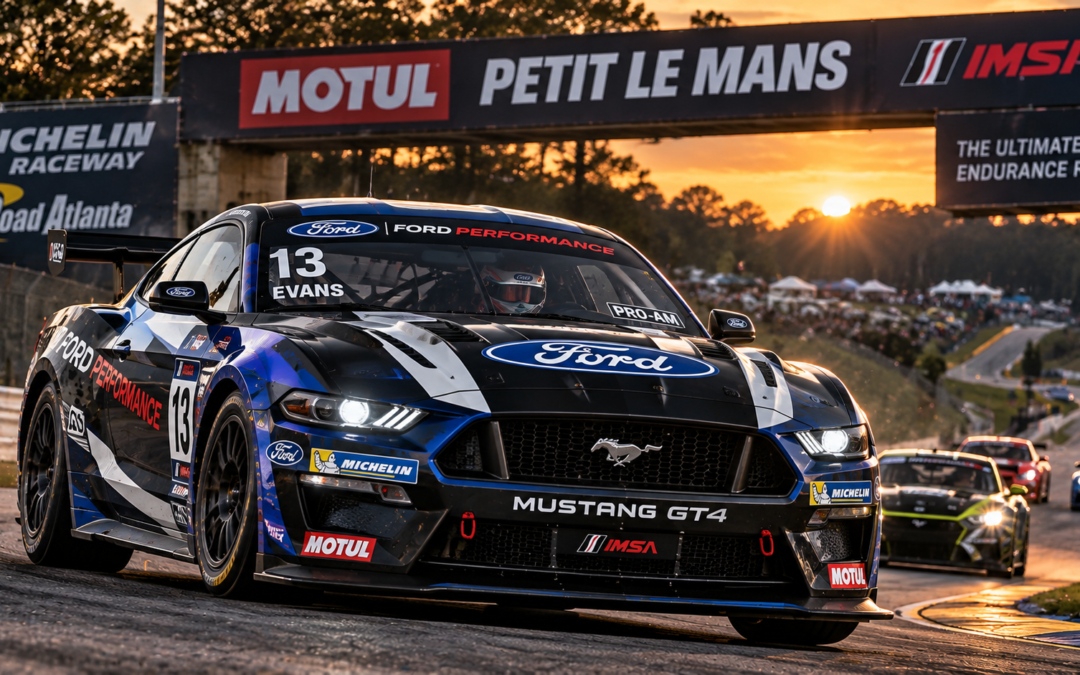
After building an impressive career in European GT4 competition, American driver Erik Evans is preparing for a deeply personal milestone: his IMSA debut at Michelin Raceway Road Atlanta. A carefully assembled sponsorship effort, support from Ford Racing, and a promising teammate have turned a long-held ambition into reality.
For many racing drivers, the opportunity to compete at a major endurance event represents the culmination of years of work. For Erik Evans, the upcoming Motul Petit Le Mans weekend carries an additional significance.
The 23-year-old American is preparing to make his IMSA debut at a circuit that is not merely another stop on the racing calendar. Michelin Raceway Road Atlanta is in his hometown, and the chance to race there represents a dream he has pursued since the beginning of his career.
Evans will share a Ford Mustang GT4 with fellow Ford Racing Development driver Jenson Altzman in the Fox Factory 120, part of the Motul Petit Le Mans weekend. The opportunity marks his first GT race in the United States and provides a new stage for a driver whose career has largely developed across the Atlantic.
Getting to the starting grid, however, required considerably more than simply securing a seat. Evans had to bring together sponsors, a race team, manufacturer support, and a suitable teammate. The result is a project that reflects both his determination and the growing interest in his potential.
From Atlanta to the European GT4 Scene
Evans’ path to international GT racing began with a move toward sports cars and the competitive European GT4 environment.
In 2023, he made history by becoming the first American to win the overall British GT4 Championship. That achievement established him as a driver capable of competing successfully in a demanding and highly competitive racing environment.
His success did not end with that championship. Evans continued to develop his experience in the GT4 European Series, where he became a consistent front-running competitor.
European GT4 racing provides a valuable training ground for young drivers. The category features production-based performance cars adapted for competition, and success requires much more than a fast qualifying lap. Drivers must manage tire wear, traffic, race strategy, and close battles while working effectively with their teams.
The series also offers experience at a wide range of circuits, each demanding a different approach.
For Evans, the European program has become an important part of his development. It has provided opportunities to compete against experienced drivers, learn different tracks, and refine the racecraft required for a possible future move into GT3 competition.
His 2026 season has not always delivered the results he wanted, but his personal performances have remained encouraging.
A Season of Speed, Frustration, and Unfulfilled Potential
Evans entered the 2026 GT4 European Series campaign with strong expectations. However, the results have not consistently reflected the pace he believes he and his team have demonstrated.
According to Evans, the season has been marked by frustrating incidents, particularly in qualifying. Starting near the back of the grid can make an already difficult GT4 race substantially harder, especially when the field is closely matched.
A poor qualifying position forces a driver to spend valuable time working through traffic. Overtaking can carry additional risks, and the need to recover positions may compromise tire life or expose the car to unnecessary contact.
Despite those setbacks, Evans has continued to believe that his underlying performance has been strong.
He described himself as operating at the highest level of his career, noting that he and his team have regularly been among the fastest competitors on track. The challenge has been converting that speed into race results.
That distinction matters in motorsport.
A driver can deliver excellent lap times and still finish outside the points because of a qualifying problem, an incident, or circumstances beyond the team’s control. Over a full season, those setbacks can obscure the progress being made behind the scenes.
For Evans, the upcoming IMSA appearance offers an opportunity to put that performance on display in a new environment.
The Moments That Have Kept Evans Motivated
Although the 2026 European campaign has been frustrating, there have been several performances that demonstrate Evans’ potential.
One of the highlights came at Circuit Paul Ricard, where he and his team were involved in a battle for the lead. The result may not have delivered the ultimate reward, but competing at the front of a highly competitive GT4 field provided valuable confirmation of their pace.
Another standout performance came at Misano.
Evans reportedly started 37th and climbed to ninth during a 26-minute stint. Recovering that many positions in such a short period required a combination of speed, awareness, and effective traffic management.
GT4 racing can be particularly demanding in this respect. Cars are often closely matched, and the driver must identify opportunities without compromising the vehicle’s tires or risking contact.
A recovery drive from deep in the field can therefore be a more revealing demonstration of racecraft than a straightforward victory from pole position.
For Evans, the Misano performance became one of the highlights of his season and reinforced his belief that he is ready for the next stage of his career.
Turning a Hometown Dream Into a Real Program
The opportunity to race at Road Atlanta did not happen by accident.
Evans began working on the project early in the year, contacting people and organizations in the Atlanta area who might be interested in supporting his participation.
His approach was direct: he wanted to compete in the event and was willing to pursue every possible avenue to make it happen.
That effort eventually brought together Coca-Cola United, Monster Energy, and QuikTrip in a three-way sponsorship arrangement. The partnership helped provide the financial foundation required to assemble the program.
In professional motorsport, funding is often one of the biggest barriers facing emerging drivers. A competitive seat requires much more than a driver’s talent. Teams must cover vehicle preparation, personnel, transportation, tires, testing, entry fees, and the many other costs associated with operating at a high level.
A driver who can help build a viable commercial program brings additional value to a team.
Evans’ project illustrates how a personal ambition can become a broader partnership between a driver, sponsors, a manufacturer, and a racing organization.
The support also gives him an opportunity to compete in front of people who have played a role in his career.
Ford Racing’s Role in the Opportunity
Ford Racing Development has been an important part of Evans’ progression through GT competition.
The manufacturer’s driver-development program has helped him establish a pathway in sports-car racing, while also providing access to teams and fellow drivers within the Ford performance network.
For the Road Atlanta project, Ford helped Evans connect with McCumbee McAleer Racing, the team responsible for entering the Ford Mustang GT4.
That support was important because the quality of the race team is central to any driver’s prospects.
A competitive GT4 program requires experienced engineers, mechanics, strategists, and crew members who understand how to extract consistent performance from the car. Endurance events add another layer of complexity, with pit stops, driver changes, fuel strategy, and reliability becoming crucial parts of the result.
Evans will enter the event with a team structure designed to give him a strong introduction to American sports-car racing.
He also has the advantage of arriving with experience in the same vehicle category.
A Familiar Car With One Important Difference
One of the most useful aspects of Evans’ upcoming IMSA appearance is that he will be driving the same basic specification of Ford Mustang GT4 that he competes in during the European season.
That continuity should reduce the amount of time required to adapt to the car.
The Mustang GT4 is a purpose-built competition version of Ford’s iconic pony car. It features race-oriented suspension, aerodynamic modifications, braking systems, safety equipment, and other components designed for circuit competition.
Although the car is based on a production model, a GT4 racer is engineered specifically for the demands of professional motorsport.
Evans explained that the car is essentially the same specification across the two racing environments, with the major tire difference being that the European car uses Pirelli tires while the IMSA entry will use Michelin tires.
That familiarity is valuable.
A driver moving between racing series must often learn a new car, a new tire, a new team, and a new set of sporting procedures at the same time. Evans will still face plenty of new challenges in the United States, but he will not be starting from zero with the vehicle itself.
The tire change will nevertheless require careful preparation. Different tire constructions and compounds can influence braking, cornering balance, tire degradation, and the way a car responds over a long stint.
Understanding those differences will be one of the important tasks for Evans and the engineering team.
Jenson Altzman Brings Valuable Experience
Evans’ teammate for the Road Atlanta event will be Jenson Altzman, another member of Ford Racing Development.
Altzman brings his own experience in GT competition and came close to winning the Michelin Pilot Challenge championship the previous year.
That background makes him a valuable partner for Evans’ first IMSA appearance.
In a multi-driver sports-car race, teamwork is essential. Drivers must share information about tire behavior, traffic, braking points, and car balance. They also need to work closely with engineers to ensure that the vehicle remains competitive throughout the race.
A strong pairing can help accelerate the learning process.
Evans will be able to draw on Altzman’s familiarity with American racing, while Altzman can benefit from Evans’ experience in European GT4 competition and his knowledge of the Mustang GT4 in that environment.
Their combined experience should give the team a solid foundation for the event.
However, the race will still require both drivers to adapt to the specific conditions of Road Atlanta, the demands of the IMSA weekend, and the challenges of endurance competition.
Why Road Atlanta Is Such a Significant Challenge
Michelin Raceway Road Atlanta is one of the most distinctive circuits in North American sports-car racing.
Located in Braselton, Georgia, the track features a fast and flowing layout with elevation changes, blind corners, and demanding braking zones. Its combination of speed and technical complexity makes it a favorite among drivers and fans.
The circuit’s most famous feature is the Esses, a sequence of fast corners that rewards precision and commitment. The track also includes the challenging downhill approach to Turn 10 and the long straight leading toward Turn 12.
For GT4 drivers, Road Atlanta presents a complicated balance of speed and risk.
The circuit is fast enough to punish mistakes, but its compact layout also creates frequent traffic interactions when multiple classes share the track.
The Fox Factory 120 is part of a larger endurance-racing weekend, which means drivers must remain alert to the presence of other categories of race cars. Faster vehicles may approach from behind, while GT4 competitors must find opportunities to overtake slower traffic without losing momentum.
For Evans, learning those patterns will be a major part of his first IMSA outing.
Racing at his home circuit should provide emotional motivation, but the track will demand the same discipline and concentration required at any major international venue.
The Importance of the Fox Factory 120
The Fox Factory 120 provides a valuable entry point into the IMSA environment.
The race is associated with the Michelin Pilot Challenge, a major North American sports-car championship featuring production-based competition cars. The series provides drivers with opportunities to develop endurance-racing skills while competing in a highly competitive field.
For a driver like Evans, the event represents more than a single race.
It is a chance to gain experience with American race procedures, team operations, traffic management, and the unique demands of sports-car competition in the United States.
The event also takes place during the prestigious Motul Petit Le Mans weekend, bringing additional attention to the circuit and the surrounding paddock.
Road Atlanta attracts a broad range of racing teams, manufacturers, engineers, and drivers. A strong performance can therefore provide exposure that extends beyond the immediate results sheet.
Evans understands the importance of the opportunity. He has described the race as a stepping stone toward establishing his name in the American racing paddock and, potentially, advancing toward GT3 competition.
Why a Strong IMSA Debut Could Matter
The transition from GT4 to GT3 is a major ambition for many sports-car drivers.
GT4 cars provide an important foundation in racecraft, but GT3 competition introduces a higher level of performance, technical sophistication, and professional competition.
GT3 machinery generally features more advanced aerodynamic systems, greater performance, and increasingly complex engineering requirements. Drivers must be able to work closely with engineers, manage tire performance, and adapt quickly to changing conditions.
Success in GT4 does not guarantee a successful GT3 career, but strong results and consistent performances can help establish a driver’s credentials.
For Evans, the IMSA appearance could become an important part of that progression.
A competitive showing would demonstrate his ability to adapt to a new championship, work with a different team, and perform at a familiar but challenging level of vehicle performance.
It would also provide an opportunity to build relationships within the American sports-car racing community.
Those relationships can become valuable as drivers seek future opportunities, particularly in a sport where seats and sponsorship are often closely connected.
European Experience Meets American Racing
Evans’ background gives him an interesting perspective on the differences between European and American GT competition.
European GT4 racing exposes drivers to a broad variety of circuits and highly competitive fields. The racing environment places considerable emphasis on qualifying performance, close competition, and the ability to adapt to different track conditions.
American sports-car racing, meanwhile, offers its own distinct challenges. Multi-class events, endurance formats, and long race weekends require drivers to manage traffic and strategy over extended periods.
The two environments are not identical, even when the cars share the same basic specification.
For Evans, that contrast makes the IMSA opportunity especially valuable. He will be able to bring his European experience to the American paddock while learning the techniques and procedures required to succeed in a different racing culture.
The event may also help clarify which areas of his skill set are already well developed and which require further work.
The Personal Meaning of Racing at Home
Beyond the career implications, the Road Atlanta event carries a powerful personal dimension.
Evans has never raced in his hometown in any form of motorsport. That makes the upcoming appearance an especially meaningful occasion.
Many drivers spend years traveling internationally in pursuit of competition opportunities. They may race at famous circuits, compete in distant countries, and build careers far from their families and original support networks.
Returning home to compete in front of people who have helped them along the way can be an emotional milestone.
Evans has expressed excitement about having supporters and sponsors present to watch him race in person. The event offers him an opportunity to share a major career moment with people who have contributed to his journey.
That personal connection may also provide additional motivation during a demanding weekend.
However, the challenge will be to balance the excitement of the occasion with the focus required to perform effectively.
A New Opportunity, Not a Guaranteed Breakthrough
The Road Atlanta project offers Evans an important opportunity, but it is not a guarantee of future success.
The field will include drivers with experience in American sports-car racing, and the demands of the event will be substantial. Evans and Altzman will need to adapt quickly to the circuit, the tire package, and the specific characteristics of the race team.
The GT4 category can be exceptionally competitive, with small differences in pace often separating several cars.
A successful debut will require more than outright speed. It will depend on qualifying, race strategy, traffic management, pit-stop execution, and reliability.
Avoiding unnecessary incidents will be particularly important.
For a driver making his first IMSA appearance, completing a clean and competitive race can be a valuable achievement in itself. A strong result would be welcome, but the experience gained over the weekend could be equally important to his long-term development.
Evans appears to understand that balance.
He has expressed confidence in Ford, McCumbee McAleer Racing, and his teammate, while also viewing the event as a stepping stone toward future opportunities.
The Road Ahead
The Road Atlanta event arrives during a busy period in Evans’ schedule.
Before making his IMSA debut, he is due to return to the GT4 European Series for its visit to Zandvoort in the Netherlands. The Dutch circuit presents another challenge, with its distinctive banked corners, fast sections, and demanding rhythm.
Following the American event, Evans will travel to Portugal for the GT4 European Series finale at Portimão.
That schedule creates a demanding sequence of races across two continents. It also offers an opportunity to compare his performance in different racing environments within a relatively short period.
The experience could be especially useful as he considers his next career steps.
For now, his focus remains on preparing for the Road Atlanta appearance and making the most of an opportunity that he has worked toward for much of the year.
Conclusion: A Hometown Debut With Bigger Ambitions
Erik Evans’ upcoming IMSA debut is the result of persistence, talent, and a willingness to build an opportunity rather than wait for one to appear.
His European GT4 career has already produced significant achievements, including a historic British GT4 championship. His 2026 season has shown encouraging pace despite results that have not always reflected his potential.
Now, he will bring that experience to a new championship, a new team environment, and a circuit that holds special personal significance.
The combination of Ford Racing Development support, McCumbee McAleer Racing, a familiar Mustang GT4, and a promising teammate gives Evans a strong platform for his first American GT race.
The Fox Factory 120 will not be easy. Road Atlanta is demanding, the competition is intense, and endurance racing leaves little room for error.
But the opportunity is significant.
For Evans, the event represents the fulfillment of a hometown dream and a potential launching point for the next phase of his career.
A strong performance could help establish him more firmly in the American sports-car paddock, while providing valuable experience on the road toward GT3 competition.
Whatever the final result, his appearance at Road Atlanta will mark an important moment in the career of a young driver who has already demonstrated that he belongs in the international GT racing conversation.