
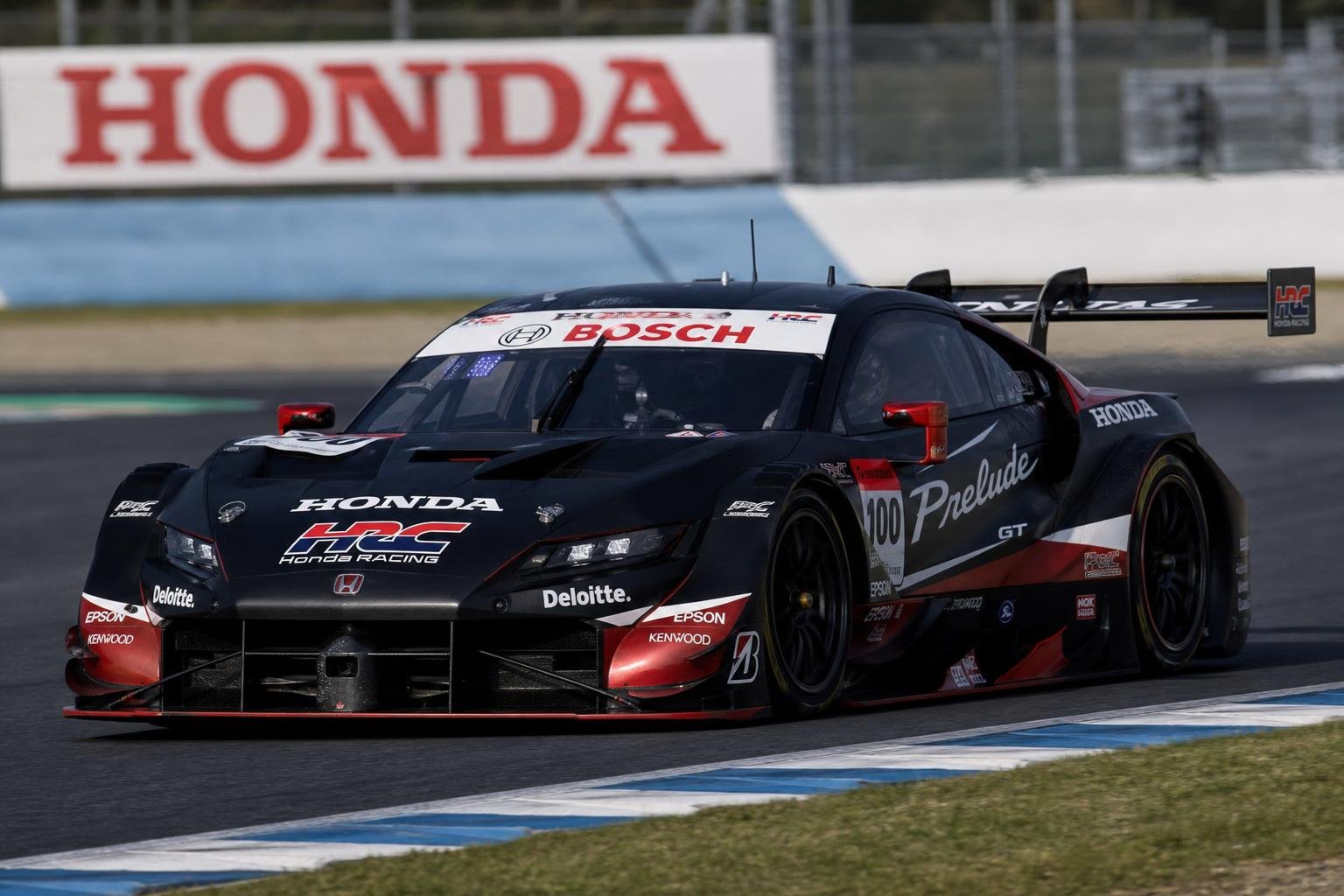

Honda’s return to the top of SUPER GT has arrived sooner than expected. Team Kunimitsu drivers Naoki Yamamoto and Tadasuke Makino won the season finale at Motegi to secure the GT500 championship in the first year of competition for the HRC Prelude-GT.
The No. 100 STANLEY Honda started from pole and controlled the 53-lap race, resisting early pressure from the TOM’S Toyota GR Supra before handing over to Makino. Honda’s new flagship finished 1.705 seconds ahead of the sister Real Racing Prelude, producing a one-two finish and sealing Honda’s first GT500 drivers’ title since Yamamoto and Makino won together in 2020.
A decisive finale for Team Kunimitsu
The championship was already leaning toward Team Kunimitsu before the final race. Yamamoto and Makino had moved to the top of the standings after finishing fifth in the opening Motegi race, leaving their main rivals, Kenta Yamashita and Sho Tsuboi in the No. 36 TOM’S Toyota, needing a major reversal of form.
Victory would guarantee the title regardless of the Toyota’s result, and Yamamoto immediately gave the Honda the advantage. Yamashita stayed within reach during the opening stint, but the gap had grown to approximately four seconds by the time both cars stopped on lap 22. Tadasuke Makino then brought the No. 100 car home without serious pressure in the closing stages.
The Toyota’s title hopes deteriorated further during the second stint. Tsuboi struggled to pass Koudai Tsukakoshi’s Real Racing Honda, then made contact with Daniil Kvyat’s Lamborghini GT3 during a full-course-yellow period. The resulting front-left damage forced the Toyota down the order and eventually into the garage. Tsuboi also made contact with Sacha Fenestraz’s SARD Toyota as the caution period ended, although Fenestraz continued to finish third.
Honda’s new GT500 challenger delivered immediately
The result completed an impressive first season for the Prelude-GT. Honda won five of the eight races, while Toyota recorded two victories and Nissan one. The No. 100 car’s Motegi success was its third win of the year, adding another major result to a campaign that ended with Honda at the top of the standings.
The Prelude-GT’s performance is particularly notable because it is a dedicated GT500 competition car carrying the Prelude name and visual identity. It should not be confused with the road-going Prelude: the HRC racer was engineered for SUPER GT competition rather than converted from a showroom vehicle.
That distinction matters. The road car provides the styling connection and renewed identity for the Prelude name, while the HRC program supplies the race-engineered package required to compete in GT500. The championship therefore represents both a successful racing program and a carefully managed link between Honda’s latest coupe and its motorsport image.
Strategy and tire management shaped the result
Motegi also demonstrated how races in SUPER GT can be decided by more than qualifying pace. Tsukakoshi’s No. 17 Real Racing Honda pitted one lap earlier than the leading Toyota and ultimately secured second place, giving Honda a one-two finish in the GT500 race. The car had been started by Yuto Nomura.
Fenestraz completed the podium for SARD after the team again chose not to change tires during its stop. That strategy left the Toyota vulnerable late in the race but proved effective enough to hold off Kazuki Hiramine’s Team Impul Nissan. Katsumasa Chiyo and Mitsunori Takaboshi finished fifth in the works NISMO Nissan, while Toshiki Oyu recovered to sixth after a late spin.
The finale was also the last SUPER GT race of the series’ multi-manufacturer tire competition. The Yokohama-shod Racing Project Bandoh Toyota finished 12th, while Nakajima Racing’s Dunlop-equipped Honda fell to 13th after a traffic-induced spin for Riki Okusa. The change ends an important technical dimension of the championship and gives Honda’s title an additional point of historical interest.
Yamamoto adds another title to a remarkable record
For Yamamoto, the championship is his third GT500 drivers’ crown. His first came in 2018 alongside Jenson Button, followed by the 2020 title with Makino. Their reunion has now produced another championship at the beginning of a new Honda racing era.
Makino completed the winning second stint at Motegi, bringing the No. 100 Prelude-GT across the line to secure the title. Team Kunimitsu’s experience, combined with Honda’s development work, allowed the program to move from a new entry to the benchmark in only eight races.
GT300 title goes to Kondo Racing
The GT300 championship was decided by a much narrower margin. Kondo Racing Nissan drivers João Paulo de Oliveira and Iori Kimura secured the title with fourth place, finishing eight points ahead of Seven x Seven Racing’s Sven Mueller. K-tunes Racing’s Morio Nitta and Shinichi Takagi ended the season third overall.
The GT300 race itself went to the No. 88 JLOC Lamborghini Huracán GT3 EVO2 of Daniil Kvyat and Takashi Kogure. Kvyat recovered from his earlier contact with Tsuboi and used fresher rear tires to catch Mueller’s Porsche, completing the decisive pass through Turns 3, 4 and 5 on lap 48. Gainer’s self-constructed Nissan Z completed the podium after Ryuichiro Tomita benefited from a penalty for the sister JLOC Lamborghini.
Honda’s GT500 title is the more prominent result, but the overall finale underlined the strategic variety that continues to define SUPER GT. Tire choices, success weight, pit-lane penalties and traffic all influenced the outcome. Against that background, the Prelude-GT’s five wins and championship conversion represent more than a fast debut: they show Honda produced a complete race package capable of performing across an entire season.
For Team Kunimitsu, the victory restores Honda to the top of GT500 with a familiar driver pairing. For the Prelude name, it creates an immediate motorsport chapter—one written not by the road car’s specifications, but by a purpose-built racer that has already established itself as the car to beat.
Sources: Sportscar365; CarCody; dailysportscar.com.

0 Comments