
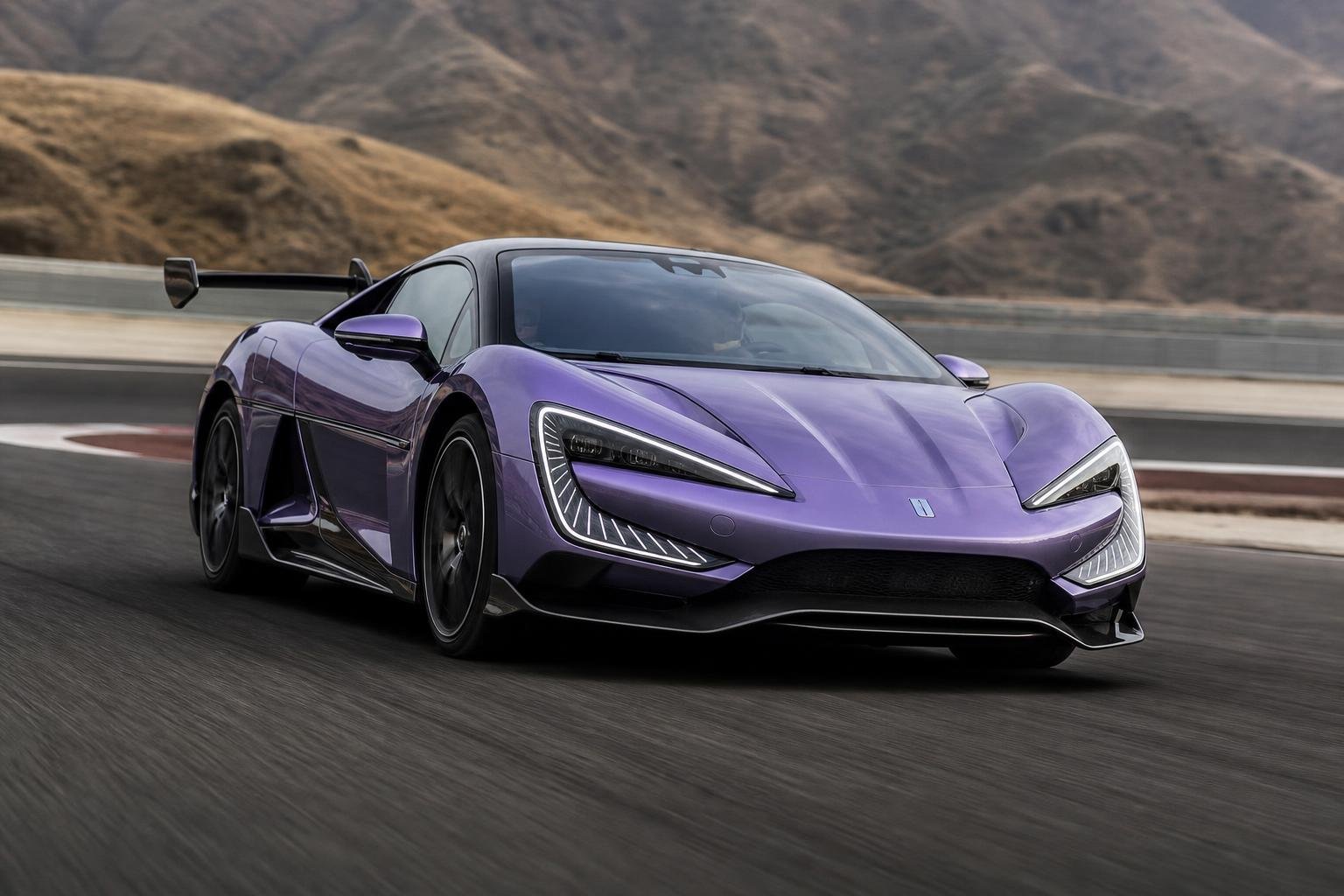

The Yangwang U9 marks China’s first production supercar, combining BYD’s electric powertrain technology with a 1,288-horsepower output, a claimed 0–100 kph time of 2.3 seconds and a Nürburgring lap time under eight minutes.
The all-electric U9 uses BYD Blade batteries with LFP chemistry, a 1,200-volt electrical architecture and 500-kW fast-charging capability. Its listed price is 1.8 million yuan, or about $269,000, placing it in the same broad territory as cars such as the McLaren Artura and Porsche 911 GT3.
A short test at Zhengzhou
The U9 was driven at BYD’s Zhengzhou test facility, which includes a dedicated circuit, low-grip skid pads, an off-road course and a sand-dune incline recognized by Guinness World Records.
The circuit is relatively compact, with a mixture of fast sweepers, tighter technical corners and a straight where the car reached approximately 200 km/h. The initial drive was limited to two hot laps, although additional laps were later provided.
The car’s dihedral doors and close-fitting seats deliver the expected supercar experience, while an electric door switch makes entry and exit easier. The test car also impressed with a rattle-free cabin and an intuitive control layout, although its overall build quality did not immediately feel as special as its performance figures.
Sharp handling and unusual brake behavior
Early impressions centered on how light the U9 felt through the first corners. Its suspension managed to combine a relatively comfortable ride with enough control to keep the car engaging, producing a driving character described as somewhat similar to a McLaren, albeit more clinical.
The carbon-ceramic brakes required more adjustment. At lower speeds, they were described as overly aggressive and difficult to modulate smoothly. Once the car reached higher speeds, however, the brakes became more progressive and predictable.
With the traction control reduced but not fully disabled, the rear could be coaxed into a slide. Small steering and throttle corrections were enough to bring the car back into line, suggesting a predictable chassis when operating within its limits.
Those limits arrived abruptly when more speed was carried into a corner. The U9 entered a brief four-wheel slide followed by understeer, requiring a quick steering correction and a measured throttle application to regain control. The incident highlighted the effect of the car’s substantial mass, which the suspension had otherwise concealed effectively.
DiSus-X suspension manages the weight
The Yangwang U9 weighs 2,470 kilograms, or roughly 5,500 pounds. Its mass is influenced not only by the battery pack but also by the hydraulic DiSus-X suspension system and the weight characteristics of LFP battery chemistry compared with higher-energy-density alternatives such as NMC cells.
DiSus-X is one of the U9’s defining technologies. The hydraulic system can independently control wheel movement, allowing the car to lift individual corners and perform the dramatic suspension movements shown in demonstrations. Sensors scan the road ahead and use that information to adjust each wheel’s behavior.
Although the system may appear theatrical, the test indicated that it has a meaningful dynamic role. It helps keep the heavy U9 composed and contributes to the car’s sharp steering response and poised chassis.
Tire limitations remain a concern
The test car used Pirelli tires, while the U9 Extreme is fitted with specially developed tires from Giti. Because the Giti-equipped version was not driven, its potential impact could not be assessed.
Even so, the available tires appeared unable to fully match the U9’s combination of weight and performance. Until the car exceeded its grip threshold, it remained predictable and enjoyable, but the transition into understeer exposed how demanding the package is on its rubber.
Durability was less concerning during the short test. Two U9 cars handled repeated laps with a fleet of journalists, requiring only a 15-minute pause to allow the brakes to cool before continuing.
An impressive first supercar
The Yangwang U9 does not deliver the same poise, drama or emotional character associated with established supercar makers such as Porsche, Lamborghini and Ferrari. However, it demonstrates that BYD’s first production supercar is more than a collection of acceleration figures.
The U9 combines strong straight-line performance with sharp steering, an active chassis and enough driver involvement to distinguish it from electric performance cars focused almost entirely on specification-sheet numbers. The brief test also revealed clear areas for improvement, particularly around tire performance and the car’s behavior at the limit.
At 1.8 million yuan, the Yangwang U9 is positioned among serious performance cars rather than conventional luxury EVs. Its development could remain a standalone halo project, but the car’s first showing suggests BYD has made a credible opening attempt at a production supercar.
0 Comments