
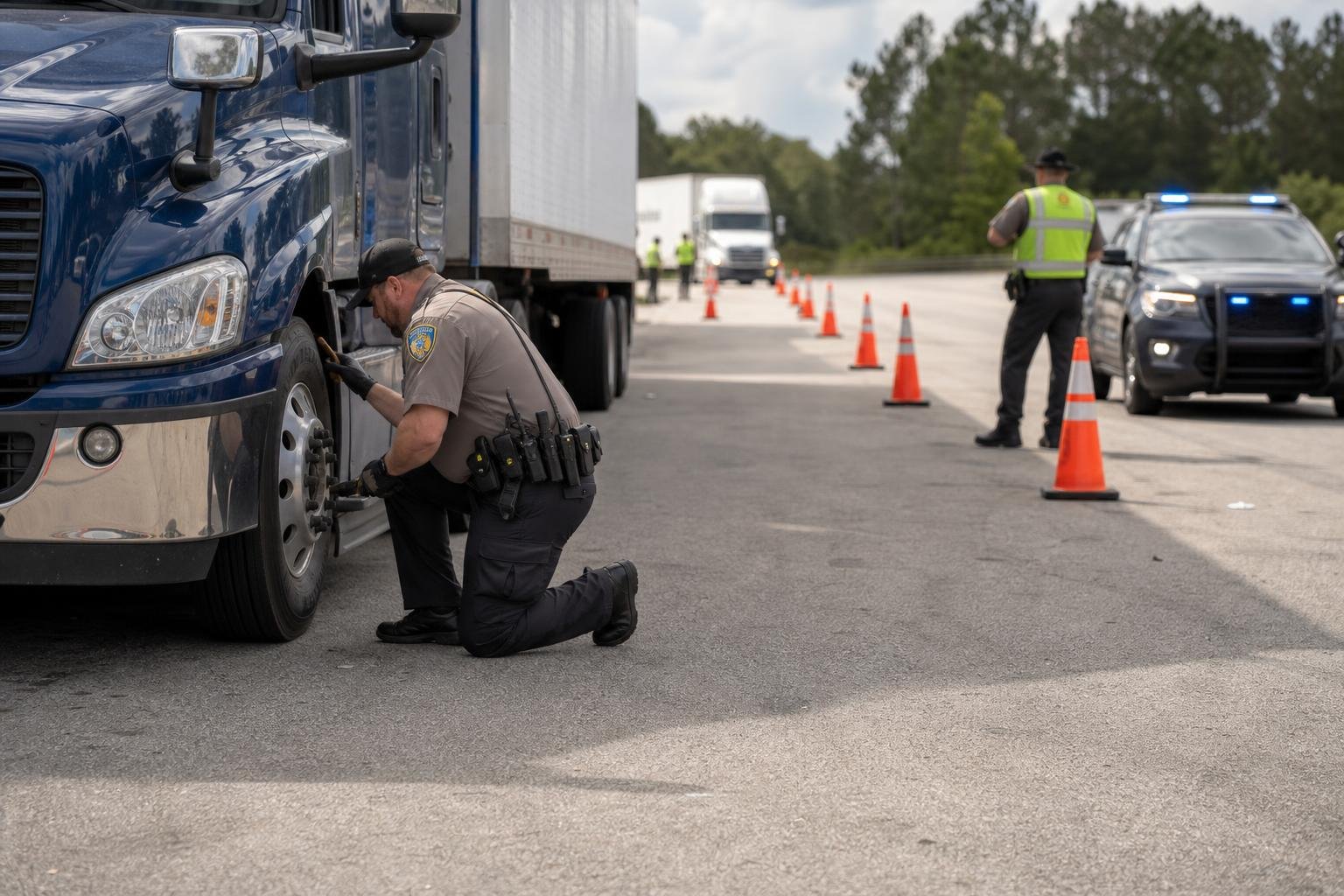

A commercial vehicle enforcement operation spanning four Southern states resulted in 568 inspections, 78 drivers being placed out of service, and 25 trucks being removed from service on September 26, 2026.
Called “Saturday Night Fever,” the overnight effort was led by the South Carolina State Transport Police with support from the Federal Motor Carrier Safety Administration and law enforcement agencies in North Carolina, Georgia, and Florida. It was South Carolina’s third operation using the name in 2026 and the first to extend across state lines.
Inspections covered drivers and vehicles
The operation focused on the I-95 corridor, with South Carolina deploying 70 officers across its interstate network. Inspections went beyond vehicle condition, covering driver credentials, fatigue, electronic logging devices, cargo securement, mechanical defects, distracted driving, and impairment.
Inspectors issued 173 moving violations during the operation. The 78 drivers placed out of service represented nearly 14 percent of all inspections, while 25 commercial vehicles were sidelined because of serious safety issues.
Twelve of the drivers removed from service failed federal English language proficiency requirements. Commercial drivers are required to read and speak English sufficiently to communicate with the public and officials under federal direction issued the previous year.
Seven criminal arrests
Authorities also made seven criminal arrests. The reported offenses included driving with a suspended license, drug possession, controlled substances, and alleged fentanyl trafficking.
The multi-state approach reflects the fact that commercial trucks regularly travel through several jurisdictions during a single shift. Georgia Department of Public Safety Major Andrew Montgomery described the cooperation as necessary because unsafe carriers can cross state boundaries.
While South Carolina has conducted the Saturday Night Fever operation before, the September effort marked its first expansion beyond the state. The participating agencies used the coordinated enforcement to examine commercial driving risks along a broader section of the I-95 corridor.


0 Comments