
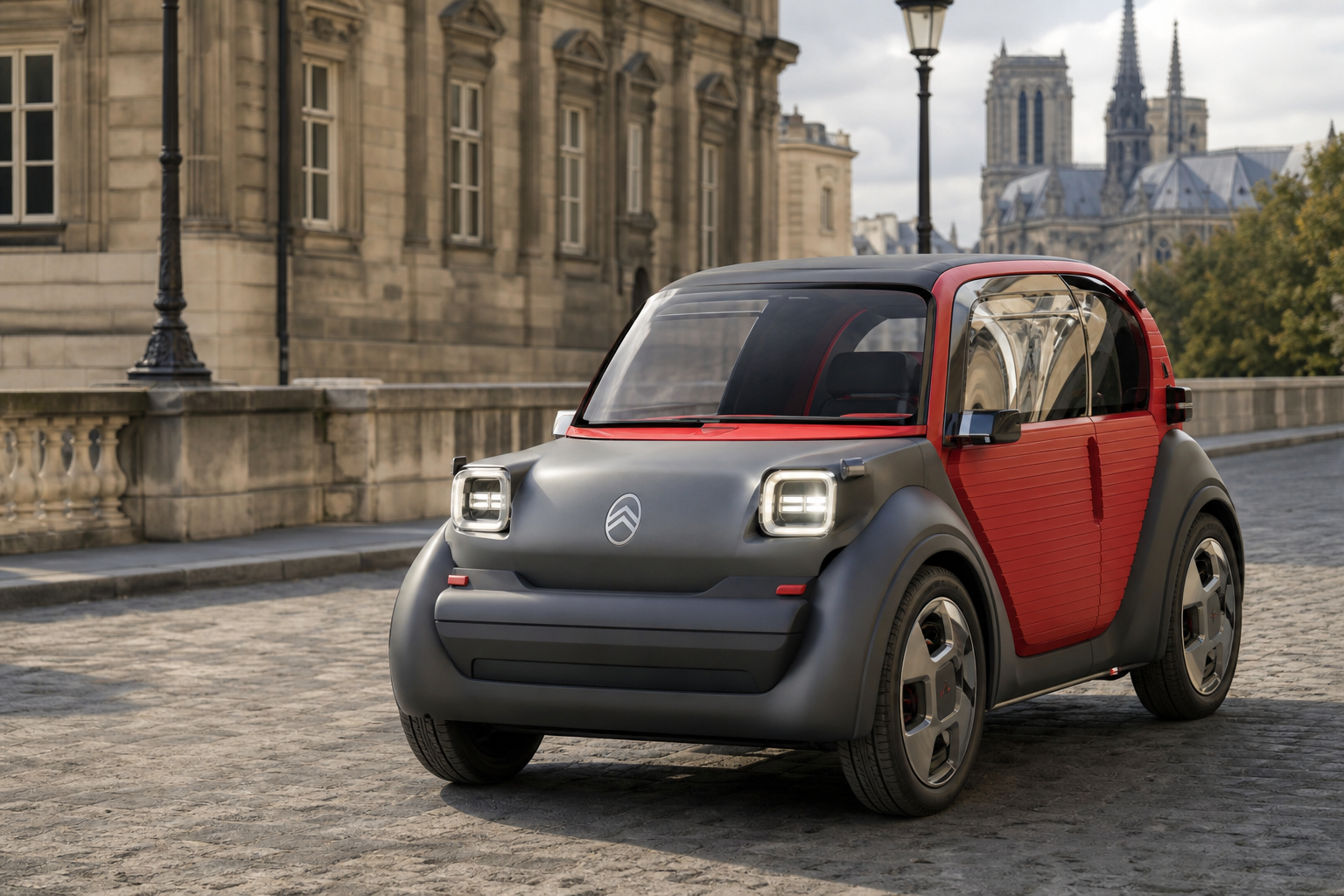

Citroën is preparing to bring the 2CV name back as an affordable electric city car. The revival will initially take the form of a concept scheduled for unveiling in Paris on October 11, while a production version is expected to arrive in 2028.
The return was officially confirmed earlier in 2026 after years of rumors. The new model is intended to reinterpret the original 2CV for modern urban mobility, with affordability and compact dimensions among its central priorities.
Retro design cues previewed
Citroën’s early teasers show several styling details inspired by the original car. Visible elements include a grooved hood, rounded fenders, semi-circular LED headlights, retro-style door handles and wheels, and indicators positioned on the C-pillars.
An earlier preview also suggested that the electric model will use a silhouette similar to its predecessor. The concept is expected to feature an illuminated double-chevron emblem on the front end.
Citroën described the project as a way to bring “the spirit of the 2 CV into the modern world,” with the stated aim of making mobility simpler, more accessible, more human and more desirable.
Designed around affordability
Technical details have not yet been disclosed beyond confirmation of a fully electric powertrain. The 2CV is expected to use a bespoke platform developed around upcoming European Union regulations for affordable electric vehicles.
That architecture will reportedly also underpin an upcoming Fiat model. The arrangement would continue the relationship seen between smaller models such as the Citroën Ami and Fiat Topolino, as well as the Citroën C3 and Fiat Grande Panda.
Citroën CEO Xavier Chardon said in interviews earlier this year that the production car should start below €15,000, or approximately $17,000, before subsidies. If that pricing is maintained, it would become Citroën’s most affordable car. The Ami remains less expensive, but its classification as a heavy quadricycle places it outside the conventional passenger-car category.
The new 2CV is likely to be smaller than the Citroën C3 subcompact crossover hatchback. That positioning would give it a role similar to the discontinued C1 and C2 as an urban-focused model.
In Europe, the electric 2CV would enter an ultra-affordable segment that includes models such as the Renault Twingo, Nissan Pixo, Dacia Spring, Honda Super-N, BYD Dolphin Surf and the upcoming Volkswagen ID. Up. The source also characterizes these vehicles as positioned between traditional small hatchbacks and cheaper heavy quadricycles, with greater safety and refinement than the latter.
A modern successor to a historic model
The original 2CV debuted at the 1948 Paris Motor Show after its development brief was created during the 1930s. Its design was intended to carry two farmers and agricultural goods across rough, plowed terrain, including a 50-kilogram sack of potatoes or a basket of eggs.
Production continued for 42 years. Although the 2CV received incremental updates, it retained its recognizable shape and interconnected suspension system. The final example was built in 1990, by which point Citroën had produced 5.1 million units worldwide.
Citroën will also present another concept at the Paris Motor Show, described as a surprise. The company’s display will additionally include the C3 Aircross Marine Nationale Concept, the Outdoor lineup comprising the Ami, C3 and C3 Aircross, the Collection series, the C5 Aircross Emeraude special edition and the GEN4 Formula E racer.

0 Comments