
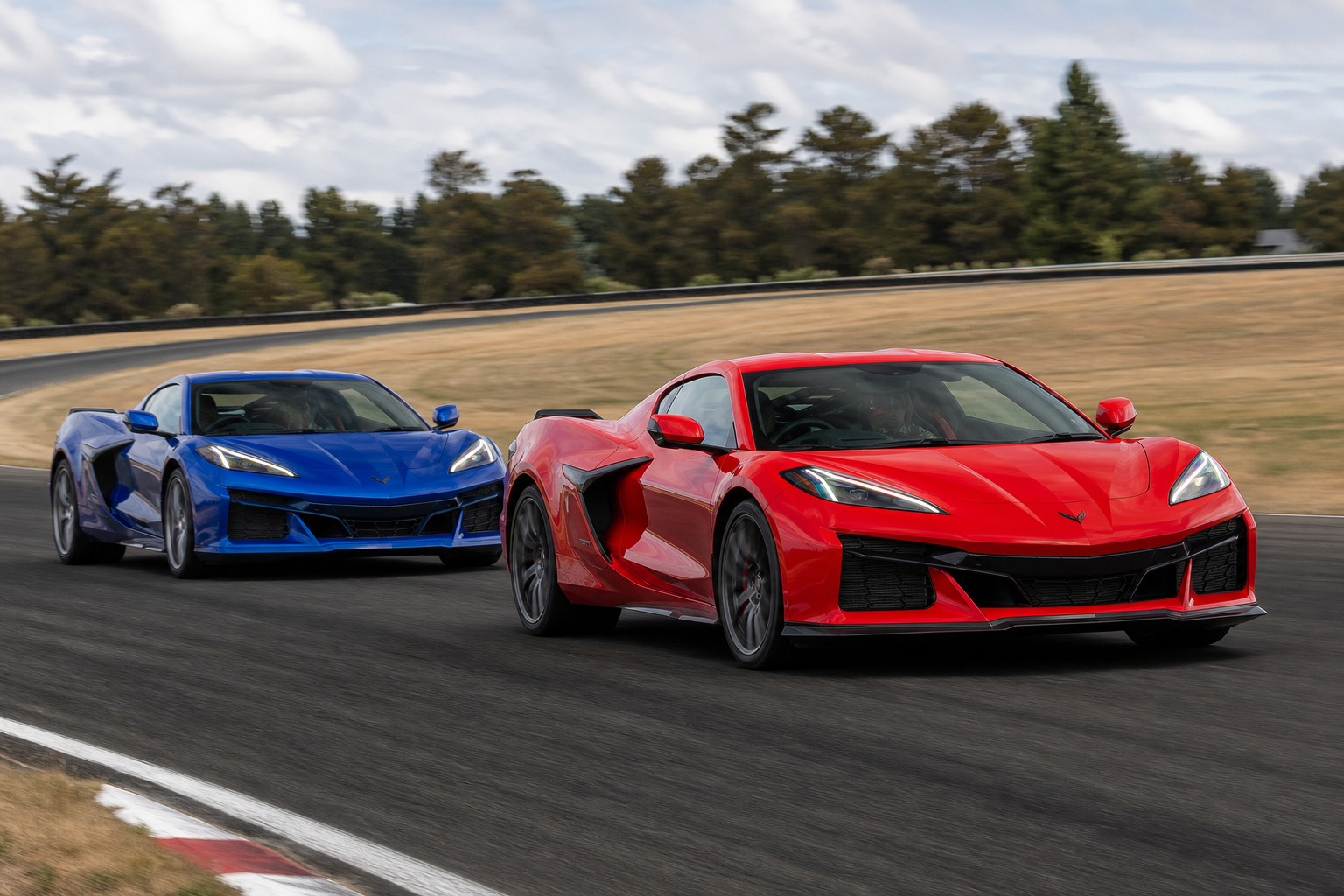

The Chevrolet Corvette Stingray and Z06 have been tested on track together for the first time by the reviewer at Baskerville Raceway in Tasmania, Australia, highlighting the different characters of the two mid-engined models.
The event followed road testing of the C8 Corvette lineup, including the Stingray, E-Ray, and Z06. Baskerville’s narrow layout and short straights provided an opportunity to assess both cars through its corners, where the Z06’s sharper responses contrasted with the Stingray’s more forgiving setup.
Updated Stingray retains its 6.2-liter V8
The 2026 Stingray used for the drive was not the newer version recently unveiled in the United States with an upgraded 6.7-liter V8. Instead, it was an older 6.2-liter model fitted with the updated interior. Chevrolet continues to build these earlier models for right-hand-drive markets such as Australia while production of the newer left-hand-drive version has begun.
Australian Stingray pricing starts at AU$193,990 for the 2LT Coupe, rising to AU$222,990 for the 3LT Coupe and AU$232,990 for the 3LT Convertible. All Australian Stingray models include the Z51 Performance Package, which adds larger Brembo brakes, an electronic limited-slip differential, Magnetic Ride suspension, Performance Traction Management, Michelin Pilot Sport 4S tires, and a revised exhaust.
The updated cabin replaces the C8’s divisive row of climate-control buttons with controls positioned beneath the larger infotainment display. The change also creates room for a wireless phone charger, while a third screen near the driver’s door and a revised drive-mode selector add to the interior changes. The drive-mode control reportedly stopped working briefly during the road portion of the test.
Z06 delivers a different track experience
The Z06 examples used at Baskerville did not have the updated interior, although a 2027 model-year Z06 has been confirmed for right-hand drive with those cabin revisions. Australian pricing for that model starts at AU$299,990.
Unlike other C8 variants affected by the mid-cycle changes, the Z06 remains largely unchanged mechanically. Its naturally aspirated, motorsport-derived 5.5-liter V8 produces 637 horsepower and 438 pound-feet of torque in Australian specification. That output is below the 670-hp figure for U.S.-specification cars because Australian models use a Euro-certified exhaust rather than the central quad-exhaust system offered elsewhere.
On track, the Z06’s flat-plane-crank V8 proved to be the most dramatic difference between the two cars. It revs to 8,600 rpm, compared with 6,500 rpm for the Stingray’s engine, and works with the Corvette’s eight-speed dual-clutch transmission. The transmission was smooth during road driving and delivered rapid shifts on the circuit.
Both models were fitted with Michelin Pilot Sport 4 S tires rather than the available Cup 2 tires because of the cold conditions. Even so, the Z06 generated substantial grip at both ends and remained communicative near the limits of adhesion. Its steering became heavier in Z mode, while the traction control remained unobtrusive during smooth driving.
Stingray offers a more forgiving setup
The Stingray was slower to accelerate but remained highly capable around Baskerville, where cornering speed mattered more than maximum power. Its suspension absorbed surface imperfections more effectively than the Z06, whose firmer spring rates made it more sensitive to bumps and undulations.
The Z06 was the more intense track car, but the Stingray offered greater comfort and composure over a long day. Both cars withstood several hours of circuit driving without reported problems with their brakes or tires. The experience also demonstrated why the track is the appropriate setting for exploring the performance of the C8 Corvette beyond what is possible on public roads.
0 Comments