
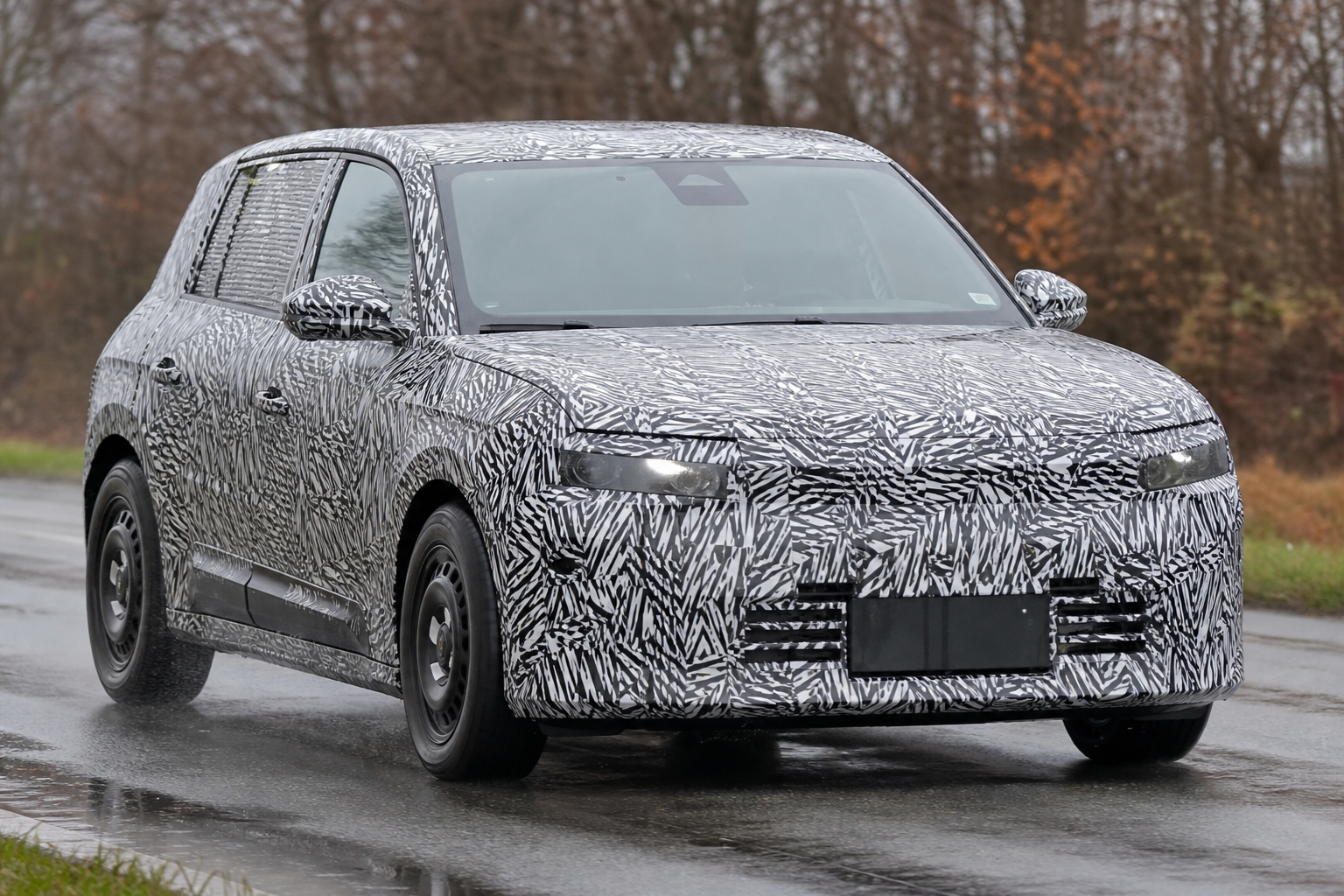

Peugeot’s next-generation E-208 has been photographed during development testing in Spain, offering an early look at the electric supermini’s redesigned exterior and interior. The model is expected to reach the market in the second half of 2027 and will be among the first production vehicles based on Stellantis’ STLA One architecture.
The camouflaged prototype is substantially more conventional than the Peugeot Polygon concept shown in 2025. Instead of the concept’s gullwing doors and futuristic greenhouse, the production car uses a familiar five-door hatchback shape that remains similar in overall layout to the current 208.
New exterior design
The front features split lighting and a fully enclosed grille. Camouflage obscures part of the lighting signature, but the car is expected to use three horizontal LED elements inspired by Peugeot’s claw motif.
Its side profile appears slightly more upright and squared-off, with a greenhouse influenced by the classic Peugeot 205. A shorter rear overhang leads into a more vertical tail, where the taillights also appear to use three horizontal lighting elements. The roof spoiler extends toward the sides of the rear window, a design intended to support aerodynamic performance.
Visible panel lines around the rear doors suggest that the new model could retain plastic wheel-arch cladding, which is optional on the current 208 and E-208. The prototype uses conventional door handles and black steel wheels. Production entry versions will most likely use aerodynamic covers over those wheels.
Interior previews new digital systems
Spy images provide a limited view of the cabin, including a large digital instrument display positioned ahead of the driver and a separate infotainment screen. Both are expected to form part of Peugeot’s STLA Smart Cockpit system.
The prototype also shows a rectangular steering wheel. Peugeot’s “Hypersquare” design, previously shown on concept vehicles, uses four circular openings and integrated controls. It is intended to work with steer-by-wire technology and could support more advanced autonomous-driving functions.
The E-208 is also expected to use Stellantis’ STLA Brain software architecture, making it a software-defined vehicle with its electronic systems and software integrated into a single unit.
Electric powertrain and shared architecture
Peugeot has confirmed that the new small hatchback will use the STLA One platform, which will also underpin the next-generation Opel Corsa Electric. At launch, the new Peugeot is expected to be offered exclusively with fully electric powertrains, with greater range and faster charging than the outgoing E-208.
The current 208 will remain on sale as an internal-combustion alternative, retaining its existing gasoline and mild-hybrid powertrains. Peugeot is also expected to continue offering the E-208 GTi, introduced earlier in 2026 as the range’s performance flagship.
Stellantis siblings and rivals
The new E-208 will enter a growing European subcompact EV market that includes the Renault 5 E-Tech, Nissan Micra, Volkswagen ID. Polo, Cupra Raval, BYD Dolphin, Geely EX2 and Aion UT.
Beyond the Opel Corsa Electric, which is expected to be produced at the same Spanish factory, the STLA One technical base is expected to spread to future replacements for models including the Peugeot 2008, Opel Mokka, Jeep Avenger, Fiat 600, Alfa Romeo Junior and Lancia Ypsilon.
The E-208 is one of seven new Peugeot models slated for launch by 2030. Peugeot has also announced two concept debuts for next week’s Paris Motor Show, although their body styles and potential production roles have not been detailed.
0 Comments