
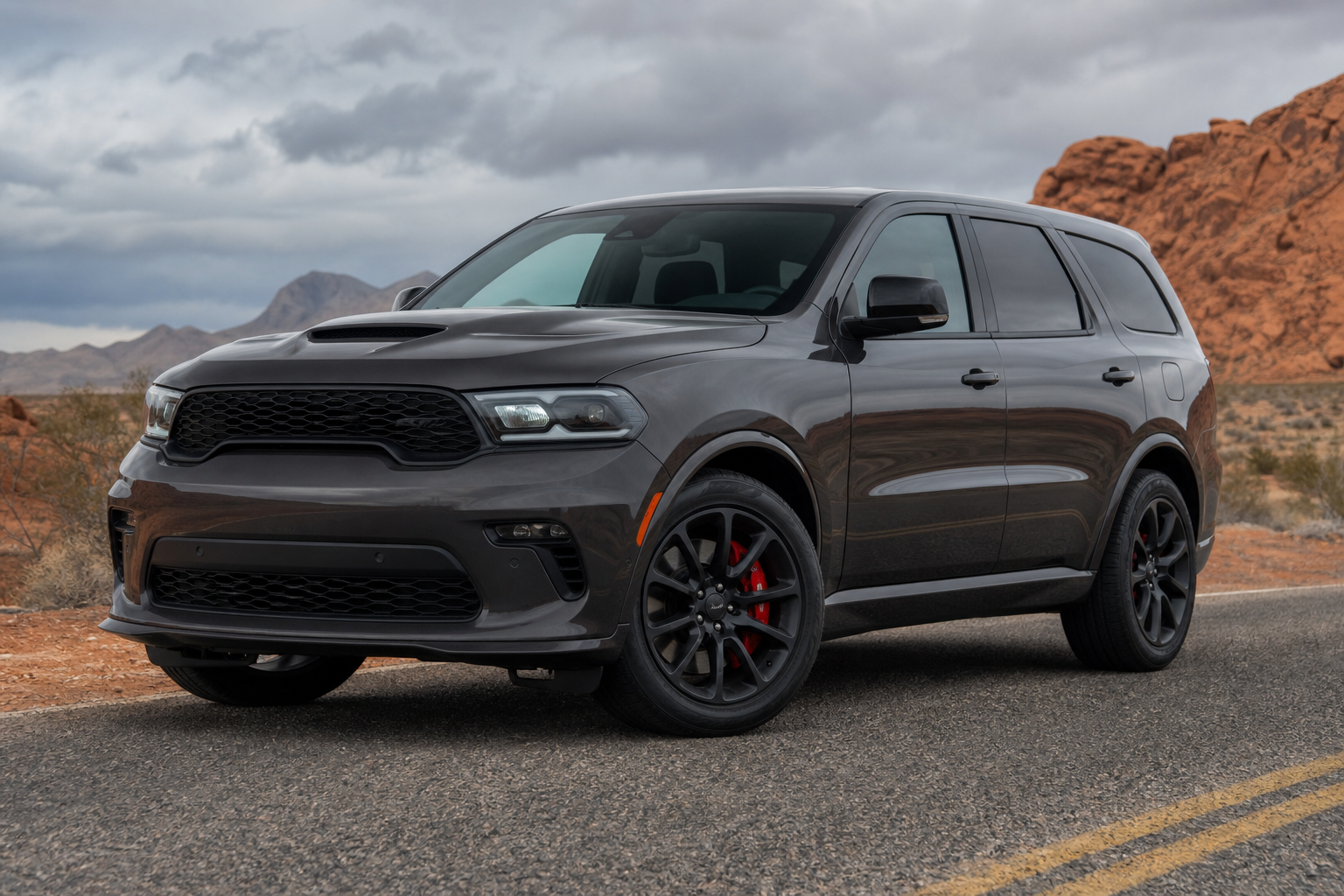

The 2026 Dodge Durango R/T 392 remains one of the most entertaining three-row SUVs available, pairing a 475-horsepower 6.4-liter V8 with useful towing capability and predictable handling. Its aging cabin and high option prices, however, make the value proposition far less convincing once the sticker climbs beyond the base model.
Base pricing makes a strong case
The Durango R/T 392 starts at $51,990 including destination. The reviewed vehicle totaled $65,425, with $5,835 of that amount going toward Red Oxide paint, the Blacktop package, Lights Out wheels and stripes. The 392 engine itself does not require an additional charge because it is included with the model.
That pricing compares favorably with a 2025 Durango R/T previously reviewed at $72,460, despite that vehicle using the smaller 5.7-liter Hemi V8. The two examples were equipped differently, so the figures do not represent a direct model-year price comparison. They do show how quickly the options list can alter the Durango’s value.
Familiar styling and an older cabin
The Durango’s upright, broad proportions remain well suited to a large family SUV. Although Dodge has made design changes since this generation arrived for the 2011 model year, the basic shape is still recognizable. The reviewed vehicle’s dark trim, wheels and stripes add visual distinction, but the test found it difficult to justify nearly $6,000 for appearance-related upgrades on a design that already works without them.
Inside, the vehicle’s age is more apparent. The chunky dashboard, door panels and dark materials give the cabin a dated appearance. The seats are broad and comfortable, while the second and third rows are simple and reasonably spacious. Access to the rear seats is easy, although the third row is less suitable for extended trips by taller adults. With four occupants, or a family carrying children, the Durango offers a more convincing balance of seating and cargo space.
A 10.1-inch infotainment display updates the cabin somewhat. The system includes performance pages with acceleration timers and G-force displays, and the physical controls below the screen remain easy to use. Heated and ventilated front seats, heated second-row seats, adaptive damping, Brembo brakes, an electronic limited-slip differential and smartphone integration are listed as standard equipment, rather than requiring the $7,600 Premium package.
V8 performance remains the main attraction
The 6.4-liter V8 produces 475 horsepower and 470 pound-feet of torque, substantially exceeding the original R/T’s 360 hp and 390 lb-ft from its 5.7-liter engine. An eight-speed automatic transmission replaces the 2011 model’s five-speed unit and was described as responsive and predictable during testing.
Dodge quotes a 4.4-second 0-to-60-mph time. Testing on an unprepared road produced a best result of 4.8 seconds with rollout subtracted, or 5.06 seconds from a standstill. The Durango’s appeal extends beyond acceleration figures: steering response is consistent, the body remains predictable through corners and the brakes deliver progressive stopping power.
The Durango is still a large, heavy SUV rather than a sports-SUV benchmark. Even so, its comfortable ride, quiet highway behavior and lack of exhaust drone at cruising speeds make the V8 usable for everyday driving. Fuel economy remains a drawback, with ratings of 13 mpg city, 19 highway and 15 combined. The test did not produce an observed fuel-economy average.
Useful capability, but strong competition
Properly equipped, the Durango R/T 392 is rated to tow 8,700 pounds. That is considerably more than the Ford Explorer ST’s 5,000-pound rating. The Explorer offers a newer cabin and a rear-wheel-drive configuration, while the Durango’s lower starting price gives it a financial advantage: $51,990 including destination versus roughly $57,000 for an Explorer ST after delivery.
The review’s conclusion favors the base-priced Durango R/T 392. It retains its comfort, utility and distinctive V8 character after 15 years, but the dated interior and fuel costs become harder to accept as options push the price higher. At $51,990, it is compelling; at $65,425, the case for alternatives becomes much stronger.
0 Comments