
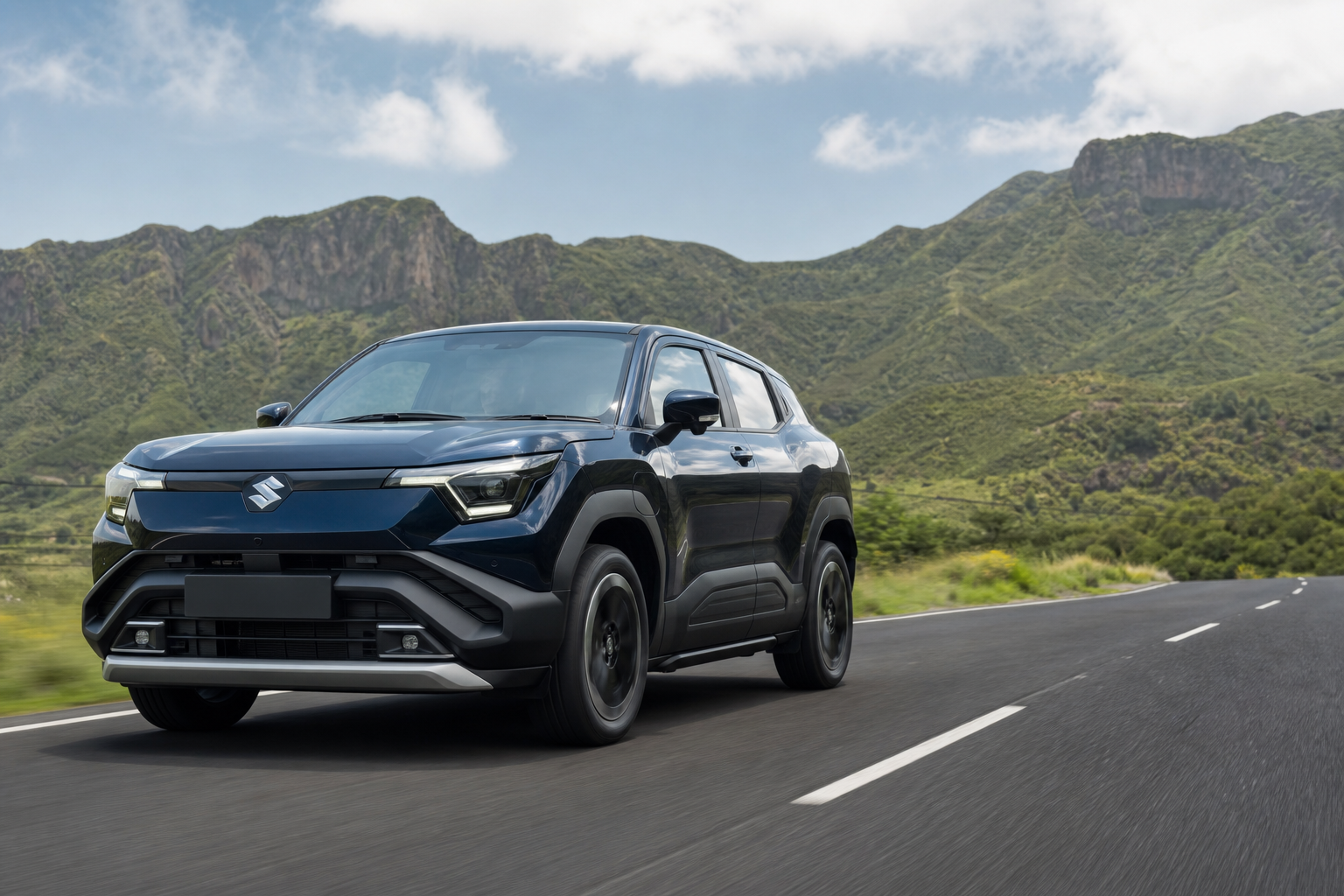

Suzuki has outlined a 10-year technology roadmap centered on modular powertrains, faster vehicle development and lower weight. The plan includes a new turbocharged gasoline engine, a more efficient mild-hybrid system and a modular series-hybrid family that will eventually include Suzuki’s first light range-extender setup.
Shared electric drive hardware
The 3-in-1 e-Axle used by the fully electric e Sky kei car is set to evolve into a 6-in-1 unit. Suzuki says the expanded system will retain the current dimensions and be shared across battery-electric and hybrid vehicles under its “Right x Light Mobile Tech” approach.
A version that is 10% larger is also planned for subcompact, compact and midsize models. Urban vehicles such as the e Sky are expected to use a 94-hp (70-kW/95-PS) front electric motor, with four-wheel-drive versions adding a 13-hp (10-kW/14-PS) rear motor.
Larger vehicles will use a 174-hp (130-kW/177-PS) primary e-Axle, with an optional 40-hp (30-kW/41-PS) e-4WD motor at the rear. Suzuki also wants its electric motors to avoid heavy rare-earth materials, which it says would improve their recyclability.
Series hybrids could evolve into range extenders
The upcoming mild-hybrid system for smaller vehicles targets a 15% reduction in carbon emissions, equivalent to 150 kg (331 pounds) less CO2 per 10,000 km (6,214 miles). Suzuki’s more advanced Series HEV system targets a 29% reduction, or 300 kg (661 pounds) less CO2 over the same distance.
In the Series HEV configuration, the internal-combustion engine will operate as a generator rather than directly driving the wheels. Suzuki says this architecture could be developed into a “REEV Light” system by adding plug-in capability and using a right-sized battery pack. The proposed range extender would not require the larger battery associated with many battery-electric vehicles.
According to reporting cited in the source, the Baleno hatchback and Fronx SUV are expected to be among the smallest Suzuki models to receive the Series HEV system. The S-Cross, Vitara, Grand Vitara and Victoris are also potential candidates.
New turbocharged gasoline engine
Suzuki is continuing to develop combustion-engine technology alongside its electrified systems. A direct-injection turbocharged gasoline engine is being developed for markets including India, with a CNG version likely to follow.
The company’s longer-term objective is to increase engine thermal efficiency from the 40% achieved by the current 1.2-liter Z12E three-cylinder engine to 50% in future powertrains. Technologies under consideration include high-EGR lean combustion, waste-heat recovery, low-viscosity lubricants, nano-carbon materials and an improved Miller-cycle operation.
Weight reduction and faster development
Suzuki expects stricter safety and emissions rules from 2030 onward to add about 80 kg (176 pounds) to each vehicle. Its “S Light” initiative aims to offset that increase by removing 100-120 kg (220-265 pounds) per vehicle across the lineup without compromising safety.
Measures include smaller-headed M8 bolts and 1,470-MPa ultra-high-tensile steel in crash-critical areas. The roadmap also references “SDV Lite,” a simplified software-defined vehicle architecture, along with standardized driver-assistance systems. From 2031, a Central Zone ECU is intended to reduce electronic costs by 30% and module weight by 15%.
Suzuki wants to cut vehicle development time to 24 months by 2030, while targeting 30% higher development efficiency and 50% greater production efficiency at its Manesar plant in India. The company also aims to raise annual manufacturing capacity in India to 4 million vehicles by 2030.

0 Comments