
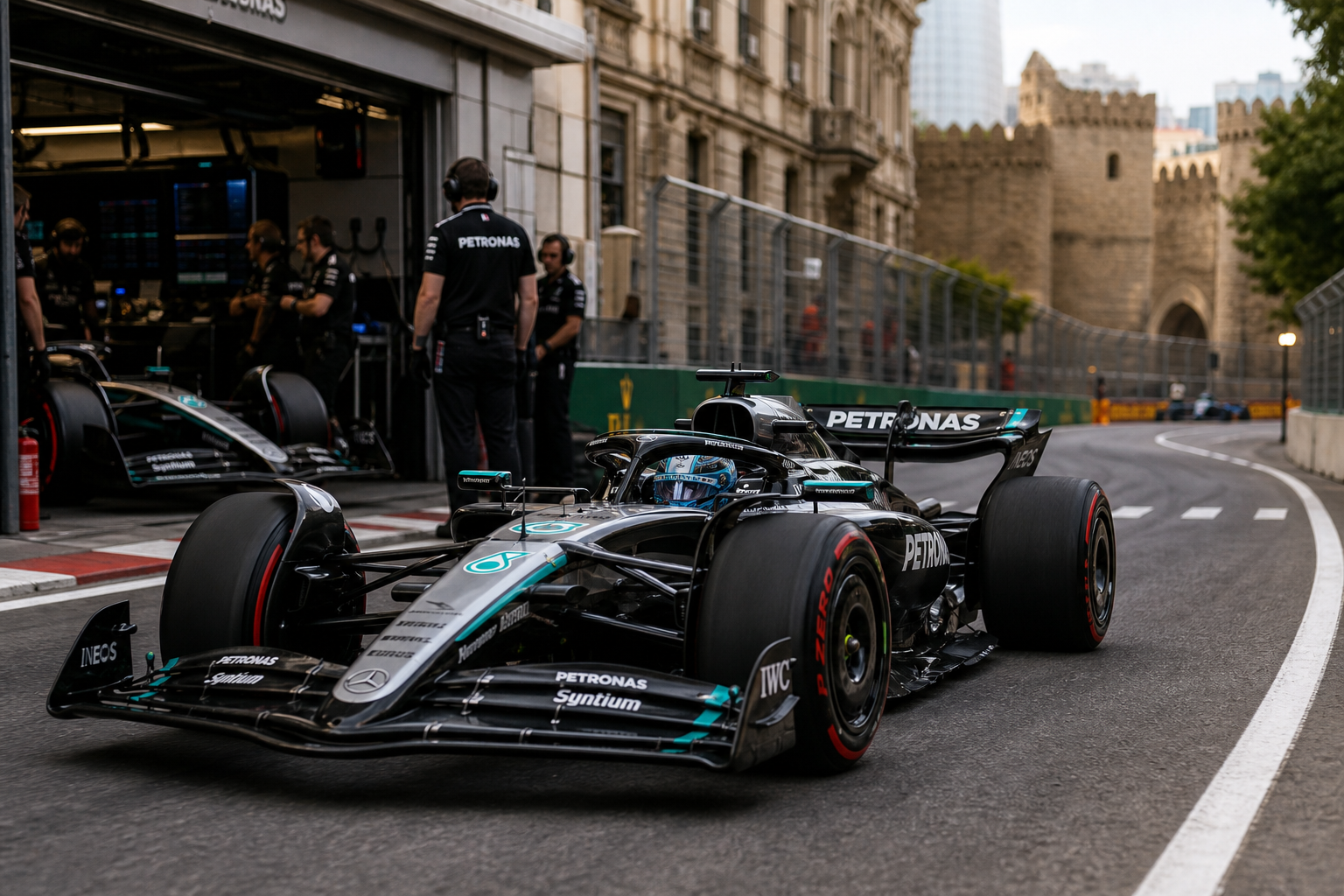

George Russell gave Mercedes the early bragging rights at the Azerbaijan Grand Prix, setting the fastest time in the opening free-practice session while his teammate Kimi Antonelli spent most of the hour watching from the sidelines after his Mercedes broke down.
Russell’s best lap, a 1:45.387 set with roughly 20 minutes remaining, was enough to put him ahead of Max Verstappen. Ferrari’s Charles Leclerc completed the leading group named from the session, while Antonelli’s mechanical problem left Mercedes with only one car gathering useful data around Baku’s unforgiving street circuit.
Russell Gets Mercedes Moving Quickly
There is no gentle introduction at the Baku City Circuit. The track combines a long, flat-out run toward the old city with tight, technical corners and walls that appear to have been positioned by someone with a personal dislike of front wings. A competitive lap demands straight-line efficiency, confidence under braking, and enough mechanical grip to keep the car from behaving like a shopping trolley with one duff wheel.
Russell’s 1:45.387 suggests Mercedes found a productive starting point during the first hour. That does not make the team favorite for the weekend, nor does it tell us how much fuel each driver was carrying or which tire programs were being used. Free practice is full of such small print. Still, a clean early session matters at Baku because teams have limited room for error and very little margin for recovering lost track time.
Russell set his benchmark late enough in the session to show that Mercedes continued to improve as the track evolved. Street circuits often change quickly as more rubber is laid down, and drivers can gain substantial confidence once the initial layer of dust and surface dirt begins to clear. The important detail for Mercedes is that its leading time came from a proper late-session push rather than an opening-lap flier that survived only because nobody else had warmed up yet.
Antonelli’s Session Ends Before It Really Begins
The more awkward story for Mercedes was parked in the garage. Antonelli encountered a problem early in the session and was unable to continue, turning what should have been a valuable hour of preparation into a decidedly expensive viewing exercise.
The available information does not identify the failed component, so there is no sensible reason to pretend otherwise. What is clear is the practical consequence: Antonelli lost track time at a circuit where every lap helps. Baku asks drivers to build confidence carefully, particularly through the fast sections and the narrow passage around the historic city walls. A driver who misses most of that process is forced to catch up while the rest of the field is already refining setup and braking references.
There is also a cost for the engineers. One car can provide useful information about balance, tire behavior, ride height, and the compromises required between the circuit’s slow corners and its enormous straight. It cannot provide the same range of comparison as two cars running different settings. Mercedes now has less data from Antonelli’s side of the garage and less opportunity to test whether Russell’s direction works equally well for both drivers.
Why Baku Makes Practice Times Tricky to Read
The fastest lap is always the headline in a practice session, but Baku is particularly good at making early rankings look more meaningful than they are. Teams must choose between low drag for the long straight and enough downforce to keep the car stable through the slower, more awkward sections. There is no setup that makes every part of the lap happy. The circuit demands a compromise, and compromises are rarely photogenic in a timing table.
A car trimmed aggressively for speed can look mighty on the main straight while becoming nervous through the corners. Add the low-grip nature of a temporary street circuit, heavy braking zones, and walls close enough to punish a moment of optimism, and the driver’s confidence becomes as important as the stopwatch. A small mistake can ruin a lap, damage the car, or both. Baku is not short of consequences.
That is why Russell’s advantage should be treated as encouraging rather than conclusive. Verstappen and Leclerc will have their own programs to complete, and the competitive order can shift once the field moves into later practice and qualifying preparation. Still, Mercedes would rather begin the weekend at the front than spend Friday diagnosing a fundamental problem. One half of the garage has delivered precisely that reassurance.
Verstappen and Leclerc Keep the Pressure Close
Max Verstappen finished behind Russell in the opening order, with Charles Leclerc also among the session’s leading drivers. Neither result represents a crisis. At this stage, the useful question is not simply who topped the sheet, but whether the front-running cars looked capable of extracting performance without overworking their tires or asking too much of the brakes.
Red Bull has traditionally been judged heavily on how its car handles the circuit’s contradictory demands. Baku rewards a strong top speed figure, but it also exposes any weakness in low-speed rotation and traction. Ferrari faces the same puzzle, with Leclerc’s presence near the front providing an early indication that the Scuderia was at least immediately in the conversation.
The session therefore produced a familiar but intriguing first snapshot: Mercedes at the top, Verstappen close enough to keep the matter unsettled, and Ferrari represented by Leclerc. It is a useful starting point, not a verdict. Formula 1 has spent years teaching everyone that Friday’s fastest lap can age badly by Saturday afternoon.
Mercedes Has Speed, but Also a Missing Data Point
Russell’s pace gives Mercedes something positive to work with, particularly because Baku can punish a car that lacks confidence under braking or becomes unstable over bumps. The team now needs to establish whether that speed remains available when the setup is optimized for the rest of the weekend rather than a single qualifying-style run.
Antonelli’s retirement makes that job less tidy. Mercedes must inspect the car, determine the cause of the failure, and recover as much of his program as possible in the next session. That is the mundane, unglamorous side of racing: while the television cameras celebrate a fast lap, a group of engineers is usually trying to work out why an expensive machine has decided to become modern sculpture.
For Antonelli, the priority will be straightforward. He needs clean running time, a proper feel for the track, and enough laps to reconnect with the car before the weekend’s serious sessions arrive. For Russell, the task is different: convert a promising opening benchmark into evidence that Mercedes can remain competitive when Verstappen, Leclerc, and the rest of the field reveal more of their pace.
So the first session leaves Mercedes in a curious position. It has the fastest car on the timing sheet, but only one driver was able to demonstrate it properly. That is a good headline with an asterisk attached, which is very much the natural condition of Formula 1 on a Friday.
0 Comments