
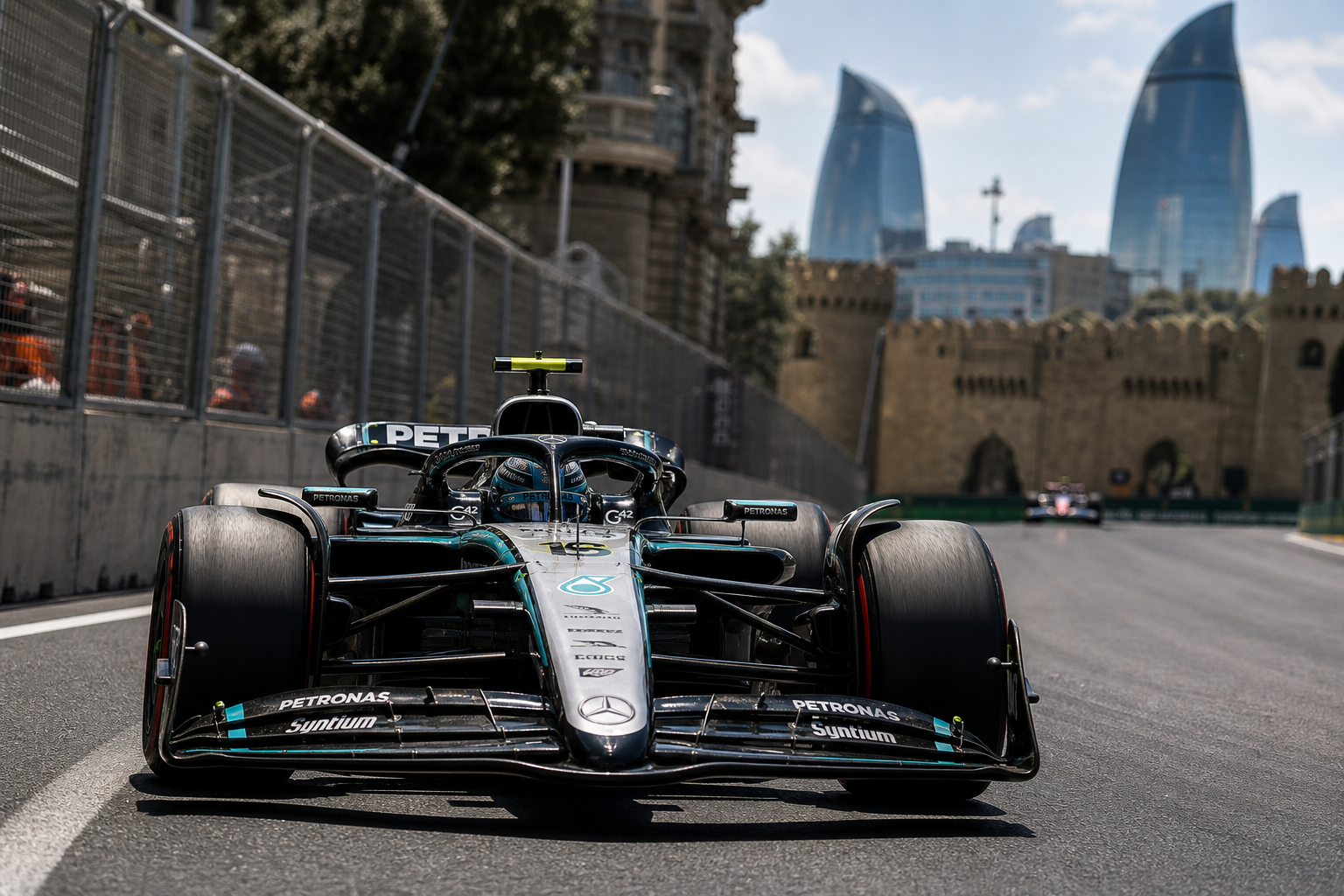

George Russell gave Mercedes the ideal opening to Azerbaijan Grand Prix weekend, but the team’s first practice session was hardly a clean sweep. Russell topped the one-hour session with a 1:45.387 lap, while teammate Kimi Antonelli spent much of the running on the sidelines after his Mercedes encountered trouble early on.
That left Russell carrying the team’s representational duties around Baku’s unforgiving street circuit. He delivered, setting his fastest time with roughly 20 minutes remaining and putting enough distance between himself and Max Verstappen to remain comfortably at the top of the order.
Russell Finds the Pace Late in the Session
Russell’s lap came well into the session rather than during the opening flurry of running. That timing matters at Baku, where the track tends to evolve quickly as more rubber is laid down and drivers gain confidence around the circuit’s concrete walls.
The circuit is an awkward but fascinating compromise. Its long start-finish straight rewards a car with strong top speed and efficient aerodynamic settings, yet the lap also winds through the tight, narrow section around Baku’s Old City. A setup that is brilliant on the straight can feel rather less clever when the track suddenly asks the driver to thread a Formula 1 car through corners with very little room for heroics.
Russell’s 1:45.387 therefore put Mercedes in a useful early position, although free practice times require the usual application of salt. Fuel loads, tire programs and engine modes remain unknown, and teams rarely reveal their hand in the first session of a race weekend. Being fastest is pleasant. Knowing precisely why is rather more useful.
Antonelli’s Early Trouble Limits Mercedes’ Data
While Russell continued building his session, Antonelli’s running ended prematurely after his Mercedes hit trouble. The issue removed one of the team’s two cars from the early work and left Antonelli with limited opportunity to learn the circuit, evaluate tire behavior or help Mercedes compare setup directions.
That is particularly inconvenient on a track as specialized as Baku. Drivers need confidence under braking, stability over the circuit’s bumps and enough rear grip to attack the slower corners without compromising acceleration toward the enormous straight. A lost practice session means fewer chances to establish where that compromise sits.
It also increases the workload on Russell and the engineering group. Mercedes can still use data from the lead car, but the two sides of a garage do not always experience the same problems in precisely the same way. Antonelli will need to recover that lost preparation quickly when the car returns to the track.
Verstappen and Leclerc Complete the Leading Group
Max Verstappen finished behind Russell, with Ferrari’s Charles Leclerc also among the leading runners. The result offered an early glimpse of the expected front-running battle without settling much beyond the fact that Mercedes began the weekend briskly.
Verstappen’s presence near the top is hardly a surprise at a circuit where Red Bull has traditionally been capable of extracting strong performance from its car across long straights and heavy-braking zones. Ferrari, meanwhile, has often looked competitive on street circuits, where precise front-end response and confidence under braking can be worth a great deal.
Still, FP1 is not qualifying in disguise. The first session is primarily about learning the track, checking systems and gathering information. The fastest lap may have been set on a particularly aggressive tire or fuel run, while another contender may have been focused on longer runs rather than headline times. The stopwatch tells us who went quickest; it does not tell us who has the best race car.
Why Baku Punishes Lost Track Time
Baku is one of the few venues where a driver can be wrestling with two entirely different cars during the same lap. The opening and closing sections demand straight-line speed and aerodynamic efficiency. The central section, by contrast, rewards mechanical grip, precision and a willingness to place the car alarmingly close to solid masonry.
That makes practice especially valuable. Teams must understand how the car behaves over the circuit’s bumps, how aggressively the tires can be used and how much downforce they can afford to carry without sacrificing too much speed on the straight. The answer is rarely obvious after a handful of laps.
For Antonelli, the early Mercedes problem removes part of that learning process. The Italian’s weekend is not ruined, but the margin for experimentation has narrowed. He will have to make up ground while also dealing with the normal pressure of a demanding street circuit, where mistakes are not politely absorbed by a gravel trap. Baku tends to send the bill directly to the bodywork department.
Mercedes Has the Lead, Not the Verdict
Russell’s opening-session pace is encouraging for Mercedes, particularly because it came with Antonelli unavailable for much of the running. But the team will need to turn that single-car advantage into a clearer understanding of its setup before the weekend develops.
Verstappen and Leclerc remain close enough in the early picture to keep the competitive order unsettled. More importantly, the leading teams still have practice running ahead in which to adjust aerodynamic balance, tire usage and braking stability. A fast lap in FP1 is a useful line on the timing screen, not a championship trophy.
For now, Mercedes has the headline: Russell at the top with a 1:45.387. The less comfortable footnote is that its second car was forced into an early retreat. On a circuit where every lap teaches the driver something, that may prove more significant than the first session’s final order.


0 Comments