
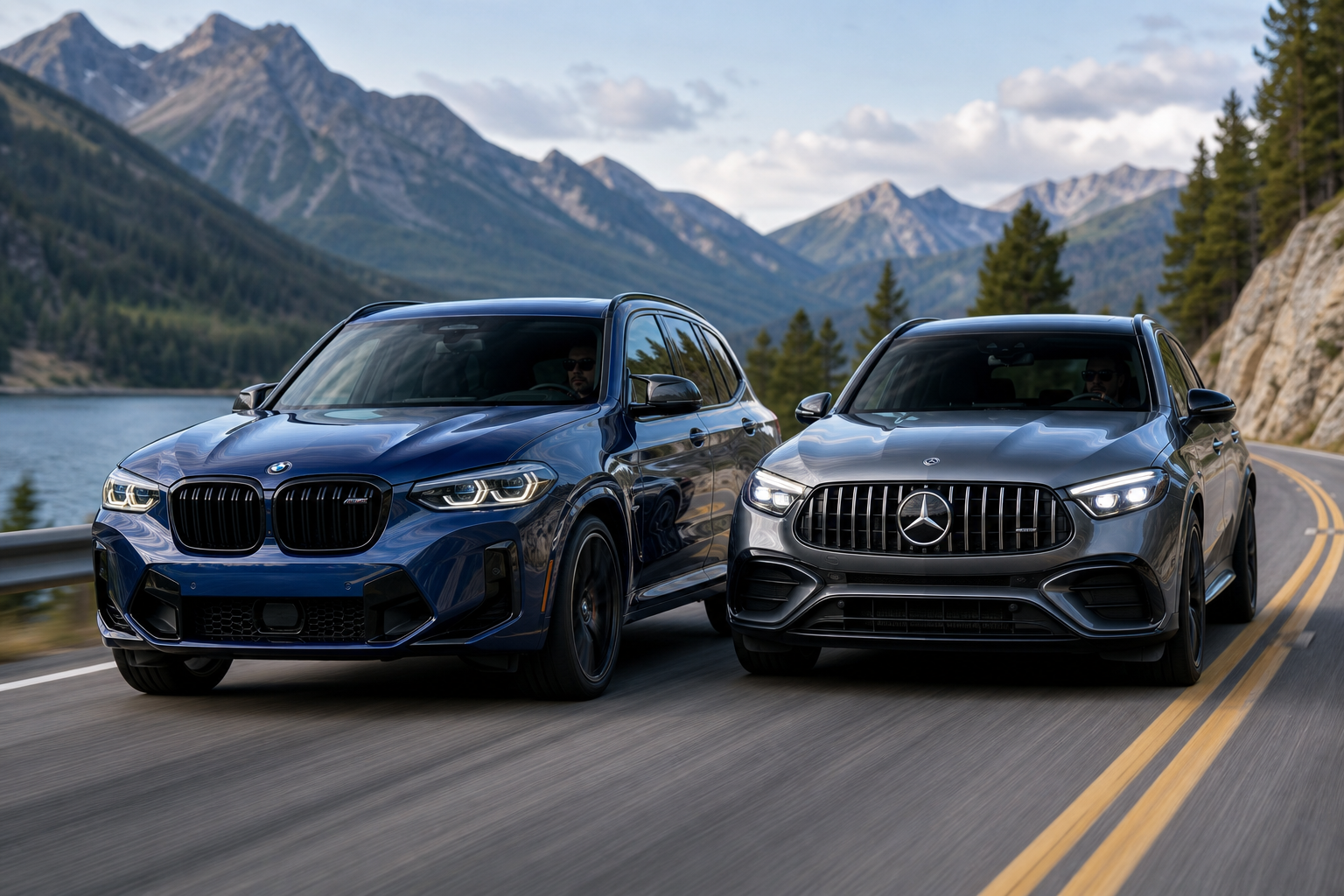

BMW and Mercedes-AMG are doing what they have been doing for decades: placing two performance-minded machines next to each other and daring everyone to decide which one feels more convincing. This time, the contestants are the 2026 BMW X3 M50 and the 2027 Mercedes-AMG GLC53.
Neither is a stripped-out sports car wearing a thin disguise. These are premium compact SUVs expected to handle daily commutes, family duties, poor weather, long highway drives, and the occasional enthusiastic blast down a winding road. That is a rather broad job description. A Miata only has to be fun. An SUV has to remember where it left the groceries.
An Old Rivalry in a New Shape
The BMW X3 and Mercedes-Benz GLC have long occupied the same part of the market, with the M50 and AMG GLC53 adding extra power, sharper chassis tuning, more aggressive styling, and a larger bill. Their rivalry is familiar, but the latest versions arrive at a time when manufacturers are trying to make performance SUVs feel both more sophisticated and more efficient.
That creates an interesting test. The question is not merely which vehicle is faster in a straight line. Buyers considering either model will want to know which one feels more natural at normal speeds, which one is easier to place on a narrow road, and which one remains agreeable after the novelty of its exhaust note and oversized wheels has worn off.
Because both vehicles sit above their ordinary SUV counterparts, the comparison also examines whether the extra performance equipment changes the driving experience in a meaningful way or simply turns the same practical vehicle into a louder, more expensive object. There is a difference between genuine engineering substance and adding decorative menace to the bodywork. The industry has occasionally confused the two.
What the Comparison Needs to Settle
A proper comparison between the BMW and Mercedes-AMG should begin with the fundamentals: how each vehicle delivers its performance, how confidently it changes direction, and how much of its character survives when the road stops behaving like a racetrack.
Engine response will be important, but so will the transmission calibration and the way each SUV manages its power. A quick vehicle can still feel awkward if the throttle is too jumpy, the automatic transmission hesitates, or the drive modes bury useful settings beneath a touchscreen menu designed by someone who has never tried to adjust a car while wearing gloves.
Steering feel deserves similar attention. Modern performance SUVs can generate impressive grip, yet grip alone does not make a vehicle satisfying. The BMW and Mercedes-AMG need to communicate what their front tires are doing, particularly when the driver carries speed into a corner or encounters a mid-corner bump. An SUV that feels secure but numb may impress during a brief test drive while becoming tiresome over time.
Ride quality will be just as revealing. Sportier suspension tuning is easy to advertise and easy to feel, especially over broken pavement. The clever part is preserving body control without making every expansion joint feel like a personal argument between the chassis and the occupants.
Performance Is Only Half the Job
The X3 M50 and GLC53 must also justify their existence as compact luxury SUVs. That means examining the seating position, outward visibility, cabin storage, rear-seat usefulness, cargo access, and the general ease of living with each vehicle. A performance SUV that demands compromise every time somebody needs to carry luggage is less a versatile machine and more an expensive fitness program for the owner.
Interior execution will likely separate the two in less obvious ways. The important questions are not limited to screen size or the number of available drive modes. Can the driver find the climate controls without taking a scenic tour through the infotainment system? Are the primary controls intuitive? Do the materials and switchgear feel appropriate for vehicles positioned near the top of their respective lineups?
These details matter because the performance hardware is only used occasionally. The cabin, ride, visibility, and interface are present on every trip. A sharp weekend drive cannot entirely excuse a vehicle that becomes irritating during a Tuesday morning commute.
Two Different Interpretations of “Sporty”
BMW and Mercedes-AMG have never approached performance in precisely the same way. BMW traditionally leans toward a driver-focused feel, with an emphasis on balance, response, and the sense that the vehicle is cooperating with the person at the wheel. Mercedes-AMG often brings a more theatrical character, combining strong acceleration with a cabin and exterior treatment that make the vehicle feel like an event even when it is parked outside a supermarket.
Those broad tendencies do not decide the result, but they provide useful context. The best BMW will not necessarily be the best choice for somebody who wants the most dramatic presentation. The most flamboyant AMG will not automatically be the more satisfying vehicle on a challenging road.
That is where a comparison test earns its keep. Brochure figures can establish what each manufacturer claims. A road test reveals whether the machines feel coherent when all their priorities collide: performance, comfort, efficiency, refinement, practicality, and cost.
The Decision May Come Down to Character
With two closely matched premium SUVs, the final choice is unlikely to rest on a single feature. Both are designed to provide speed without abandoning everyday usefulness, and both appeal to drivers who want something more involving than a conventional luxury crossover without moving into a dedicated sports car.
The BMW X3 M50 and Mercedes-AMG GLC53 therefore face a familiar but increasingly difficult challenge. They must be exciting without becoming silly, comfortable without turning soft, and sophisticated without burying the driving experience under layers of software. That is a lot to ask from a vehicle carrying a child seat, a set of golf clubs, and enough computing power to run a small office.
The winner will be the SUV that makes the fewest compromises feel like compromises. If the BMW delivers the more convincing connection with the road, it will appeal to drivers who still want a sense of occasion from the steering wheel. If the Mercedes-AMG proves more rounded, more theatrical, or easier to enjoy every day, its broader personality may carry the argument.
Either way, the comparison gives this long-running German rivalry a suitably modern setting: two compact luxury SUVs, both expected to do nearly everything, and both trying to convince drivers that practicality need not be the end of the fun.

0 Comments