
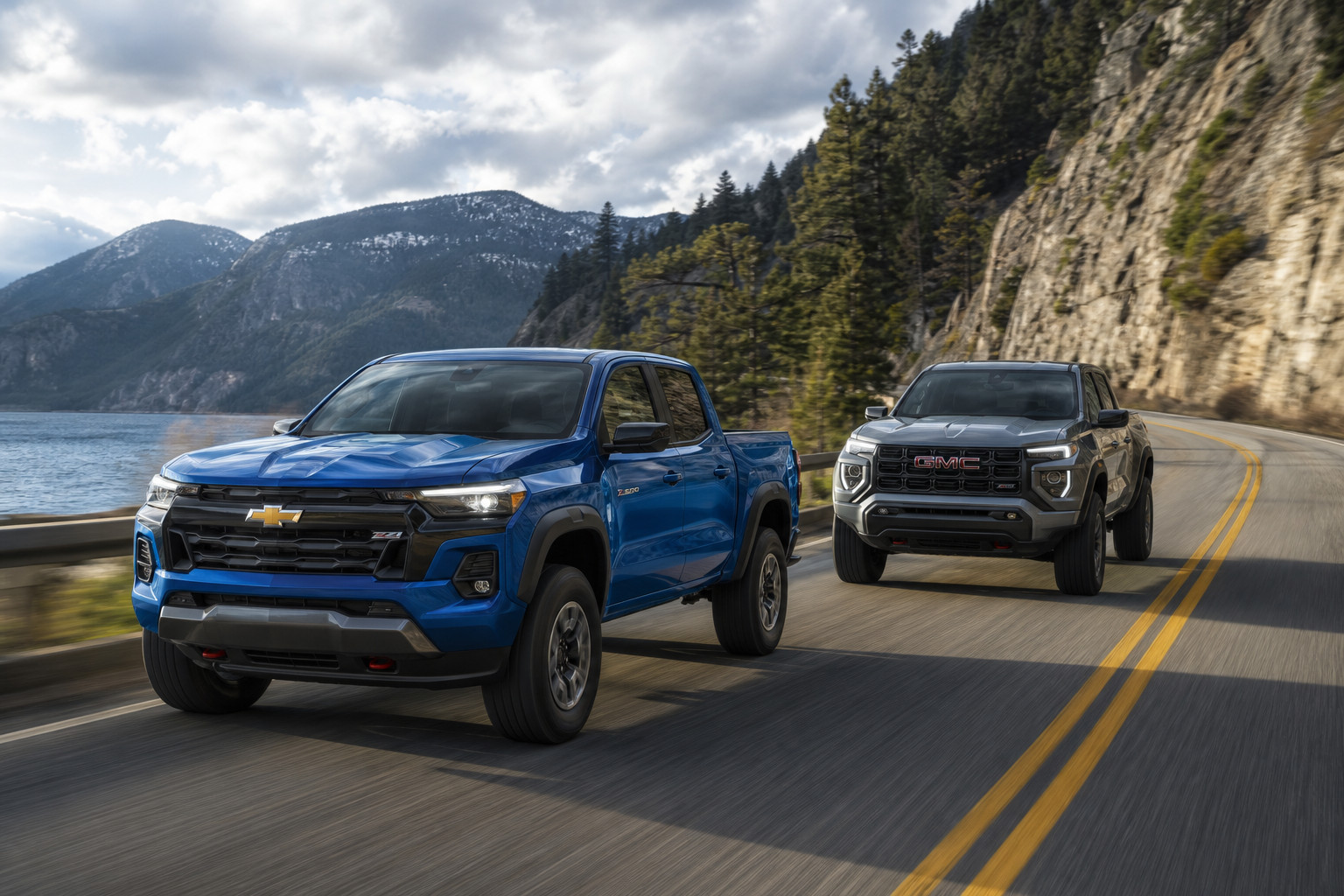

General Motors is giving its midsize pickups a useful shove in the ribs. For 2027, the Chevrolet Colorado and GMC Canyon will use an upgraded version of the L4B TurboMax engine producing 350 horsepower—an increase that should make both trucks feel considerably less out of breath when accelerating, merging, or hauling a trailer.
There is, however, a small catch. GM has increased the headline power figure, but the company has not yet published the complete towing and payload story. That means the 2027 Colorado and Canyon may be quicker without necessarily becoming more capable on paper. Pickups, rather inconveniently, are judged by more than the number printed in the horsepower box.
More Power From the TurboMax Four-Cylinder
The L4B TurboMax is a 2.7-liter turbocharged four-cylinder gasoline engine already used in the Colorado and Canyon. In their current forms, the two trucks rely on turbocharging and substantial low-end torque to do the work buyers expect from a midsize pickup, rather than using a larger six-cylinder engine simply because cylinders are comforting.
For 2027, GM is raising output to 350 horsepower. The company has not provided a full technical breakdown of the upgrade in the available announcement, so it would be premature to claim that the change comes from a revised turbocharger, new engine internals, software calibration, or some combination of those alterations. The sensible assumption is that the power increase involves calibration and hardware changes, but that remains an assumption until GM releases the details.
What the extra output should provide is fairly obvious. A 350-hp Colorado or Canyon ought to have stronger acceleration than the current trucks, particularly when joining a freeway or climbing a grade with passengers and cargo aboard. It could also give the TurboMax a more convincing answer to buyers who like the compact dimensions of a midsize pickup but dislike the idea of making a dramatic event out of passing a delivery van.
Horsepower Is Only Half the Pickup Argument
More power does not automatically mean a higher tow rating. Towing capacity depends on far more than engine output, including transmission durability, cooling capacity, axle gearing, brakes, suspension tuning, tires, frame loads, and the vehicle’s certified gross weight limits. Payload figures are similarly constrained by the truck’s curb weight and axle ratings.
That is why the lack of published towing and payload numbers matters. GM has announced the 350-hp figure, but the available information does not confirm whether the 2027 trucks will tow more, carry more, or simply accelerate harder. Those are three different outcomes, and the marketing department would dearly love us to treat them as one.
For buyers who use a Colorado or Canyon as a working truck, the eventual specification sheet will be more important than the engine badge. A higher tow rating could make the upgrade genuinely useful. An unchanged rating would still make the trucks faster, but it would position the TurboMax update as a performance improvement rather than a capability overhaul.
Why the Upgrade Makes Sense for Colorado and Canyon
The Colorado and Canyon occupy a tricky middle ground. They are easier to maneuver and park than full-size pickups, yet many buyers still expect them to tow recreational equipment, carry construction gear, or handle long highway trips without sounding as if the engine is negotiating its resignation.
That makes additional horsepower particularly useful in everyday driving. Midsize trucks often carry a weight penalty compared with similarly sized SUVs because of their frames, bed structures, four-wheel-drive hardware, and towing equipment. Extra power can make the entire vehicle feel less burdened, even when the official payload and towing limits remain unchanged.
It also gives Chevrolet and GMC a stronger answer to buyers comparing midsize pickups on paper. A 350-hp rating has the sort of clean, persuasive quality that works well in a dealership conversation. It is simple, memorable, and considerably easier to advertise than a paragraph explaining cooling capacity or axle ratings. Numbers are obedient little creatures that way.
What GM Has Not Yet Explained
The missing details will determine how meaningful the upgrade really is. GM has not, in the supplied information, confirmed the engine’s torque output, the rpm range where the additional horsepower arrives, fuel-economy changes, transmission revisions, or whether the 350-hp engine will be available across every Colorado and Canyon configuration.
Those points matter. Horsepower is calculated from torque and engine speed, so an increase that arrives only near the top of the rev range may feel very different from a broader improvement in the midrange. Pickup drivers tend to notice the latter while towing, climbing, or leaving a stoplight with a bed full of inconveniently heavy objects.
GM also needs to clarify whether the upgrade changes the trucks’ cooling systems or recommended maintenance requirements. A more powerful turbocharged engine is not automatically a troublesome one, but higher output can place greater demands on thermal management and drivetrain components. Until the manufacturer publishes the complete specification, there is no reason to turn a horsepower announcement into a reliability forecast.
A Faster Colorado and Canyon, Not Necessarily a Different Truck
The 2027 Chevrolet Colorado and GMC Canyon appear set to become stronger performers thanks to the TurboMax engine’s 350-hp rating. That should improve acceleration and give both trucks more breathing room in normal driving. It is a worthwhile upgrade, particularly for buyers who want midsize dimensions without accepting leisurely performance as part of the bargain.
But the important footnote remains the one printed in invisible ink beneath every pickup advertisement: capability depends on the numbers GM has not yet released. Until towing and payload ratings arrive, the TurboMax upgrade is best understood as a power increase—not proof that the Colorado and Canyon have become more capable work trucks.
That distinction may sound fussy. It is also the difference between confidently towing a trailer and discovering, halfway through a weekend trip, that horsepower was never the limiting factor.


0 Comments