
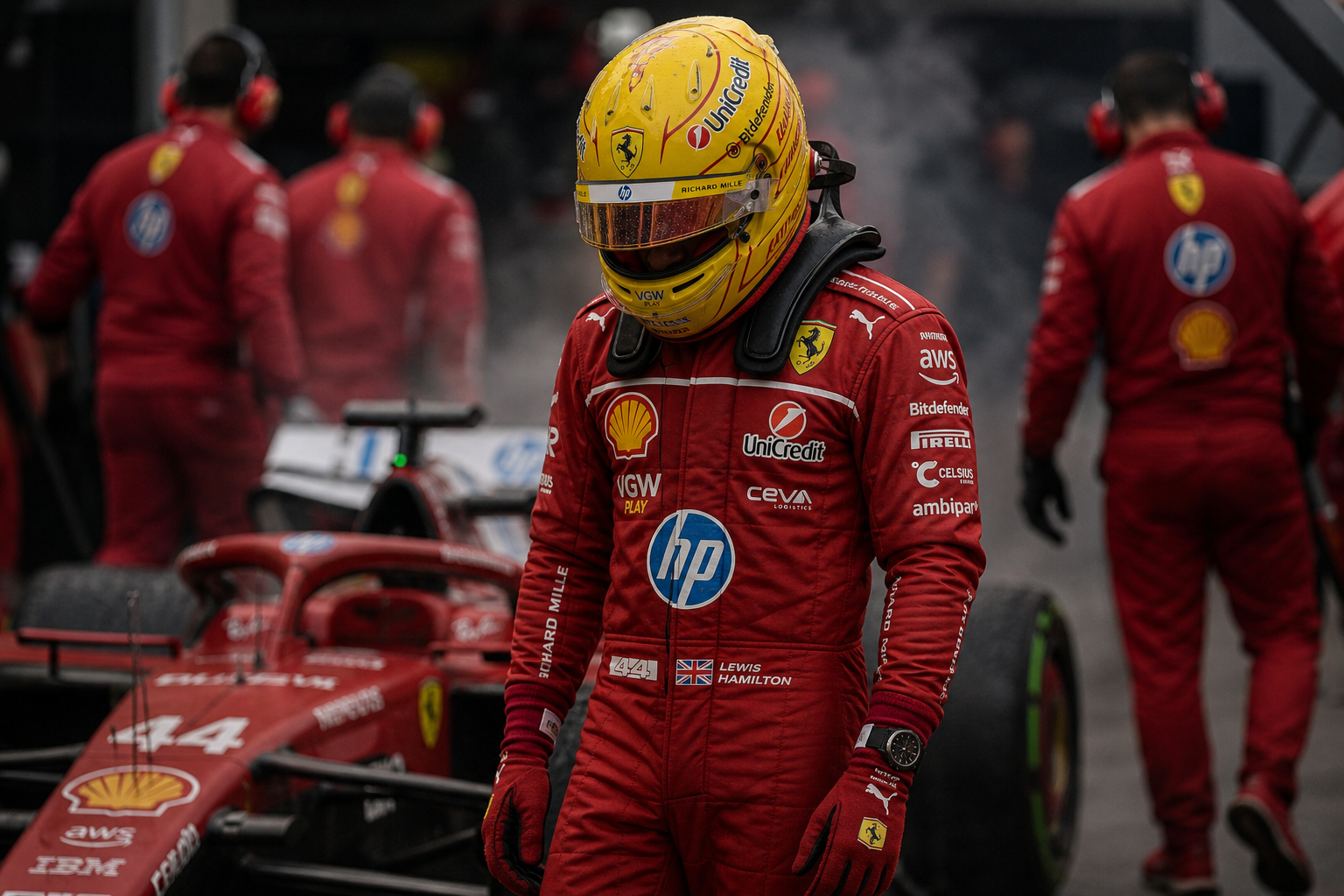

Lewis Hamilton’s Ferrari title campaign has reached the point where even a comeback specialist is calling time on it. After a brake-related retirement at the Spanish Grand Prix, former IndyCar driver and F1 TV pundit James Hinchcliffe declared Hamilton and Ferrari’s 2026 championship hopes “over.”
That is a brutal verdict, particularly with the season still carrying enough uncertainty to make absolute predictions dangerous. Formula 1 has a habit of turning confident declarations into expensive confetti. But the numbers behind Hinchcliffe’s argument are difficult to ignore: Hamilton now sits 101 points behind championship leader Kimi Antonelli after leaving the brand-new Madring circuit without a finish.
A Mechanical Failure With Championship Consequences
Hamilton’s retirement was not the result of a harmless off-weekend or a poor strategic call. A brake issue ended his race, turning what might have been a valuable points haul into a complete blank on the standings sheet.
That distinction matters. Drivers can recover from a bad qualifying session. They can claw back points after a slow pit stop or a questionable tire call. A mechanical failure is more destructive because it removes the opportunity to limit the damage. Ferrari did not merely lose ground at the Spanish Grand Prix; Hamilton lost an entire race in which he could have narrowed the gap to Antonelli.
A 101-point deficit is enormous by any sensible measure. A standard Grand Prix victory is worth 25 points, meaning Hamilton would need to gain the equivalent of more than four outright wins on the championship leader even before accounting for Antonelli’s own results. Sprint events can alter the arithmetic, and Formula 1 seasons can become strange very quickly, but the basic problem remains: Hamilton needs a sustained run of superiority while Antonelli must begin leaving points on the table.
Why Hinchcliffe’s “Over” Call Is So Severe
Hinchcliffe’s statement is deliberately categorical. Saying a championship is “over” is not the same as saying a driver has made the title difficult for himself. It suggests the gap has become too large for a realistic recovery rather than merely mathematically impossible.
Strictly speaking, a 101-point deficit does not automatically eliminate Hamilton from contention. The available points, the number of remaining races, and the relative pace of Ferrari and Antonelli’s car would all have to be considered before anyone could make that claim with mathematical certainty. But championship chances are not decided by mathematics alone. They are shaped by reliability, development speed, team execution, and whether a driver can consistently finish ahead of the rival he needs to beat.
That is where the situation becomes particularly uncomfortable for Ferrari. Hamilton cannot recover those points in the garage. He needs the car to be quick enough to fight at the front, reliable enough to finish, and predictable enough for the team to execute without handing away additional opportunities. One retirement has already created a sizeable hole. Another failure would make the phrase “title hopes” sound increasingly theoretical.
Ferrari’s Problem Is Bigger Than One Lost Race
It would be easy to treat the Spanish Grand Prix retirement as an isolated mechanical mishap. Racing cars break. Even the most polished teams occasionally produce a component that decides it has had enough of motorsport and wishes to pursue a quieter life.
The trouble is that championship campaigns are built from dozens of small gains and avoided losses. A driver who finishes second instead of first loses seven points. A poor pit stop can cost several more. A reliability failure costs everything. When a rival is already leading the standings, every zero becomes particularly painful because the points do not merely disappear; the leader has a chance to extend the advantage without needing to win.
Ferrari therefore needs to solve two problems at once. It must recover the performance gap, if one exists, while also making sure the car reaches the checkered flag. Those goals are related but not identical. Chasing speed can encourage more aggressive setups, tighter operating windows, or development decisions that introduce fresh reliability risks. A championship contender cannot afford to choose between being fast and being dependable, although Formula 1 has often offered teams precisely that charmingly unpleasant choice.
Hamilton’s Ferrari Move Under Greater Pressure
Hamilton’s arrival at Ferrari carries more weight than an ordinary driver transfer. A seven-time world champion is not joining the team merely to add another famous name to the hospitality unit. The expectation is that his experience, race management, feedback, and ability to perform under pressure can help Ferrari challenge for the championship.
That also means the patience traditionally granted to a new driver is likely to be limited. A difficult race can be explained. A run of difficult races becomes a pattern. When the championship deficit reaches 101 points and a technical problem ends another Sunday, the discussion naturally shifts from adjustment period to opportunity cost.
None of this means Hamilton has suddenly become a lesser driver. A brake failure says nothing useful about his ability. It says the car failed him at the worst possible time. But title campaigns are not graded on sympathy, and the standings do not award points for mechanical unfairness. They record who finished and who did not, with all the warmth of a tax form.
Antonelli’s Advantage Is More Than a Number
Kimi Antonelli’s lead gives the situation a second layer. Hamilton is not chasing an abstract points total; he is trying to overhaul a specific championship leader. Every strong Antonelli result makes the task harder, even if Hamilton finishes well himself.
If Antonelli continues scoring consistently, Ferrari cannot rely on one dramatic Hamilton victory to change the picture. It would need a sustained sequence of high finishes, preferably wins, combined with weekends in which Antonelli fails to collect comparable points. That sort of swing can happen in Formula 1, particularly when reliability becomes a factor, but it cannot be ordered from the menu.
The pressure will also extend beyond Hamilton. Ferrari’s second car, race strategy, pit crew, and reliability department all become part of the recovery effort. A title challenge is a team project in the most literal sense. The driver receives the trophy, but the points are won and lost through hundreds of decisions made before and during the race.
Can the Championship Still Turn Around?
Until the points are mathematically unavailable, Ferrari and Hamilton will continue to have a reason to fight. That is not the same as saying the title remains likely. It is simply the difference between possibility and probability.
The next races will reveal whether the Spanish Grand Prix was a one-off failure or evidence of a deeper problem. Ferrari needs the brake issue understood and contained, while Hamilton needs a clean run of weekends in which the car delivers the performance its championship ambition requires. If those things happen, the deficit can begin to shrink. If they do not, Hinchcliffe’s blunt assessment will look less like punditry and more like an early postmortem.
For now, the verdict is harsh but understandable. Hamilton’s 2026 title bid is not officially dead on the information available, yet Ferrari has lost the luxury of ordinary bad luck. From this point forward, every retirement, strategic error, and missed podium will carry the same unpleasant question: was that the weekend when the comeback finally became fiction?


0 Comments