
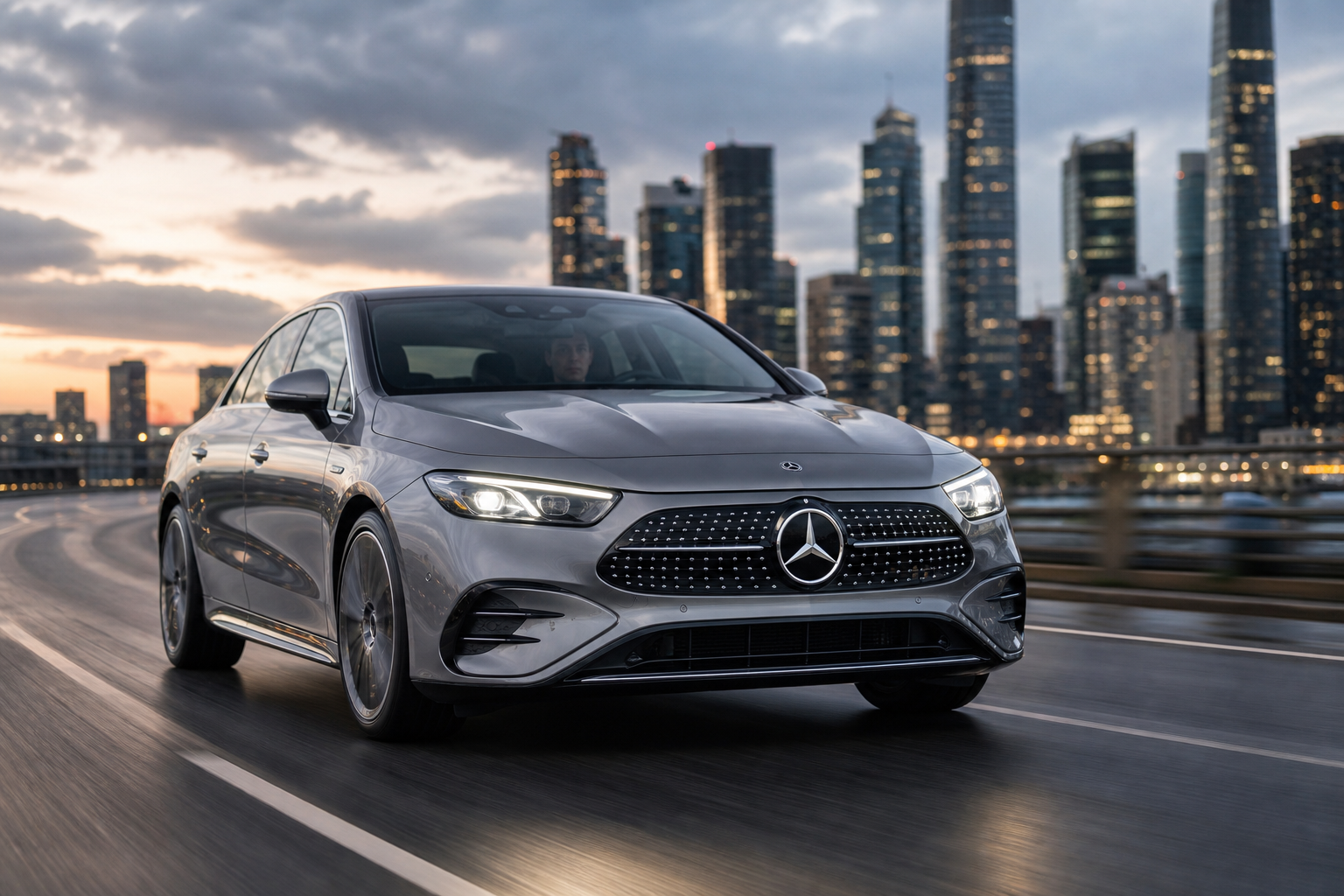

Mercedes-Benz and Wayve are aiming to put a new artificial-intelligence driving system into production vehicles within two years. That is the enticing part. The less glamorous, but rather more important, detail is that the companies have not yet said which Mercedes models will receive it, where those cars will be sold, or precisely when customers can expect to see the system.
The agreement gives Wayve a production route for its AI Driver technology, with Mercedes-Benz set to integrate it as a future driver-assistance system. This is not an announcement of a fully autonomous Mercedes arriving in showrooms with nobody required to pay attention. It is a deal to bring Wayve’s software into the sort of production-car environment where safety validation, regulatory approval, hardware constraints, and the occasional owner who treats a warning chime as a personal insult all become very real problems.
What the Mercedes-Benz and Wayve Agreement Actually Says
The central commitment is straightforward: Mercedes-Benz has signed an agreement with Wayve to integrate AI Driver into future production vehicles. The companies have not identified a model, vehicle platform, market, or confirmed launch date in the available announcement.
The two-year timeframe comes from the headline surrounding the agreement, but it should not be treated as a complete product plan. There is a considerable difference between targeting production integration within two years and promising that a specific Mercedes-Benz sedan or SUV will be available for purchase worldwide by a particular month.
That distinction matters because driver-assistance systems are not ordinary infotainment features. A navigation application can sulk, crash, and restart. A driving system has to deal with road markings that vanish, construction zones that appear overnight, cyclists behaving like they have a death wish, and drivers who believe turn signals are an optional subscription. It must also operate within the legal framework of each market where it is offered.
Why Wayve’s AI Approach Has Attracted Mercedes-Benz
Wayve is known for developing AI-based driving software rather than simply adding another collection of isolated automated functions. The broad ambition behind this type of system is to use machine learning to interpret the road environment and make driving decisions across a wide variety of situations.
That approach is attractive to automakers because the software can, in principle, become more capable through training and development rather than requiring a separate engineering solution for every possible road scenario. It is also the sort of technology that can be adapted across different vehicles if the underlying hardware and safety architecture are suitable.
In practice, however, production integration is where the clever demonstrations meet the paperwork. A system must work consistently in changing weather, at different times of day, across different road layouts, and with the sensors and computing hardware Mercedes-Benz is prepared to install in its vehicles. It must also fail safely when conditions exceed its operating limits.
That last point is crucial. Artificial intelligence may be excellent at recognizing patterns, but a road-going assistance system cannot merely shrug when confronted with an unusual scene. The vehicle needs a clearly defined fallback strategy, understandable driver alerts, and a reliable way of handing responsibility back to the human at the wheel.
Driver Assistance, Not a License to Ignore the Road
The language used around AI driving technology often becomes slippery. “AI Driver” sounds more capable than “advanced driver assistance,” which sounds more exciting than “the car can help in certain conditions but you remain responsible.” The final category is the one buyers need to understand.
Mercedes-Benz has already worked on highly automated driving systems, including technology designed for limited conditions and approved operating areas. Wayve’s involvement suggests a different emphasis: bringing an AI-based driving capability into a broader production-car strategy rather than keeping the software as a research project or a tightly controlled demonstration.
That does not tell us how the future system will operate. It could support highway driving, assist with urban navigation, manage more complex traffic situations, or provide a mixture of functions depending on the vehicle and market. Until Mercedes-Benz names the models and describes the system’s operating conditions, any more precise claim would be guesswork wearing a very expensive press badge.
The Missing Details Are More Important Than They Sound
Several obvious questions remain unanswered.
- Which Mercedes-Benz models will receive AI Driver?
- Will the system be available first on premium vehicles, electric models, or a new vehicle platform?
- Which countries and regulatory markets will support it?
- What sensors and computing hardware will be required?
- Will customers buy the feature outright, subscribe to it, or receive it as part of a trim level?
- What limits will apply to speed, weather, road type, and driver attention?
Those questions determine whether this becomes a meaningful showroom feature or another impressive technology that lives mainly in presentations. A system can be technically sophisticated and still be frustrating if its operating window is narrow, its warnings are intrusive, or its capabilities vary wildly between regions.
The business model will be interesting, too. Automakers are increasingly treating software as an ongoing revenue stream, while customers remain understandably wary of paying a monthly fee for equipment already installed in the car. A useful driver-assistance system could justify its cost. A feature that spends most of its life reminding the driver to keep their hands on the steering wheel may struggle to inspire similar enthusiasm.
Why Production Integration Is the Real Test
Wayve can develop the software, but Mercedes-Benz controls the vehicle environment in which that software must operate. That includes the electrical architecture, sensor placement, braking and steering systems, driver monitoring, safety validation, and the interface that tells the driver what the car is doing.
None of this is particularly theatrical. There is no smoky racetrack, no dramatic launch-control sequence, and probably no opportunity to make the tires squeal for the cameras. It is engineering work of the most demanding kind: making a complex system behave predictably thousands of times in situations that cannot all be rehearsed in advance.
The agreement is therefore significant without yet being specific. It gives Wayve access to a major vehicle manufacturer and gives Mercedes-Benz another route into the rapidly developing field of AI-based driver assistance. But the commercial value will depend on what appears in the final cars, not on how impressive the partnership sounds in a press release.
For now, the sensible reading is cautious optimism. Mercedes-Benz and Wayve have established a production relationship, and the two-year target suggests that neither company views AI Driver as a distant laboratory experiment. The interesting story will begin when they reveal the vehicle, the hardware, the legal operating conditions, and the exact responsibilities left to the person sitting in the driver’s seat.
Until then, keep your hands on the wheel. It remains the least complicated piece of the arrangement.
0 Comments