
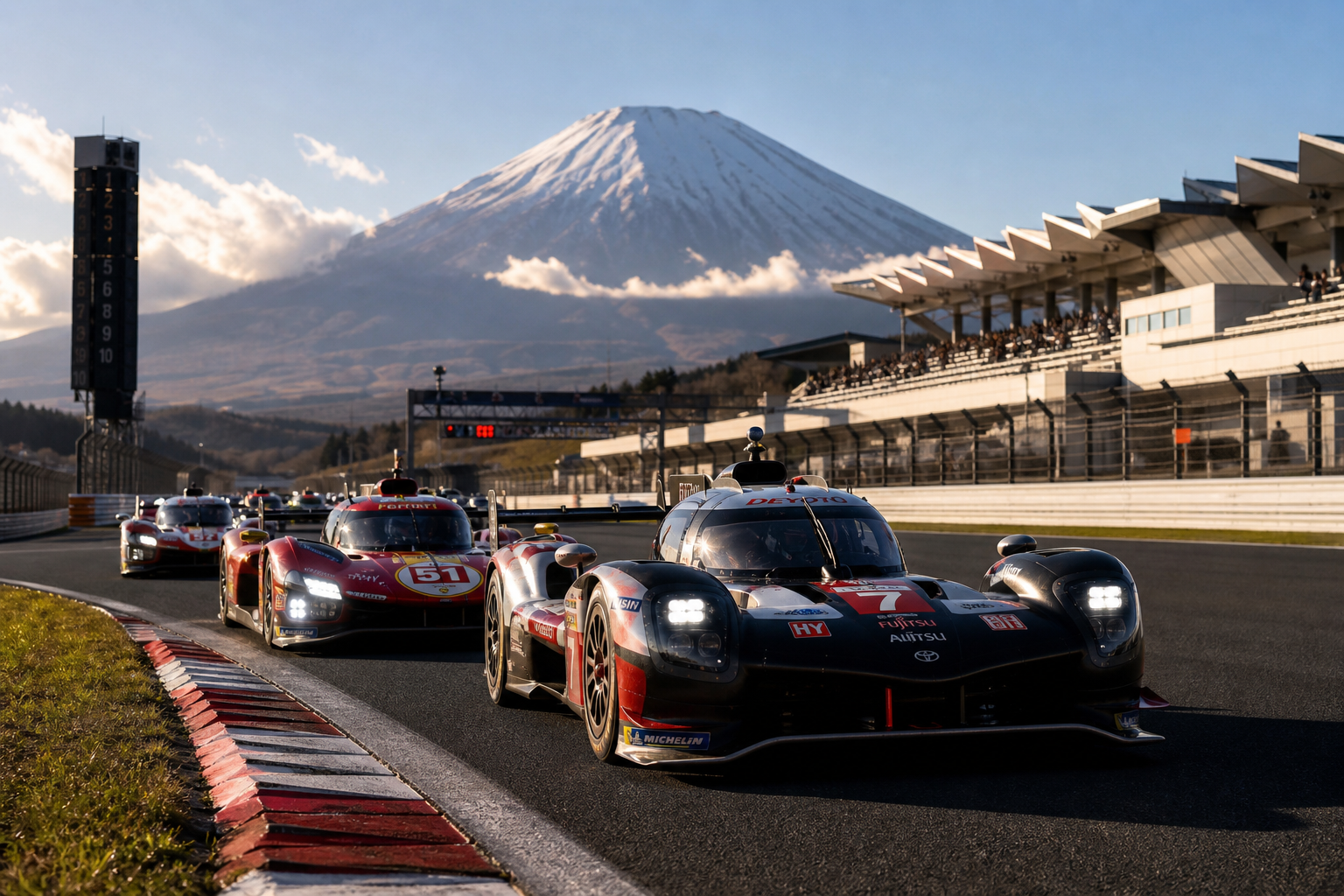

Fuji is not the sort of circuit where a manufacturer can hide a disappointing weekend behind a clever press release. The long straight, heavy braking zones, changing weather and famously imposing Mount Fuji backdrop tend to expose weaknesses rather efficiently. That makes the 2026 Fuji 6 Hours an especially important date for Toyota, which returns home three weeks after a late-race disappointment at the Lone Star Le Mans.
The sixth round of the 2026 World Endurance Championship takes place in Japan from September 25-27. Ferrari arrives with renewed title momentum after the Austin race, while Toyota will be looking for a response on one of the calendar’s most emotionally significant venues. Endurance racing is rarely short of drama, but this one already has a reasonably tidy storyline before anyone has switched on the pit-lane lights.
When Is the 2026 Fuji 6 Hours?
The Fuji 6 Hours runs across the September 25-27 weekend at Fuji Speedway. It is the sixth round of the 2026 WEC season, placing the event deep enough into the championship for every result to carry proper weight, but early enough that the title picture can still change shape rather dramatically.
The weekend will follow the championship’s usual endurance-racing structure, with track activity building toward the six-hour race. That normally means practice sessions, qualifying and the main event, although the exact session-by-session timetable and local start times should be checked against the official WEC schedule as the weekend approaches. The available event information confirms the three-day date window, but does not provide the detailed clock times.
That distinction matters for international viewers. A race beginning in Japan can land at an inconvenient hour for audiences in Europe and North America, because the planet remains annoyingly large and has yet to adopt a universal motorsport time zone.
Why Fuji Matters to Toyota
Fuji Speedway is Toyota’s home race, and that gives the event a significance that goes beyond the points table. The circuit is closely associated with Toyota’s endurance program, while the manufacturer’s presence in Japan ensures that the race carries particular importance for the company, its employees and its domestic supporters.
A home event also brings pressure. Toyota cannot treat Fuji as just another stop on a 2026 schedule when its engineers, executives and fans are watching from nearby. The expectation is not merely to appear with polished hospitality units and a heroic quantity of branded merchandise. Toyota will want a competitive car, clean execution and a result that answers the frustration of Austin.
That late-race disappointment is the immediate backdrop to the Japanese round. The source material does not specify the precise incident or result that harmed Toyota’s race, but the effect is clear: the team has been left chasing a response, and Fuji provides the most obvious place to deliver one.
Ferrari Has Reopened the Title Conversation
Ferrari’s position has improved after the Lone Star Le Mans, with the Austin results breathing new life into its championship hopes. That wording is important. Ferrari has not been handed a title by one race, but it has gained the sort of momentum that can alter the character of an endurance season.
At this stage of a WEC campaign, points are valuable because the leading manufacturers are rarely separated by a comfortable margin for long. A podium can become a victory when another contender suffers a tire problem, a slow pit stop, contact or one of the many small mechanical annoyances that make six-hour races such wonderfully elaborate exercises in stress management.
Ferrari’s task at Fuji will be to turn its Austin revival into consistency. Toyota, meanwhile, needs to stop the momentum from becoming a pattern. That battle should be central to the race, particularly if both manufacturers remain closely matched in qualifying and the opening stints.
Fuji Speedway Rewards Patience
Fuji Speedway has a distinctive layout. The long front straight places a premium on top speed and gives faster cars a useful opportunity to attack, but the lap is not simply a matter of fitting the biggest possible rear wing and hoping for the best. The circuit also contains slower corners and significant braking zones, so teams must make compromises between straight-line performance, tire management and stability under braking.
That compromise becomes more complicated over a six-hour race. A setup that looks clever over one qualifying lap may become less attractive when tires lose performance, fuel loads change and traffic from other classes begins to complicate every braking zone. Hypercar drivers must work around LMGT3 traffic, while the slower cars have to judge mirrors, corner entry and straight-line positioning with considerable care. It is not a place for casual daydreaming.
Weather can add another layer of mischief. Fuji’s conditions can change the grip level and make tire selection especially important, although the precise forecast will not become meaningful until much closer to race week. A dry circuit, a damp track or a brief shower can produce very different strategic problems, particularly around pit-stop timing and the decision to remain on slick tires.
What Fans Should Watch During the Weekend
- Toyota’s response: The home team needs a strong recovery after its Austin disappointment. Pace alone will not be enough; pit work, reliability and traffic management will be just as important.
- Ferrari’s title momentum: Austin revived Ferrari’s championship prospects. Fuji will show whether that was the beginning of a genuine run or merely one very useful afternoon.
- Qualifying performance: Positioning matters at a circuit with a long straight and heavy braking zones. A clean qualifying lap can reduce the need to fight through traffic during the opening stint.
- Weather and tire strategy: Any change in conditions could turn the race into a contest of timing rather than outright pace.
- Traffic between classes: The interaction between the Hypercar and LMGT3 fields will shape overtaking opportunities, pit windows and the risk of avoidable delays.
Fuji 6 Hours Schedule and TV Information
The confirmed event window is September 25-27, 2026. The race forms the sixth round of the World Endurance Championship, but detailed practice, qualifying and race start times are not included in the available event information. Broadcast arrangements and regional television listings should therefore be verified through the official WEC channels and local rights holders before the weekend.
That may sound less satisfying than a neat table packed with times, but publishing invented broadcast details would be rather worse than admitting they have not yet been confirmed. WEC coverage varies by territory, with television and streaming availability often differing between the United States, Europe, Japan and other markets. Viewers should check whether their local listing carries the complete race, qualifying and support-session coverage rather than assuming that every part of the weekend will appear on the same platform.
What is already clear is the sporting importance of the date. Fuji arrives after Austin, with Ferrari’s hopes strengthened and Toyota under pressure to answer in front of its home crowd. Six hours later, the championship picture may look considerably less tidy than it did on Friday morning. That, frankly, is exactly how endurance racing likes it.
0 Comments