
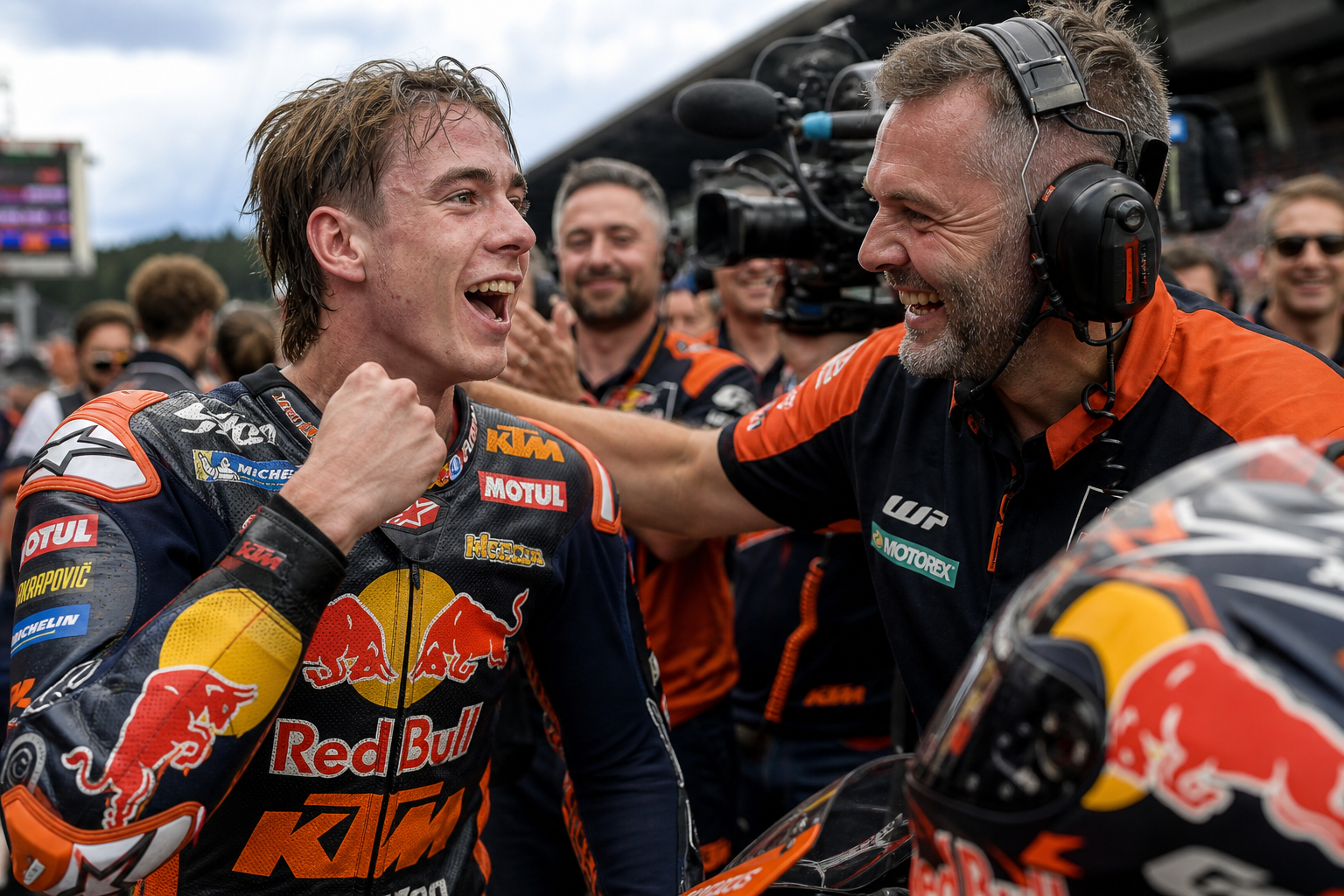

Pedro Acosta’s first MotoGP victory was emotional enough without anyone adding a horror-movie soundtrack. Then his KTM crew chief, Paul Trevathan, described the young Spaniard’s remaining potential as “scary.” That is quite a thing for a senior race engineer to say after finally reaching the top step.
Trevathan wasn’t suggesting Acosta has somehow been sleepwalking through MotoGP. The opposite, really. The breakthrough win at Spielberg showed what the rider and KTM can produce when speed, race execution, confidence, and machinery all line up. Trevathan’s point was that Acosta still has room to improve, and nobody in his camp seems entirely keen on calculating how fast he might become once the rough edges are filed away.
That is the intriguing part of this story. A first MotoGP win is usually treated as the arrival of a rider. In Acosta’s case, it looked more like evidence that the arrival may have happened some time ago and the paperwork is only now catching up.
A Breakthrough Built on More Than Raw Speed
Acosta has never lacked attention. His rise through motorcycle racing was spectacular, and he entered MotoGP with the sort of reputation that can become a burden if the results do not arrive quickly. Young riders are often praised as future champions before they have had time to learn where the bathrooms are in the paddock. Then every mistake becomes proof that the hype was premature.
Acosta’s challenge was particularly demanding because MotoGP punishes impatience. The premier class is not merely a faster version of Moto2 or Moto3. The motorcycles are heavier, more powerful, more physically demanding, and packed with aerodynamic and electronic systems that change how riders attack a corner. Braking performance is immense, tire management can decide a race long before the checkered flag, and a rider has to understand not only how to go fast but how to preserve performance while surrounded by the best competitors on the planet.
Raw talent gets a rider noticed. It does not, by itself, deliver a MotoGP win.
That is why the Spielberg victory carries more weight than a single line on a results sheet. It suggests Acosta and the KTM crew managed to convert his natural aggression into a complete race performance. Trevathan’s comments indicate that the team sees the win as confirmation of progress rather than a final answer.
The Trevathan-Acosta Relationship Matters
Acosta described Trevathan as a father figure after the victory, which gives the result a more personal dimension than the usual post-race handshake and television interview. The two have worked together since Acosta moved up to the next stage of his career, building a relationship through the unglamorous parts of racing: data analysis, setup changes, difficult weekends, arguments over small details, and the long process of teaching a gifted rider how to extract results consistently.
A crew chief is not simply the person who changes the motorcycle’s setup on a Friday afternoon. The role sits at the center of the rider’s technical and emotional support system. He has to interpret data, manage a large group of engineers and mechanics, communicate clearly under pressure, and understand when a rider needs a technical answer and when he needs someone to stop talking for five minutes.
That last skill is probably worth more than it appears. Motorcycle racing is an intensely personal business. The rider is the one absorbing every bump, every braking load, and every moment when the front tire decides it would like to negotiate terms. Trust between rider and crew chief allows the team to work through those moments without panic.
The emotion surrounding Acosta’s win suggests that Trevathan’s involvement goes beyond a conventional professional arrangement. Their partnership has developed during one of the most scrutinized early careers in modern MotoGP, and the victory rewarded both the technical work and the patience required to get there.
Why Acosta Still Has Room to Improve
It may sound odd to discuss untapped potential immediately after a MotoGP win. Surely the difficult bit has been done? Not quite. Winning once proves that a rider can reach the required level. Becoming a regular front-runner requires doing it across different circuits, conditions, tire situations, and technical circumstances.
Acosta still has to refine the less glamorous parts of being a premier-class rider. That includes qualifying execution, tire preservation, race management, and the ability to understand when a fight is worth taking and when it is better to bank points. A rider can be dazzlingly fast and still lose a championship by turning every Sunday into a personal duel with physics.
There is also the matter of adapting to the motorcycle as KTM develops it. A MotoGP rider cannot simply demand a machine that behaves exactly as he wants. Teams are constantly balancing corner entry, drive out of turns, tire life, aerodynamic behavior, and electronics. A setup that feels wonderful over one lap may punish the rear tire over race distance. A bike that is brilliant at one track can expose weaknesses at another.
Acosta’s value to KTM lies partly in his ability to provide sharp, detailed feedback while riding at an exceptional level. The faster a rider becomes, the more useful that feedback can be. Engineers need to know not merely that the motorcycle is slow, but whether the problem appears under braking, at maximum lean, during the transition to throttle, or when the tire begins to fade. The best riders turn discomfort into information.
That learning process is why Trevathan’s description is so revealing. He is not talking about a rider who has reached his finished form. He is talking about a rider whose ceiling remains difficult to see.
KTM Has a Serious Asset on Its Hands
For KTM, Acosta’s breakthrough is both a sporting victory and a useful validation of its long-term investment. The manufacturer has built its MotoGP identity around aggressive engineering, strong rider development, and a willingness to challenge established rivals. A young rider with speed, ambition, and the ability to grow alongside the project is precisely the sort of asset a factory team wants.
There is, however, a difference between finding a fast rider and keeping one happy. Acosta’s trajectory means expectations will rise rapidly. After a first win, every podium becomes evidence of progress, every non-podium result becomes a question, and every technical problem risks being interpreted as a crisis by people who have never had to make a MotoGP motorcycle turn at 200 mph.
KTM will need to give Acosta a machine capable of fighting regularly while allowing him enough freedom to develop his own approach. Young stars do not always respond well to being placed inside a rigid corporate plan. They need structure, certainly, but also room to make mistakes and discover how they want to race at the highest level.
That makes Trevathan’s role especially important. A crew chief can help translate a rider’s instinct into a development direction, preventing the team from chasing every complaint or every rival’s latest trick. Racing departments have enormous amounts of data and remarkably little time. Without a clear relationship at the center, all that information becomes expensive wallpaper.
The First Win Changes the Questions
Before Spielberg, the question surrounding Acosta was whether he could turn his obvious ability into a MotoGP victory. That question has now been answered. The more interesting questions are considerably harder.
Can he win again when the KTM is not perfectly suited to a circuit? Can he manage a championship campaign without allowing one bad weekend to become three? Can he lead development as well as attack a race? Can he maintain the same level of aggression while becoming more efficient and less vulnerable to mistakes?
Those are not criticisms. They are the normal demands placed on a rider once he has shown he belongs at the front. MotoGP is littered with talented competitors who produced one extraordinary afternoon. The riders remembered as greats are the ones who turn extraordinary speed into a habit.
Acosta’s first victory at Spielberg was therefore important, but it was not necessarily the most interesting thing that happened there. The more revealing moment may have been Trevathan looking at a rider who had just achieved the result everyone wanted and still seeing considerable unfinished business.
That is a flattering problem to have. It is also a dangerous one for everyone else in the paddock. If Acosta can add consistency, restraint, and technical maturity to the speed that brought him this far, KTM may not have merely found its next race winner. It may have found the rider who makes the next few seasons rather uncomfortable for its competitors.
0 Comments