
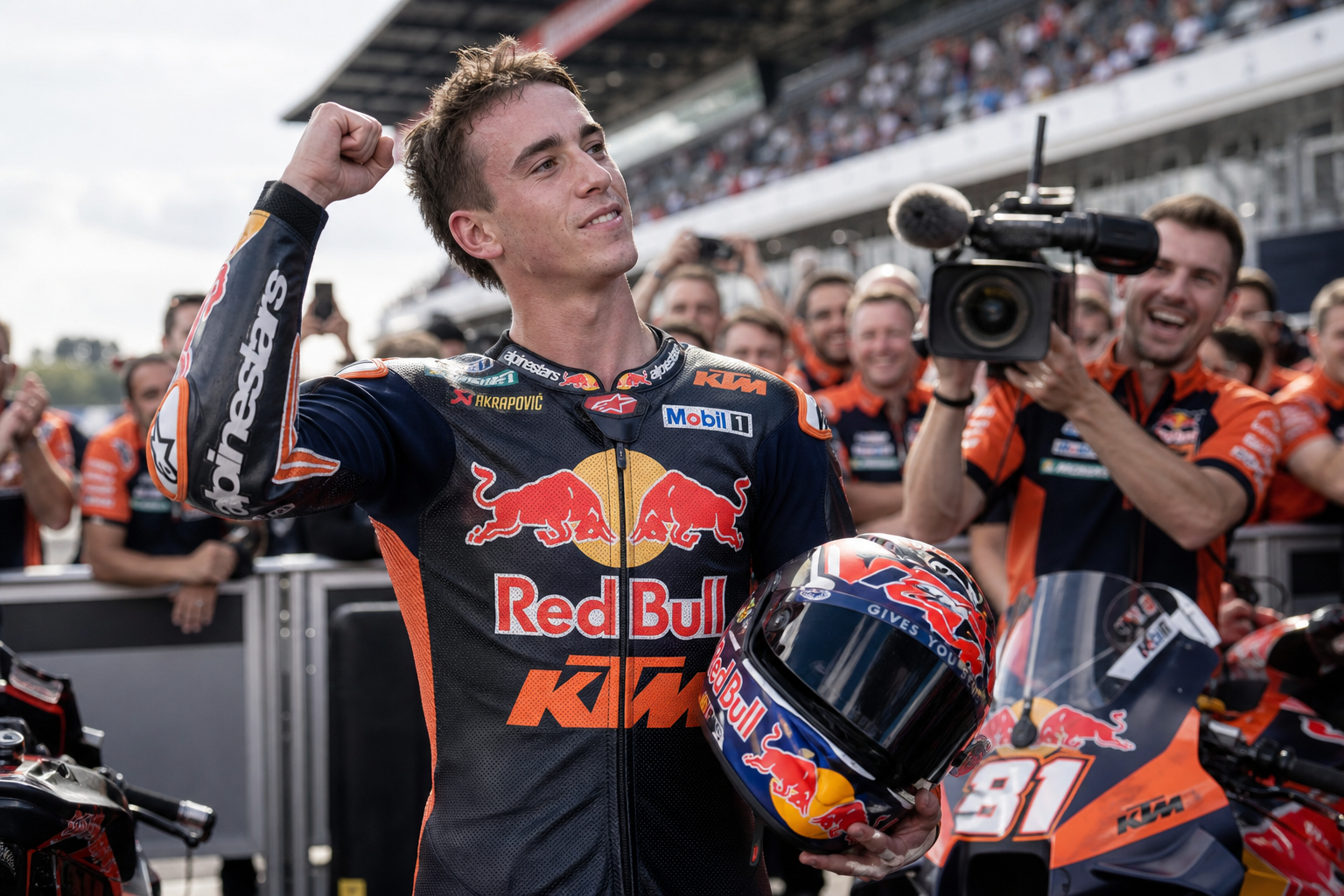

Pedro Acosta’s MotoGP victory has given KTM something it badly needed: proof that the orange machines can still reach the top step. It has also given the company a rather awkward responsibility. KTM must enjoy the win without mistaking one glorious Sunday for a complete recovery.
The significance is easy to grasp. Before Acosta’s success, KTM’s most recent MotoGP victory had come from Miguel Oliveira at the 2022 Thai Grand Prix, a race shaped heavily by rain. That was not a routine dry-weather display of dominance; it was a win earned in unusually difficult conditions, where judgment, tire management, and confidence mattered as much as outright pace.
Since then, the wait has grown long by MotoGP standards. KTM has had fast riders, moments of genuine speed, and enough machinery to remain relevant, but relevance is not the same thing as winning. Racing departments do not spend millions of dollars to be described as “interesting.” They want trophies, preferably before the hospitality coffee goes cold.
Acosta’s Win Is Significant, But It Is Not a Reset Button
Acosta’s victory matters because it links two separate stories: KTM’s need to return to the front and the rapid rise of a rider who was still learning the Moto2 class only a few seasons ago.
On the same Sunday as Oliveira’s 2022 Thai Grand Prix victory, Acosta finished 16th in the Moto2 race. It was his first season in the intermediate category, and a fairly ordinary result on paper. Yet the wider trajectory was anything but ordinary. Acosta became Moto2 world champion in 2023, moved into MotoGP for 2024, and has now delivered the premier-class win KTM had been waiting for.
That sequence is a useful reminder of how quickly fortunes can change in motorcycle racing. A rider who was buried in the middle of a Moto2 result sheet at Buriram is now the man responsible for ending KTM’s longest recent drought at the top level. Racing has a peculiar habit of turning old results into historical footnotes.
But one victory cannot answer every question surrounding a MotoGP project. It cannot prove that the bike has become consistently competitive, that every development decision is correct, or that KTM has solved the problems that kept it away from victory for so long. It proves that the combination of rider, motorcycle, setup, tires, circumstances, and execution was good enough on this particular weekend. That is valuable. It is not magic.
KTM’s MotoGP Story Has Always Been About Momentum
KTM’s arrival in MotoGP was never intended to be a quiet exercise in brand exposure. The company entered the championship with a racing identity already baked into its public image, from off-road competition to the Red Bull-backed junior ladder. Its MotoGP program was supposed to be aggressive, visible, and capable of challenging established manufacturers rather than politely filling the grid.
That ambition produced genuine breakthroughs. KTM collected its first premier-class victory with Brad Binder at the 2020 Czech Grand Prix, then added further wins with Oliveira. Those results suggested the manufacturer had found a route from newcomer to serious contender in remarkably short order.
The trouble with rapid progress is that expectations accelerate even faster. Once a manufacturer has won, every subsequent season is judged against that achievement. A podium becomes evidence of a missed opportunity. A fourth-place finish is treated as a problem to diagnose. A win in difficult weather can be dismissed as conditional, while a dry-weather win creates demands for another one immediately. Grand Prix racing is a hungry little beast.
KTM has therefore lived through the familiar cycle of a young racing operation: breakthrough, expectation, frustration, technical development, rider changes, and renewed pressure. Acosta’s victory interrupts the frustrating part of that cycle, but it does not eliminate the need for discipline.
Why Acosta Changes the Conversation
The obvious attraction is speed. Acosta arrived in MotoGP with a reputation built on results, not merely promotional noise. His Moto2 championship in 2023 provided the strongest possible qualification for the premier class, and his rookie season in 2024 gave him experience of the physical, technical, and strategic demands of MotoGP.
That experience matters. MotoGP is not simply Moto2 with more horsepower. The bikes generate vastly different levels of acceleration, braking force, aerodynamic load, and tire sensitivity. Riders must manage sophisticated electronics while adapting to changing grip, tire behavior, and race conditions. A talented young rider can be quick almost immediately, but converting that speed into a complete race-winning performance requires time.
Acosta’s progression gives KTM an asset many manufacturers would happily steal from the garage if the paddock allowed such things. He is young enough to develop with the project, already experienced enough to identify what the bike needs, and now armed with the credibility that comes from winning at the highest level.
That combination creates opportunity, but it also creates danger. A manufacturer can easily begin designing its entire future around one rider’s latest success. Engineers hear “the bike can win” and start treating every shortfall as a rider or setup problem. Management hears “the young star has delivered” and raises expectations for the next race. Before long, the project is chasing headlines rather than building a stable technical foundation.
The Lesson KTM Should Take From Its Own History
KTM’s earlier victories show that it knows how to produce a winning motorcycle. They also show why individual wins need to be placed in context.
Oliveira’s wet-weather victory in Thailand was a reminder that MotoGP rewards adaptability as much as raw speed. Binder’s 2020 win demonstrated KTM’s ability to take advantage of an opportunity in a highly competitive field. Those achievements were not meaningless exceptions. They were evidence of real capability. But neither automatically guaranteed a sustained run of victories afterward.
The useful lesson is not that unusual conditions make a win less important. Quite the opposite. Rain races expose riders and teams to a different set of demands, and winning them requires excellent decisions. The lesson is that a single triumph—whatever the conditions—must become information. What worked? Which parts of the motorcycle generated confidence? How did the team handle tire choice, setup changes, and pressure? Which lessons can be transferred to a normal dry weekend?
Acosta’s win should be treated as a technical case study, not merely a celebration photograph. KTM needs to understand whether the result came from a broad improvement in the package, a circuit-specific advantage, an unusually strong rider-bike combination, or several factors arriving together. Usually, the answer is annoyingly complicated. Cars and motorcycles rarely behave like tidy corporate presentations.
Consistency Will Matter More Than the Party
The next measure of KTM’s progress is not how loudly the team celebrates this victory. It is what happens afterward.
A genuine step forward would mean more frequent front-running pace, stronger qualifying performances, and the ability to remain competitive across different circuit layouts and grip conditions. It would mean turning an isolated peak into a pattern. MotoGP rewards the manufacturer that can perform when the track is fast, slow, smooth, bumpy, hot, cool, friendly, or deeply irritating. There is always one of those days.
Acosta’s victory also raises the standard for the rider himself. That is not unfair; it is the natural tax on success. He does not need to win every race, and expecting that would be spectacularly foolish. He does need to keep converting potential into points, podiums, and useful feedback. A young rider’s value is not measured only by spectacular weekends. It is also found in how quickly he understands a problem and whether he can help the team solve it.
KTM, meanwhile, must avoid the temptation to rush. The company’s racing identity favors bold decisions, which is part of its appeal. But boldness without patience becomes expensive theater. A successful MotoGP program needs clear development priorities, stable communication, and the humility to accept that a rival may have found a better answer on a given weekend.
A Win Worth Celebrating—Carefully
There is no reason to downplay what Acosta has achieved. Ending KTM’s MotoGP victory drought is a major result, and doing so after progressing from a 16th-place Moto2 finish in Thailand in 2022 makes the story considerably more satisfying. It is a sharp illustration of how quickly a rider’s career can move when talent meets the right opportunity.
But KTM should resist turning one win into a declaration that everything is fixed. The manufacturer has been here before: fast enough to win, ambitious enough to expect more, and vulnerable to confusing a breakthrough with a finished project.
The clever response is simple. Enjoy the trophy, study the data, listen to Acosta, and get back to work. In MotoGP, humility is not a lack of ambition. It is how ambitious teams avoid being reminded, one race later, that the championship has a very long memory.
0 Comments